




01. Edit your form online
Type text, add images, blackout confidential details, add comments, highlights and more.

Type text, add images, blackout confidential details, add comments, highlights and more.

Draw your signature, type it, upload its image, or use your mobile device as a signature pad.

Send it via email, link, or fax. You can also download it, export it or print it out.
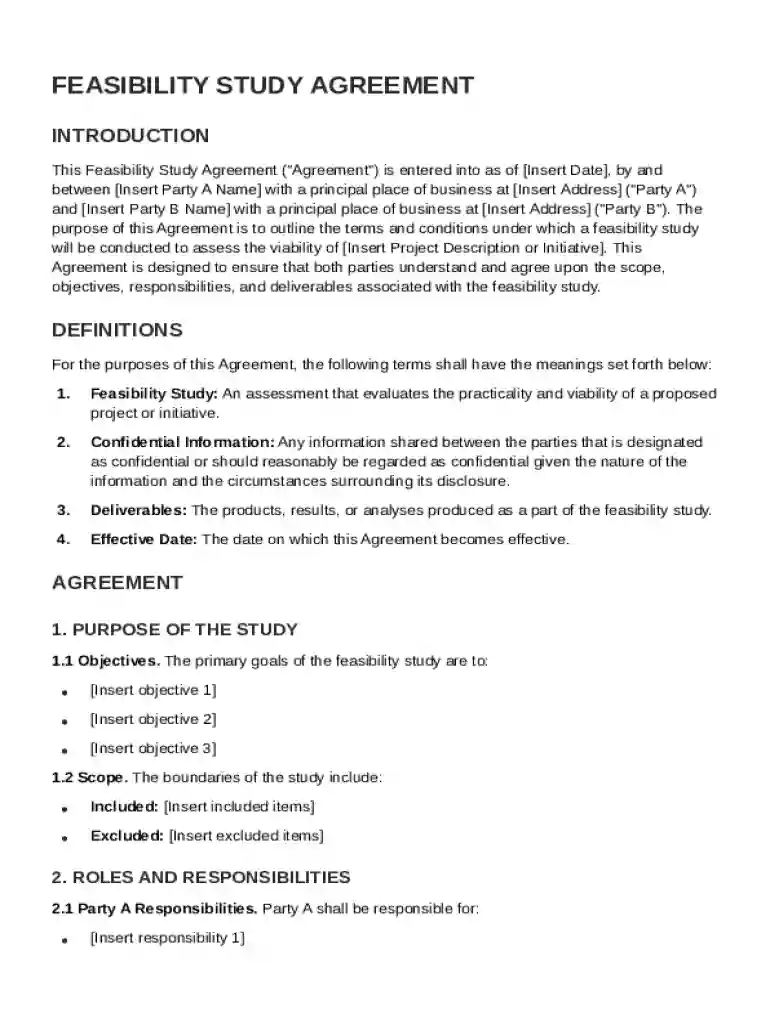
The Feasibility Study Agreement Template is a legal document used to outline the terms and conditions between two parties engaging in a feasibility study. It defines what a feasibility study entails and details the mutual understanding and expectations between the parties involved. Typically, this document is a preliminary step in any project to assess its viability before committing significant resources. The agreement covers essential concepts, including confidentiality, deliverables, roles, responsibilities, timeline, and budget, thereby ensuring a structured approach to evaluating the potential success of a proposed initiative.
The Feasibility Study Agreement Template serves as a foundational document to establish the terms under which a feasibility study will be conducted. To effectively use this template, parties must first read through and understand each section of the document. Afterward, they should fill in specific details like names, addresses, and particular terms relevant to their project.
Employing a Feasibility Study Agreement Template is pivotal in ensuring transparency and alignment between the parties involved in a project. It helps mitigate risks by outlining all agreed-upon terms before embarking on the feasibility study. Additionally, this document sets expectations and serves as a reference point throughout the study, fostering a cooperative and organized approach to determining the project’s viability.
The Feasibility Study Agreement Template is primarily used by businesses, project managers, and consultants who require a formal agreement to conduct a feasibility study. It is particularly beneficial for industries where significant investments are made, such as construction, technology, and manufacturing. Academics and research institutions may also use this template to formalize studies in various fields.


The template includes several critical sections designed to ensure comprehensiveness and utility. Key elements often encompass the title page, objectives, scope, roles, methodology, timeline, and budget.
The Feasibility Study Agreement Template is a legally binding document once signed by the involved parties. It should comply with any relevant laws and regulations to ensure enforceability. Legal counsel may be consulted to tailor the agreement to specific needs and ensure all legal aspects are appropriately covered.
Understanding specific terminology within the Feasibility Study Agreement Template helps clarify the roles and expectations of the involved parties. Familiarity with these terms can prevent misunderstandings and ensure that all aspects of the agreement are duly considered.
Practical examples demonstrate how the Feasibility Study Agreement Template can be applied in various scenarios. These examples highlight the flexibility and adaptability of the template across multiple industries and projects.
At DocHub, your data security is our priority. We follow HIPAA, SOC2, GDPR, and other standards, so you can work on your documents with confidence.



Nov 7, 2025 Feasibility Study for Second Location in Jefferson County Youngstown State University (the University) is seeking an experienced leader in
The final feasibility study is usually based on the most attractive alternative for the project. The aim of the study is to remove all DocHub uncertaintiesRead more


