
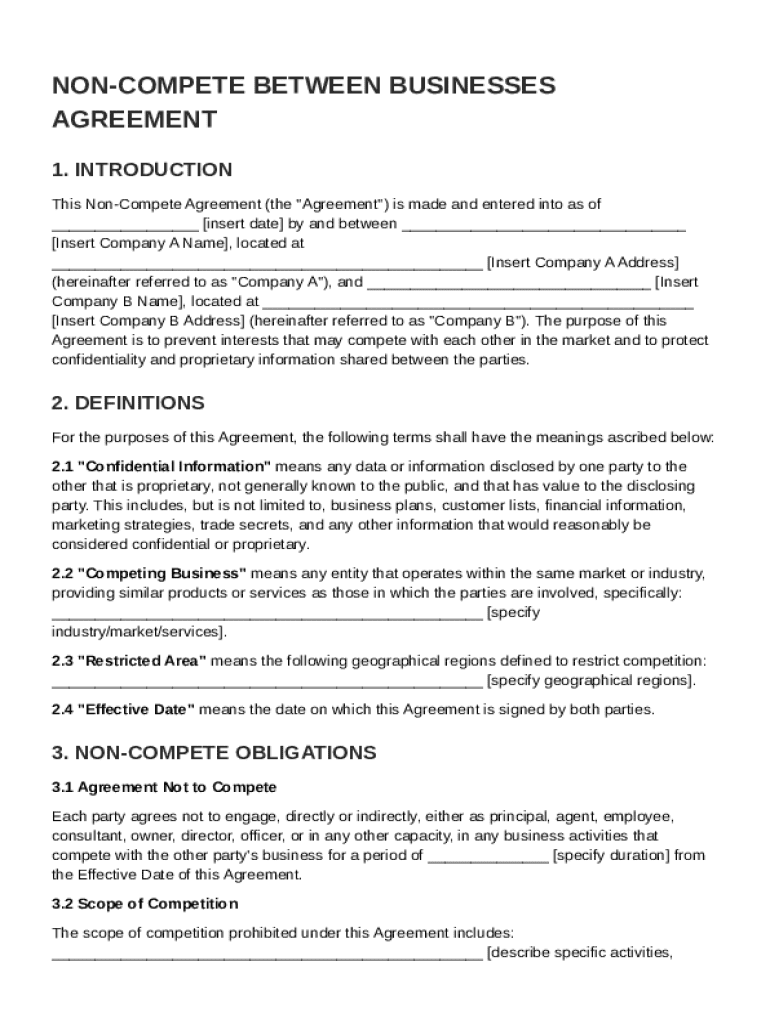







Definition & Meaning
A Non-Compete Agreement Between Businesses is a legal document that outlines the restrictions placed on two or more companies to prevent them from engaging in competitive activities that could harm each other's business interests. These agreements typically define terms such as 'Confidential Information' and 'Competing Business' and specify the obligations and restrictions for a given duration. This agreement aims to protect trade secrets and proprietary information and to limit actions that could lead to unfair competition.
Key Elements of the Non-Compete Between Businesses Agreement Template
The agreement generally includes several critical components to ensure clarity and enforceability:
- Confidential Information: Defines what constitutes proprietary business data and the necessity of its protection.
- Competing Business: Clearly identifies the business activities considered competitive.
- Restrictions and Obligations: Outlines the geographic scope and the duration of the non-compete obligations.
- Enforcement and Remedies: Details the legal measures available to enforce the agreement and any penalties for breaches.
- Termination Clause: Specifies the conditions under which the agreement may be terminated.
How to Use the Non-Compete Between Businesses Agreement Template
To effectively utilize the template, follow these steps:
- Review the Template: Understand its components and how they apply to your business needs.
- Customize the Agreement: Modify the template to reflect the specific terms and conditions relevant to the parties involved.
- Consult with Legal Counsel: Ensure that all included terms comply with federal and state laws.
- Distribute to Relevant Parties: Share the tailored agreement with all parties involved for their review and input.
- Finalize and Sign: Once all parties agree on the terms, proceed with signing the document to make it legally binding.
Important Terms Related to the Non-Compete Between Businesses Agreement Template
Familiarity with certain terms is crucial for understanding and drafting a non-compete agreement:
- Proprietary Information: Any data or knowledge proprietary to the business, including trade secrets and client lists.
- Scope of Non-Compete Clause: Specifies geographic and temporal limits.
- Non-Disclosure Clause: Protects confidential information from being shared with third parties.
- Indemnification: The agreement by one party to cover potential losses incurred by the other.
Legal Use of the Non-Compete Between Businesses Agreement Template
The legal application of this agreement involves several considerations:
- Compliance with State Laws: State regulations vary, particularly regarding enforceability, with some states imposing stricter regulations.
- Reasonableness of Restrictions: Courts often assess the reasonableness of geographic scope, duration, and nature of restrictions.
- Justification for Agreement: Businesses must demonstrate legitimate interests, such as protecting trade secrets, to justify the agreement.
Who Typically Uses the Non-Compete Between Businesses Agreement Template
This template is commonly utilized by:
- Partnership Firms: To prevent partners from engaging in competitive activities.
- Corporations and Franchises: To protect proprietary methods and client information.
- Joint Ventures: To clearly define competitive boundaries among collaborating entities.
- Companies in Mergers or Acquisitions: To safeguard interests during transitions.


Steps to Complete the Non-Compete Between Businesses Agreement Template
Completing the template requires a methodical approach:
- Gather Information: Collect details about the parties involved, geographic scope, and the definition of competitive activities.
- Draft Initial Agreement: Use the template to draft an agreement reflecting gathered details.
- Review for Accuracy: Ensure all terms are precise and applicable, confirming they meet legal standards.
- Circulate for Feedback: Share with involved parties to gather feedback and address concerns.
- Revise as Necessary: Make amendments based on the feedback and reach a consensus.
- Finalize the Document: Obtain signatures from all parties to formalize the agreement.
State-Specific Rules for the Non-Compete Between Businesses Agreement Template
Since non-compete agreements are subject to state law, understanding these regional differences is essential:
- California: Generally prohibits non-compete clauses, except in limited circumstances like partnership dissolutions.
- Texas: Allows non-compete agreements only if they are reasonable in scope and duration.
- New York: Permits such agreements, provided they are necessary to protect legitimate business interests.
Business Types That Benefit Most from Non-Compete Between Businesses Agreement Template
Certain business structures and sizes find more advantage in using the non-compete agreement:
- Startups: Early-stage often require protection of unique ideas and processes.
- Large Corporations: To prevent piracy of key strategies and functions.
- Small to Medium Enterprises (SMEs): To secure niche markets and local client bases.




