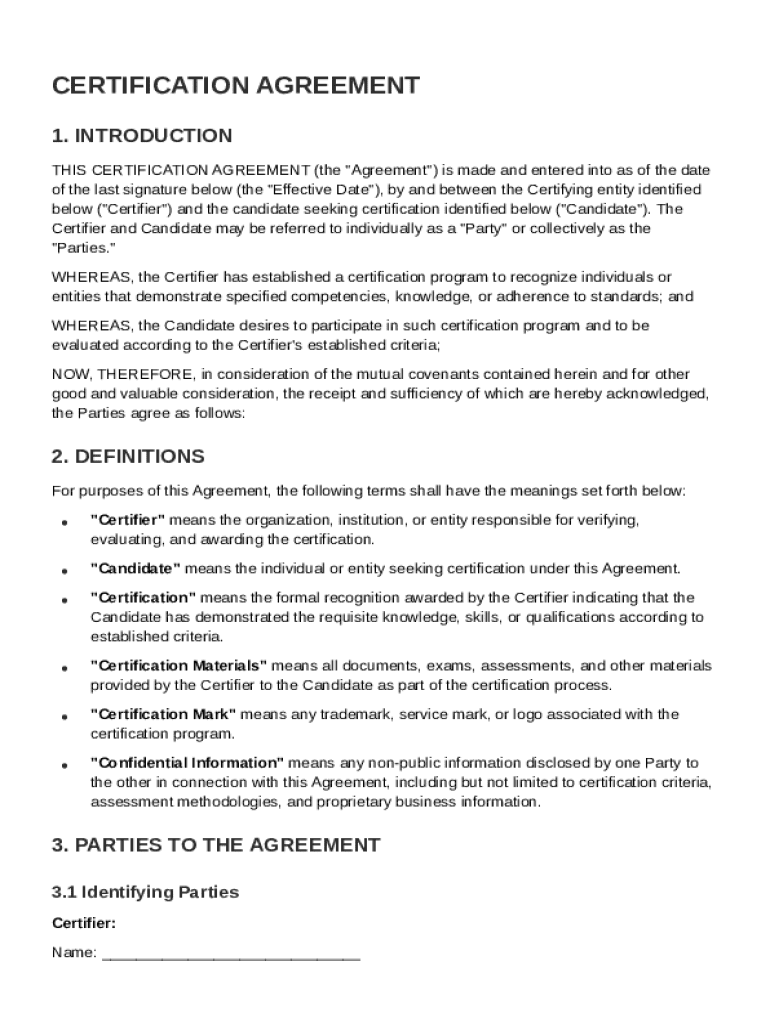







Definition and Purpose of a Certification Agreement Template
A Certification Agreement Template is a structured legal document designed to formalize the relationship between a certifying organization and individuals or entities seeking certification. The agreement outlines the terms and conditions under which the certification is granted, ensuring both parties understand their roles, responsibilities, and obligations. Key elements include the criteria for certification, the evaluation process, confidentiality agreements, and a framework that ensures a fair assessment of skills or competencies in line with industry standards.
Key Elements of the Certification Agreement Template
The Certification Agreement Template typically contains several critical components that help define the agreement's scope and ensure transparency. Key sections include:
- Roles and Responsibilities: Outlines the duties of both the certifier and the candidate. For instance, the certifier might be responsible for conducting assessments, while the candidate needs to comply with standards and provide necessary documentation.
- Application and Evaluation Processes: Details the steps candidates must take to apply for certification, including documentation requirements and processes for evaluation.
- Confidentiality Obligations: Specifies both parties' responsibilities to maintain the confidentiality of proprietary information shared during the certification process.
- Fee Structures and Payment Terms: Indicates any costs associated with obtaining certification and the terms of payment, including renewal fees if applicable.
- Termination Clause: Establishes the conditions under which the agreement can be terminated by either party.
How to Use the Certification Agreement Template
Using the Certification Agreement Template involves several steps to ensure all relevant aspects are properly documented and agreed upon. Here is a typical process:
- Customizing the Template: Modify the template to include specific details unique to the certifying organization and the field of certification, such as specific industry standards.
- Reviewing Legal Terms: Ensure that all legal terms are accurate and comprehensive, considering consultation with legal professionals when necessary.
- Negotiating Terms: Both parties should discuss and agree upon the terms, making amendments as necessary to reflect mutual understanding and consent.
- Finalizing and Signing: After all terms are agreed upon, both parties sign the document to make it legally binding.
Steps to Complete the Certification Agreement Template
Completing the Certification Agreement Template requires attention to detail to ensure that all critical factors are appropriately captured. Here are some steps to follow:
- Identify Parties: Clearly state the names and details of the certifier and the candidate seeking certification.
- Specify the Certification Scope: Include a comprehensive description of what the certification covers, including any competencies or skills to be assessed.
- Outline Evaluation Criteria: Provide detail on the standards and criteria used for assessments, along with the methods employed (e.g., written exams, practical assessments).
- Detail Confidentiality and Data Protection Measures: Clearly define how confidential information will be protected, including any data protection measures if personal information is involved.
- Include Dispute Resolution Mechanisms: Specify mechanisms for resolving potential disputes, such as arbitration or mediation.
Legal Framework of the Certification Agreement Template
The Certification Agreement Template must comply with legal standards to ensure enforceability. Considerations include:
- Adherence to Regulatory Standards: Ensure compliance with relevant laws and regulations, which may vary depending on industry and geography.
- Legally Binding Signatures: Include provisions for electronic signatures if applicable, ensuring they meet requirements such as those stipulated by the ESIGN Act.
- Data Protection Compliance: Incorporate terms that comply with data protection laws such as GDPR for international agreements or CCPA for California-based entities.
Examples of Using the Certification Agreement Template
Real-world examples illustrate how a Certification Agreement Template can be applied:
- Professional Certification Bodies: An industry association uses the template to certify professionals in compliance with a set of established standards, providing proof of competency to employers.
- Academic Institutions: Universities offering certification courses can outline the expectations and responsibilities between the institution and participants leveraging the template.
- Corporate Training Programs: Corporations offering internal certifications use the agreement to formalize employee participation and specify the criteria for earning certifications.
Who Typically Uses the Certification Agreement Template
The Certification Agreement Template is utilized by a variety of organizations, including:
- Certifying Bodies: Professional associations and industry groups that establish and enforce industry standards.
- Educational Institutions: Universities and training providers offering certification courses.
- Corporate Entities: Businesses implementing internal certification programs as part of employee development.


Important Terms Related to the Certification Agreement Template
Understanding key terms associated with the Certification Agreement Template is essential for its effective use:
- Certifier: The individual or organization responsible for granting certification.
- Candidate: The entity or individual seeking certification.
- Accreditation: The process by which a certifier is recognized as qualified to assess and issue certifications.
- Validity Period: The time frame during which the certification remains valid, after which renewal might be necessary.
- Renewal Process: The steps required to maintain certification status when its validity period expires.
By ensuring these elements are well defined, users of the Certification Agreement Template can facilitate clear communication, maintain compliance, and achieve successful certification outcomes.