
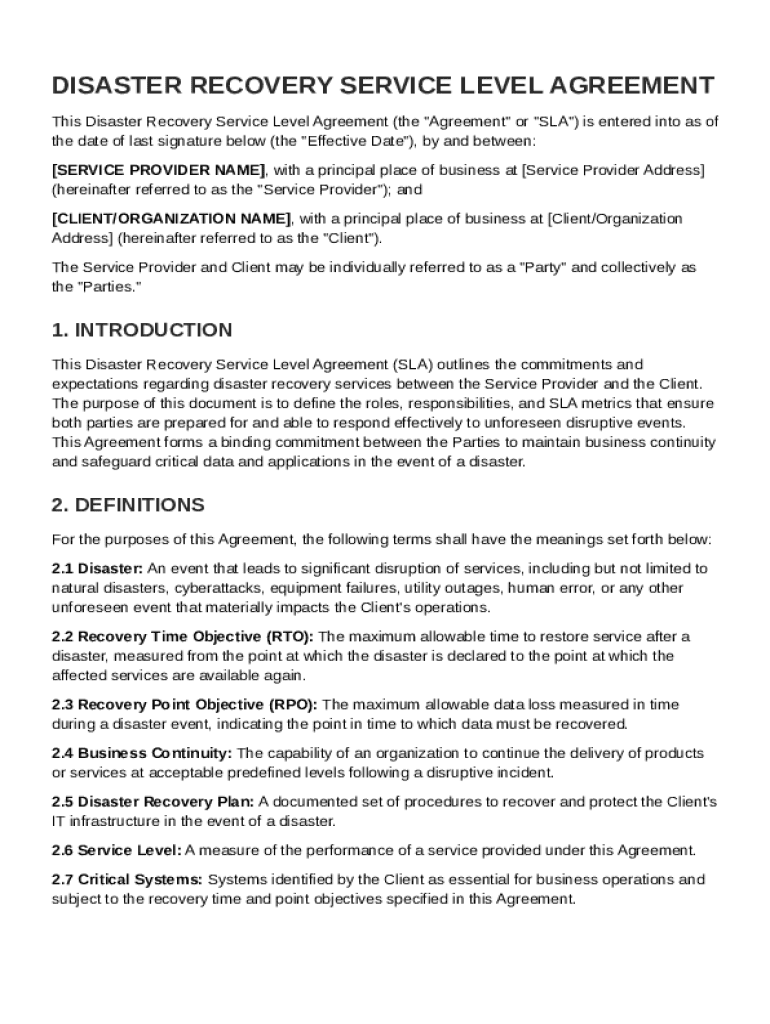







Definition & Meaning
A Disaster Recovery Service Level Agreement (SLA) Template is a structured document that outlines the commitments between a service provider and a client relating to disaster recovery services. It serves as a formal agreement that specifies the roles, responsibilities, service-level objectives, and metrics intended to ensure business continuity and data protection during disruptive events. This template provides a foundational framework to prepare both parties for unforeseen disasters, maintaining clear communication and accountability throughout.
Key Components
- Roles and Responsibilities: Clearly defined duties for both the service provider and the client.
- Service Level Objectives: Specific metrics and benchmarks that need to be achieved for effective disaster recovery.
- Scope of Services: The extent and limitations of the services offered under the agreement.
- Exclusions: Services or situations that are not covered by the SLA.
- Testing and Reporting Procedures: Routine checks and methods for reporting the performance of disaster recovery services.
Key Elements of the Disaster Recovery Service Level Agreement Template
The Disaster Recovery SLA Template consists of several critical elements that ensure both parties have a clear understanding of what is expected during a disaster recovery process.
Service Level Objectives (SLOs)
This section defines the specific operational targets that the service provider commits to achieving, and may include:
- Recovery Time Objective (RTO): The maximum time allowed for the recovery of applications and systems.
- Recovery Point Objective (RPO): The maximum data loss tolerance, measured in time.
- Performance Metrics: Standards for system performance post-recovery.
Escalation Processes
Procedures for escalating issues that cannot be resolved at the initial level of support are outlined here, providing a hierarchy of contact points and timelines.
Compliance and Audit Requirements
- Regulatory Compliance: Ensures alignment with industry standards and legal obligations.
- Audit Clauses: Describes the process for performance reviews and auditing compliance with the SLA.
Termination Conditions
Details the circumstances under which the agreement can be terminated, including breach of terms, failure to meet objectives, or at mutual consent, safeguarding both parties' interests.
How to Use the Disaster Recovery Service Level Agreement Template
Utilizing this template effectively involves understanding its purpose and customizing it to fit specific business needs.
Customization Steps
- Identify Stakeholders: Determine all parties involved in the agreement, ranging from IT teams to management.
- Define Requirements: Clearly outline what needs to be included based on the specific disaster recovery needs of the organization.
- Review Legal and Compliance Information: Ensure that the template meets legal and industry compliance standards.
- Consult with Experts: Engage with IT and legal professionals to align the SLA with industry best practices.
Practical Applications
- New Implementations: Use this template when establishing a new disaster recovery protocol.
- Periodic Reviews: Regularly review the SLA to incorporate updated technologies and operational changes.
Steps to Complete the Disaster Recovery Service Level Agreement Template
Completing the template involves a methodical approach to ensure all necessary elements are accurately captured.
Step-by-Step Process
- Gather Relevant Information: Collect data on current recovery capabilities and needs.
- Draft Initial Version: Utilize the template to create a preliminary version of the SLA.
- Review and Revise: Involve stakeholders in reviewing the draft for accuracy and completeness.
- Finalize the Document: Obtain signatures from all parties to formalize the agreement.
Final Checks
- Consistency: Verify that all sections are consistent and align with organizational policies.
- Clarity: Ensure that language is clear and free from ambiguity.
Important Terms Related to Disaster Recovery Service Level Agreement Template
Understanding the terminology within a Disaster Recovery SLA Template is essential for accurate interpretation and application.
Common Terms
- Business Continuity: Strategies and processes that enable an organization to continue operations during a disaster.
- Disaster Recovery Plan (DRP): A documented process or set of procedures to recover and protect a business IT infrastructure.
- Hot Site: A fully operational off-site data processing facility that can be activated if the primary location is compromised.
- Cold Site: A backup site equipped with basic infrastructure and facilities but no technical resources until needed.
Usage in Context
These terms are integral to the effective implementation of a disaster recovery strategy, forming the backbone of the SLA's technical and operational guidelines.
Legal Use of the Disaster Recovery Service Level Agreement Template
The legal aspects of a Disaster Recovery SLA ensure both parties are protected and adhere to applicable regulations.
Compliance with U.S. Laws
- ESIGN Act: Governs the use of electronic signatures to ensure the legality of digital agreements within the U.S.
- Data Protection Laws: Adherence to regulations like GDPR (for multinational companies) or HIPAA for healthcare providers dealing with sensitive information.
Drafting Considerations
- Legal Oversight: Involving legal experts in the drafting process ensures all clauses are enforceable and comply with relevant laws.
- Risk Assessment: Evaluate potential legal risks that may arise from the execution of the SLA.
Examples of Using the Disaster Recovery Service Level Agreement Template
Illustrating real-world applications of a Disaster Recovery SLA template helps contextualize its benefits and utility.
Case Studies
- Financial Institutions: Banks use SLAs to ensure recovery services maintain the integrity and availability of financial data during outages.
- Healthcare Providers: SLAs ensure that patient information is recovered quickly to continue providing uninterrupted care.
Benefits
- Enhanced Reliability: Provides a roadmap for restoring services effectively during disruptions.
- Improved Communication: Facilitates clear expectations and processes, reducing confusion and delays.
Versions or Alternatives to the Disaster Recovery Service Level Agreement Template
While the standard template provides a comprehensive framework, various versions or alternatives can be explored based on specific needs.
Custom Versions
- Industry-Specific Templates: Tailored SLAs that adjust terms and conditions to fit specific industry requirements, such as those seen in healthcare or finance.
- Scaled Templates: Adjustments for organizations varying in size, ensuring that the templates align with corporate capabilities and objectives.
Exploring Alternatives
- Third-Party Solutions: Some organizations opt to engage third-party services offering tailored disaster recovery SLAs.
- Online Tools: Utilize online platforms to customize and manage SLAs dynamically, integrating them with existing document management systems.
By comprehensively exploring these blocks, the Disaster Recovery Service Level Agreement Template is thoroughly discussed, providing users with a rich understanding and practical application insights.




