






Definition & Meaning
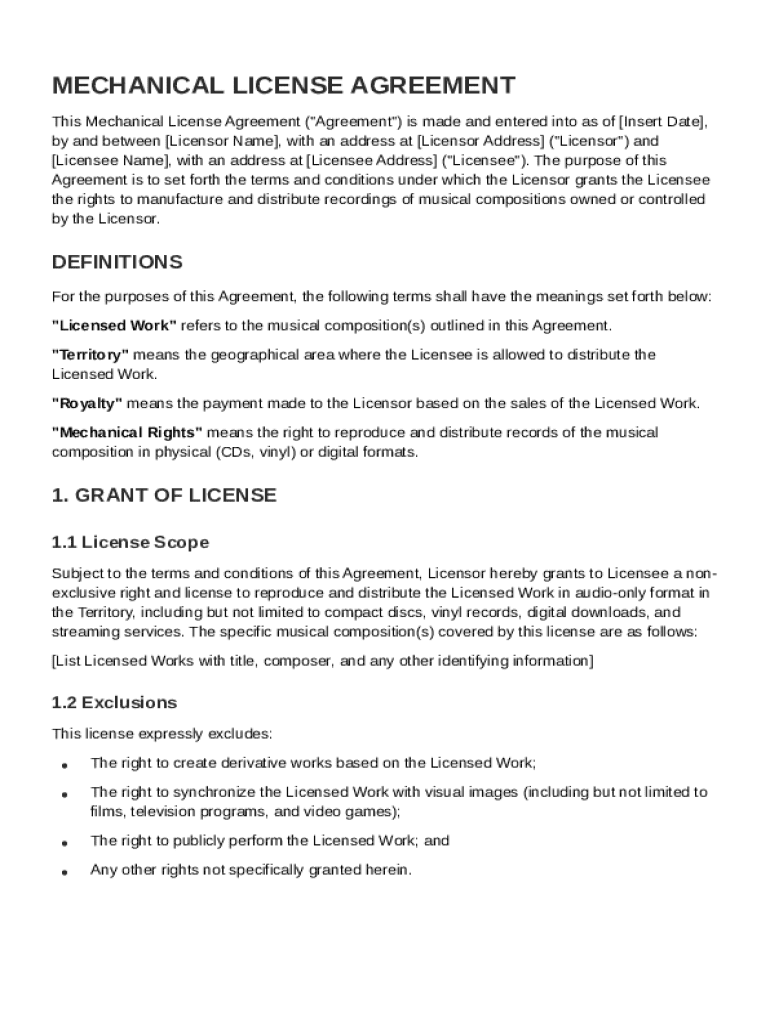
A Mechanical License Agreement is a legal contract that specifies the terms and conditions under which a Licensor grants a Licensee the rights to produce and sell recordings of specific musical works. The agreement details elements such as the 'Licensed Work', which refers to the particular musical composition that is being licensed, the 'Territory', which defines the geographic region where the rights are valid, and 'Royalty', which specifies the payments the Licensee must make to the Licensor for the use of the compositions. Additionally, this agreement encompasses the duration of the license, outlining how long these rights will be in effect, and the reporting obligations, which require the Licensee to provide accurate royalty reports to the Licensor.
How to Use the Mechanical License Agreement Template
Using the Mechanical License Agreement Template involves several key steps to ensure that all necessary details are accurately captured. First, identify all relevant parties, such as the Licensor, Licensee, and any third parties involved. It is crucial to detail the specific musical compositions included in the agreement clearly. Next, define the scope of the license, including any limitations or restrictions on the use of the compositions. You must include information on royalty rates, along with the method and frequency of payments. Ensure that reporting obligations are clearly outlined, specifying how often reports need to be submitted and in what format. Finally, review the provisions for termination and amendments, ensuring they align with both parties' interests.
Steps to Complete the Mechanical License Agreement Template
- Identify the Parties: Clearly name the Licensor, who is granting the rights, and the Licensee, who is receiving the rights.
- Outline the Licensed Work: Specify each musical composition that the Licensee is permitted to reproduce.
- Determine the Territory: Define the geographic region where the Licensee can distribute the recordings.
- Establish the Royalty Rates: Set the rates and payment schedule for royalties, ensuring clarity on how and when payments should be made.
- Set the Duration: Clearly state the start and end dates of the license period.
- Include Reporting Obligations: Specify how frequently the Licensee must report sales and royalty payments to the Licensor.
- Detail Termination and Amendment Procedures: Outline the conditions under which the agreement can be terminated and how amendments can be made.
- Sign and Store the Agreement: Ensure that all parties sign the agreement and keep a copy for records.
Key Elements of the Mechanical License Agreement Template
- Licensed Work: This section details the musical compositions covered by the agreement.
- Territory: Defines where the Licensee can distribute the recordings.
- Royalty Rates: Specifies the fees due to the Licensor for the reproduction of the music.
- Duration of Agreement: Covers the time frame of the licensing agreement's validity.
- Reporting Obligations: Outlines the requirements for reporting royalty payments and usage.
- Termination Conditions: Lists the circumstances under which the agreement can be terminated.
- Amendment Procedures: Describes the process for making changes to the agreement.
- Governing Law: Identifies the jurisdiction whose laws will govern the agreement.
Important Terms Related to Mechanical License Agreement Template
- Licensor: The individual or entity granting the rights to produce and distribute the recordings.
- Licensee: The recipient of the rights to use the musical compositions.
- Royalties: Payments made by the Licensee to the Licensor for the use of the licensed works.
- Licensed Work: The specific musical compositions covered by the agreement.
- Territory: The geographic area where the Licensee can sell the recordings.
- Duration: The time period for which the licensing agreement is in effect.
Legal Use of the Mechanical License Agreement Template
The Mechanical License Agreement Template assures compliance with U.S. copyright laws, providing a structured framework for obtaining the necessary permissions to reproduce and distribute musical compositions legally. The agreement must be comprehensive, covering all legal aspects to protect both the Licensor's and Licensee's rights. Legal use ensures that all elements such as territory, royalty rates, and reporting obligations conform to statutory requirements, reducing the risk of disputes and potential legal action.
Examples of Using the Mechanical License Agreement Template
- Independent Artists: An independent musician looking to distribute their music might use this agreement to grant rights to a small record label to reproduce and sell CDs.
- Music Labels: A record label may enter into a mechanical license agreement to legally distribute a cover version of a popular song.
- Film Producers: A producer could use this agreement to secure the rights to use a specific song in the film's soundtrack and any related merchandise.
- Online Music Sellers: An online platform wants to offer digital downloads of a song and uses this agreement to obtain licensing rights.
State-Specific Rules for the Mechanical License Agreement Template
While the Mechanical License Agreement Template generally adheres to federal copyright laws, specific state laws may affect its implementation. For example, some states may have unique requirements regarding contract execution, such as notarization or witness signatures. It is essential to verify whether additional clauses are necessary to comply with state law where both the Licensor and Licensee are based. Furthermore, because governing law clauses may designate which state's laws govern disputes, parties should consider the implications of this choice based on the jurisdictions involved.
State-by-State Differences
Mechanical Licensing laws and regulations can vary by state, potentially affecting the enforcement and interpretation of agreements. For instance, certain states may have stricter rules regarding the inclusion of indemnity provisions or require additional disclosures about royalty structures. Certain jurisdictions might also have specific requirements for contract formation, such as minimum clause standards or mandatory consumer protections. Recognizing these variances can help ensure the agreement is customized to comply with the applicable regional legal standards while addressing the specific needs of both parties involved.