




01. Edit your form online
Type text, add images, blackout confidential details, add comments, highlights and more.

Type text, add images, blackout confidential details, add comments, highlights and more.

Draw your signature, type it, upload its image, or use your mobile device as a signature pad.

Send it via email, link, or fax. You can also download it, export it or print it out.
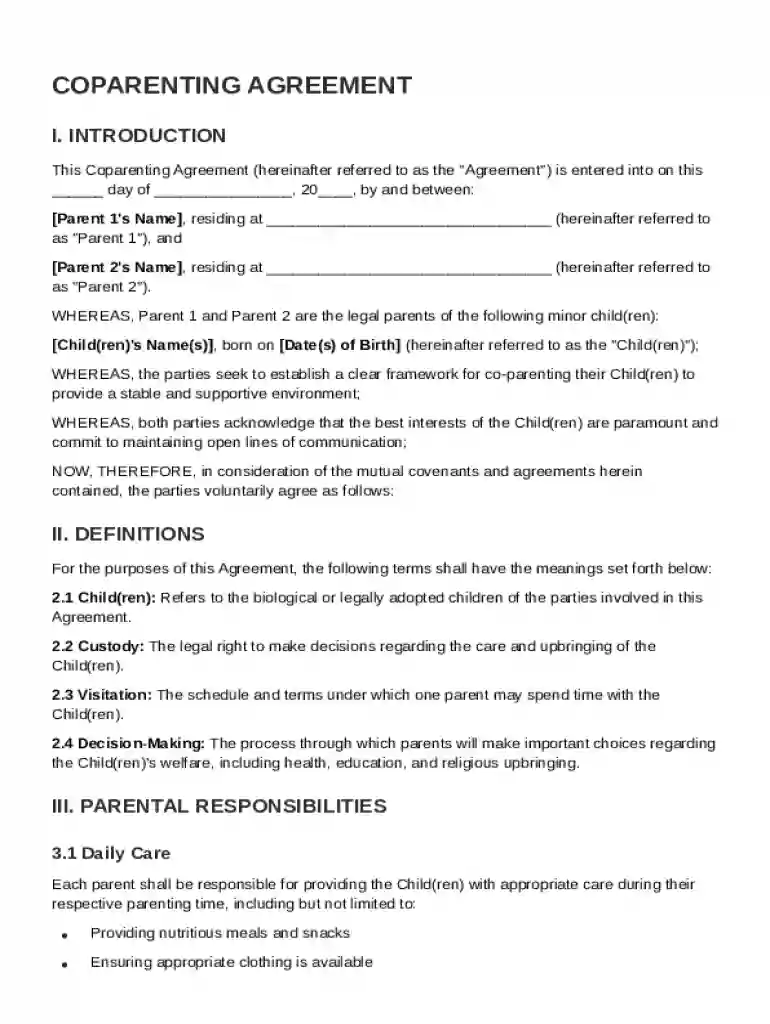
A coparenting agreement is a structured arrangement between two parents who are committed to collaboratively raising their child(ren) after separating or divorcing. This legally binding document outlines duties and expectations regarding aspects such as custody, visitation, financial obligations, and decision-making authority related to the child's welfare. It aims to establish a clear framework to promote harmonious coparenting and ensure the child’s best interests are prioritized. The coparenting agreement often incorporates conflict resolution strategies to address potential disputes amicably and efficiently.
Using a coparenting agreement template involves customizing a pre-structured format to fit the specific needs and circumstances of your family. Begin by downloading the template, ensuring that it reflects any state-specific legal requirements. Proceed by detailing both parents’ responsibilities in areas such as daily care, education, and healthcare. When modifying the template, be attentive to the language used to avoid ambiguity. Once both parties agree to the terms, include spaces for signatures and date validation. It is advisable to have the final agreement reviewed by a family law attorney to ensure compliance and enforceability.
Understanding key terms in a coparenting agreement is vital for clarity and execution. Terms like “custodial parent” and “non-custodial parent” define who the child lives with primarily and who has visitation rights. “Joint custody” versus “sole custody” specifies the nature of parental responsibilities and decision-making authority. “Visitation schedule” outlines predefined times for the non-custodial parent to spend with the child. It is essential to comprehend these terms to ensure both parents’ roles and expectations are clearly defined within the agreement.
The coparenting agreement template is a critical tool that serves not only as a guide for effective parenting post-separation but also as a legal document if disputes arise. Having a written agreement helps establish a legal precedent defining each parent's obligations and rights, which may be enforced by courts if necessary. This structured agreement is pivotal in preventing misunderstandings and providing a clear recourse in case of disagreements. Furthermore, it reinforces a cooperative approach to parenting, benefiting the child’s emotional and psychological well-being.
A comprehensive coparenting agreement template should comprise several critical components. These include custody arrangements, detailing whether custody is joint or sole and specifying parenting time for each parent. Financial responsibilities, including child support and expenses for education and extracurricular activities, should be clearly delineated. Decision-making guidelines should be outlined regarding healthcare, education, and other major life decisions. The agreement should also include procedures for modifying terms and establishing conflict resolution mechanisms, such as mediation, to handle future disputes.
State laws significantly impact the terms and enforcement of coparenting agreements. Each state in the U.S. may have unique legal requirements or preferences about how parenting plans should be structured. For instance, some states favor joint custody arrangements, while others may have specific guidelines on visitation rights. Therefore, it’s crucial to adapt the coparenting agreement to comply with these laws. Consulting with a family law expert in your state can ensure the agreement meets all necessary legal criteria and is enforceable in your jurisdiction.
Providing practical examples helps illustrate how the coparenting agreement can be effectively utilized in real-world scenarios. For instance, in a case where one parent lives out of state, the agreement might include provisions for extended holiday or summer visitation. In another scenario, parents may agree on alternating weeks as a custody arrangement to ensure equal parental involvement. These examples highlight the agreement's flexibility in accommodating various family dynamics and geographical considerations.
At DocHub, your data security is our priority. We follow HIPAA, SOC2, GDPR, and other standards, so you can work on your documents with confidence.



This guide is full of information about ways parents who live apart can work together to take care of their children. In this booklet: The Legal Agreement . . .Read more
11 hours ago A parenting plan is a voluntary written agreement between separated parents. standard template as a free online tool called Our Childs Plan,


