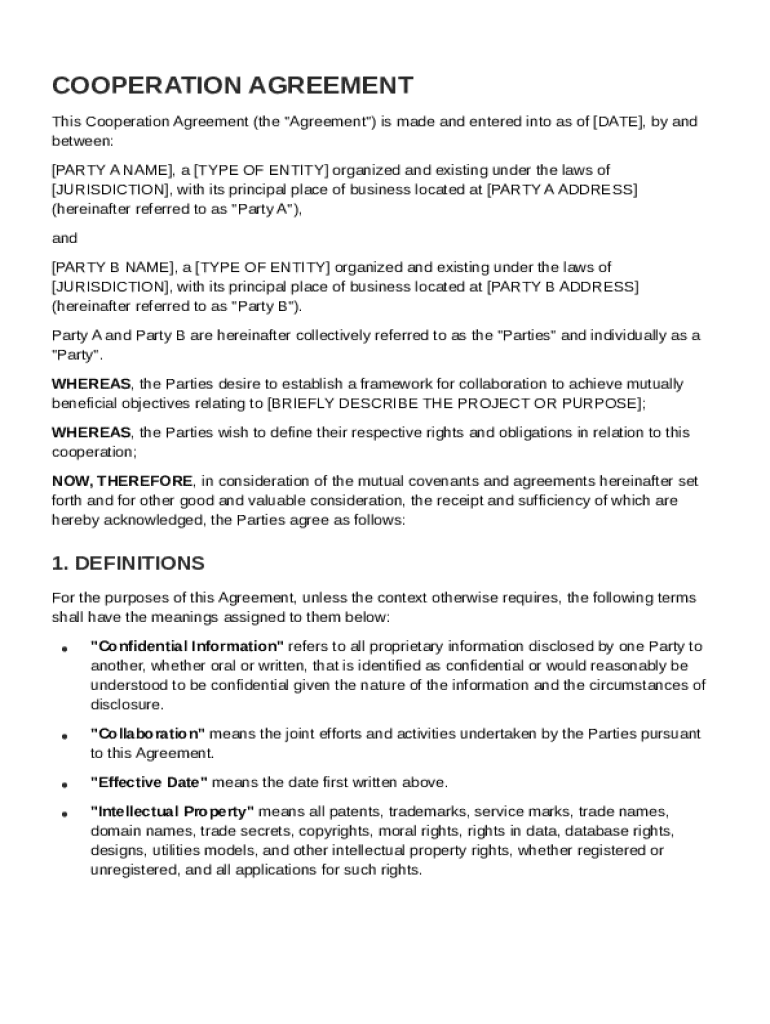







Definition & Meaning
A Cooperation Agreement Template serves as a formal outline detailing the collaborative relationship between two or more parties. This document is crucial in defining the structure of a partnership, specifying each party's roles, responsibilities, and contributions. It serves to establish clear expectations and frameworks for the project's successful execution, acting as a safeguard for all entities involved by setting boundaries and guidelines for participation.
Key Components
- Roles and Responsibilities: Specifies what each party is expected to deliver or manage within the cooperation.
- Financial Contributions: Details the cost-sharing arrangements and financial commitments each party has agreed to.
- Confidentiality Obligations: Establishes rules for handling sensitive information to protect the interests of all parties.
- Intellectual Property Rights: Outlines ownership and usage rights concerning any innovations, designs, or solutions developed during the collaboration.
Practical Example
Consider a joint marketing campaign between two companies. A Cooperation Agreement outlines the marketing budget each company will contribute, identifies which company handles logistics, and establishes the process for sharing customer data securely.
How to Use the Cooperation Agreement Template
Utilizing a Cooperation Agreement Template involves several steps to ensure it suits the specific needs of the entities involved. This structured approach facilitates clarity and mutual understanding, which are vital to a productive partnership.
Step-by-Step Instructions
- Identify the Scope of Collaboration: Clearly determine the objectives and goals of the partnership.
- Customize the Template: Insert specific roles, contributions, and responsibilities for each party.
- Consult Relevant Stakeholders: Engage all necessary departments or external advisors to ensure the template reflects all operational perspectives.
- Review for Compliance: Confirm that all elements adhere to legal standards and industry regulations.
- Finalize and Sign: Have all parties review the details and provide consent by electronically signing.
Practical Scenario
Two tech startups planning to develop a joint product might use this template to outline the project's technical specifications, development timeline, and resource allocation strategies to ensure both are on the same page.
Key Elements of the Cooperation Agreement Template
The following elements are crucial for a Cooperation Agreement Template to effectively serve its purpose of delineating a structured, reliable partnership:
Major Sections
- Dispute Resolution Provisions: Defines how disagreements will be handled to prevent potential stalemates.
- Duration and Termination Terms: Specifies the length of the agreement and the process for its termination.
- Legal Obligations and Clauses: Includes clauses related to applicable laws and jurisdictions.
Example Components
In a multi-state business venture, the template should include a choice of law clause to ensure all parties understand which state's laws will apply if legal issues arise.
Legal Use of the Cooperation Agreement Template
This template provides legal grounding and reduces risks associated with misunderstandings or contractual disputes. Legal adhesion ensures that all parties comply with the terms, maintaining the integrity of the cooperation.
Compliance with U.S. Legal Standards
- Adherence to Contract Law: Ensures enforceability by conforming to fundamental contract law principles.
- Detailed Written Terms: Mitigates the risk of verbal agreements leading to misinterpretations.
Scenario Example
Suppose two manufacturing companies decide to co-produce a series of products. Legal inclusion of non-compete and exclusivity clauses can protect against conflicts of interest or breach of trust between the parties involved.
Important Terms Related to Cooperation Agreement Template
Understanding specific legal and technical terminology is essential for effectively utilizing a Cooperation Agreement Template.
Frequently Used Terms
- Force Majeure: Provisions protecting parties from fulfilling contractual obligations due to unforeseen events.
- Indemnity: A clause specifying when and how a party will be compensated for losses or damages due to the other party's actions.
Real-World Application
In a sudden trade disruption due to geopolitical circumstances, a force majeure clause would allow parties to pause their obligations until conditions stabilize.
Software Compatibility
DocHub makes utilizing the Cooperation Agreement Template seamless with its broad software compatibility across various operating systems and devices.
Supported Platforms
- Desktop and Mobile Compatibility: Work seamlessly from any browser without additional software.
- Cloud Integration: Easily access and import documents from Google Drive, Dropbox, and OneDrive.
Example Usage
If a legal team uses DocHub to draft and sign cooperation agreements, they can smoothly transition between workplace computers and tablets, accessing necessary files from any location.
Digital vs. Paper Version
Opting for digital agreements comes with significant benefits, particularly in terms of security and convenience, when using platforms like DocHub.
Advantages of Digital Agreements
- Enhanced Security: Through encryption and password protection features.
- Ease of Access: Quickly retrieve and share documents through email and cloud services.
- Environmentally Friendly: Reduces paper use, supporting company sustainability initiatives.
Use Case
A small business owner finds greater efficiency in using digital templates when partnering with a new distributor, saving time usually spent on printing, mailing, and physical storage of agreements.
Who Typically Uses the Cooperation Agreement Template
A variety of entities leverage the Cooperation Agreement Template to formalize partnerships and collaborations.


Primary Users
- Businesses and Corporations: For joint ventures and strategic alliances.
- Non-profit Organizations: When engaging in collaborative projects or campaigns.
- Educational Institutions: Partnering on research projects or educational programs.
Practical Example
A university partnering with a pharmaceutical company to research new drug therapies would use a cooperation agreement to structure the research responsibilities, funding allocations, and data sharing protocols.