






Definition and Meaning of the Author Agreement Template
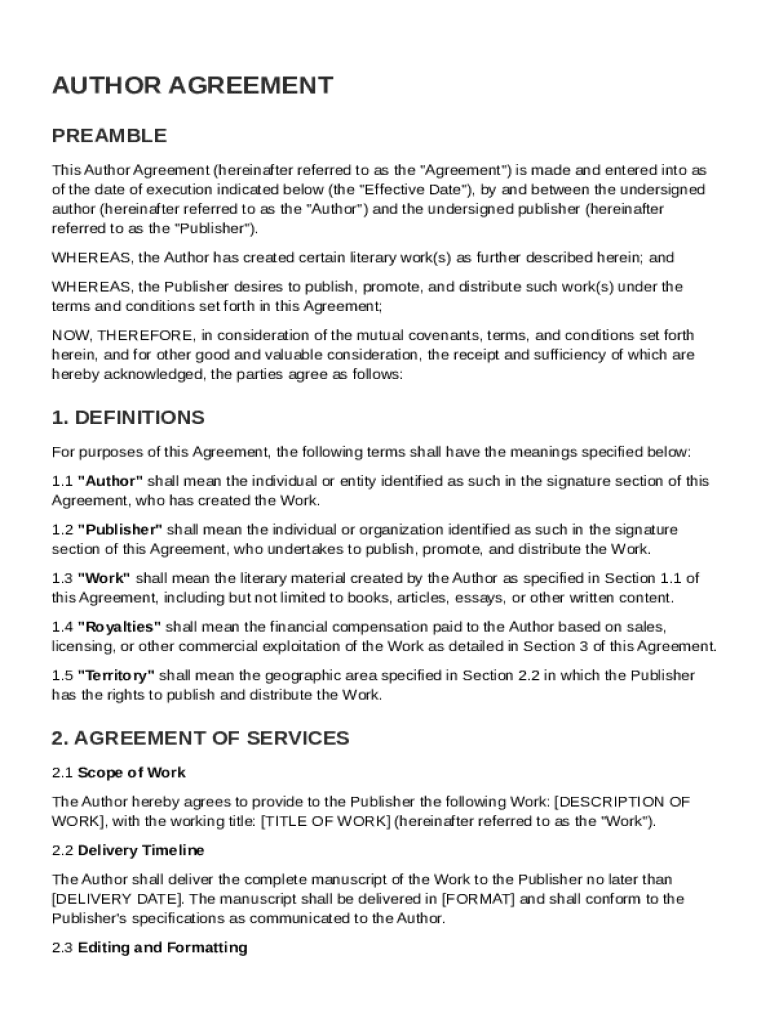
The Author Agreement Template is a crucial tool for formalizing the legal relationship between an author and a publisher. This document delineates the specific terms and conditions regarding the publication, marketing, and distribution of a literary work. Within this agreement, key terms are defined, including 'Author,' 'Publisher,' 'Work,' and 'Royalties.'
Such a template is essential for setting clear expectations between parties. It details responsibilities like manuscript submission and editing, along with copyright ownership and royalty distribution. By leveraging this template, both authors and publishers establish a mutual understanding of roles, ensuring the author's rights are preserved while permitting the publisher specific publishing rights within a designated territory and timeframe.
Key Elements of the Author Agreement Template
The Author Agreement Template comprises several critical components, each serving a distinct function to protect the interests of both the author and the publisher. These elements include:
- Manuscript Delivery: Outlines the timeline and format for manuscript submission.
- Editing and Approval: Details processes for editing and the necessary approvals before publication.
- Copyright Information: Specifies ownership rights and any licensing agreements.
- Royalties and Compensation: Defines how and when authors will receive payments and includes royalty rates and payment schedules.
- Dispute Resolution: Provides mechanisms for resolving potential disagreements.
- Publication Rights: Clarifies the scope of the publisher's rights to distribute the work.
Each element is structured to ensure comprehensive coverage, preventing potential misunderstandings or disputes.
How to Use the Author Agreement Template
Effectively using the Author Agreement Template requires a strategic approach:
- Review the Template: Carefully read through the entire document to understand each section.
- Customize the Document: Adjust the template to reflect specific details of the agreement, such as party names and unique terms.
- Consult with Legal Experts: It's advisable to involve legal counsel to ensure compliance with legal standards and protect both parties' interests.
- Negotiate Terms: Discuss any contentious points with the other party to reach a mutually beneficial agreement.
- Finalize and Sign: Once both parties agree, sign the document to formalize the agreement legally.
This step-by-step approach ensures thorough preparation and understanding before entering into a binding agreement.
Steps to Complete the Author Agreement Template
Completing the Author Agreement Template involves several steps, each crucial for formalizing the agreement properly:
- Gather Required Information: Have all necessary details, such as author and publisher information, manuscript details, and financial terms.
- Edit Template Sections: Fill in corresponding sections using accurate and clear language.
- Review for Accuracy: Double-check all entries for correctness to prevent errors.
- Seek Feedback: If possible, submit the template for review by legal professionals or trusted advisors.
- Finalize Details: Ensure all terms are agreeable, making any last-minute adjustments as needed.
- Sign the Agreement: Both parties must sign and date the document to make it official.
Following these steps minimizes risks and confirms that the agreement unequivocally reflects the parties' intentions.
Important Terms Related to the Author Agreement Template
Understanding specific terms within the Author Agreement Template is vital:
- Author: The individual or entity who creates the literary work.
- Publisher: The organization that facilitates the publication and sale of the work.
- Manuscript: The text of the work being submitted for publication.
- Royalties: Payments made to the author based on sales or licensing.
- Publishing Rights: Legal rights the publisher holds to print and distribute the work.
Each term carries significant implications, shaping the author-publisher relationship and ensuring both parties comprehend their obligations and rights.
Legal Use of the Author Agreement Template
The Author Agreement Template is fundamentally a legal document, and its validity is anchored in adherence to contract law. It must:
- Comply with Jurisdictional Laws: Ensure that it meets all legal requirements within the specific jurisdiction where it will be enforced.
- Be Executed by Competent Parties: Both signing parties must have the legal capacity to enter into an agreement.
- Include All Necessary Terms: A complete agreement should reflect every critical aspect of the author-publisher relationship to prevent legal challenges.
Understanding these legal requirements is essential for maintaining the agreement's enforceability.
State-Specific Rules for the Author Agreement Template
While the core components of an Author Agreement Template are typically universal, some state-specific nuances might affect the document:
- Copyright Registration: States may have varying processes for copyright registration and protections.
- Sales Tax Implications: Rules regarding sales tax on literary works can differ, impacting authors' and publishers' financial arrangements.
- Dispute Resolution: Local laws can prescribe different methods and venues for resolving disputes.
Authors and publishers should consult legal experts familiar with local regulations to ensure compliance and avoid potential legal pitfalls.
Examples of Using the Author Agreement Template
Consider these scenarios that illustrate the utility of the Author Agreement Template:
- Self-Publishing: An author self-publishing and using the template to agree on terms with a distributor.
- Traditional Publishing: A first-time author partnering with a publisher for a debut novel, setting clear terms for copyright and royalties.
- Collaborative Works: Multiple authors using the template to outline shared rights and responsibilities when jointly creating a work.
These examples underscore how the template provides a structured framework to negotiate various complexities inherent in the publishing world.