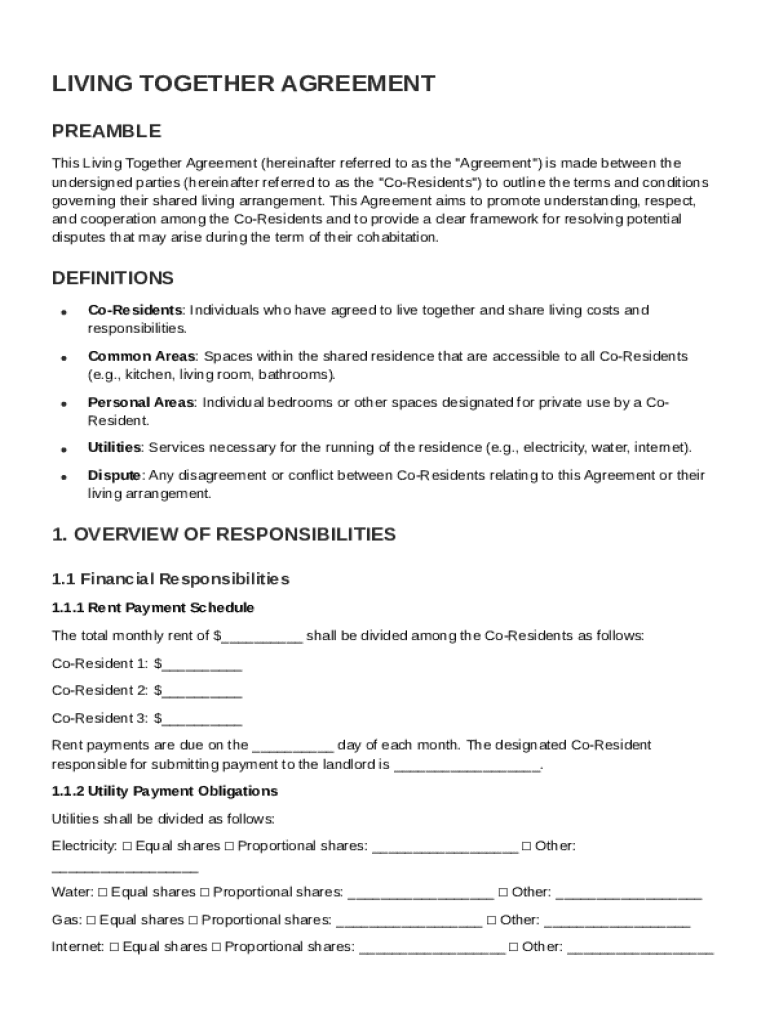







Definition and Purpose of the Living Together Agreement Template
The Living Together Agreement Template is a foundational legal document designed to establish clear terms and conditions for individuals sharing a living space. Its primary function is to outline financial responsibilities, housekeeping duties, privacy expectations, guest policies, conflict resolution processes, and procedures for terminating the agreement. This template aims to promote harmony and mutual respect among cohabitants by providing a structured framework for managing daily interactions and potential disputes. It serves as a preemptive measure to address common cohabitation issues, ensuring all parties have a shared understanding of their obligations and rights.
How to Use the Living Together Agreement Template
Utilizing the Living Together Agreement Template involves several steps to ensure it accurately reflects the needs and circumstances of all parties involved:
-
Customization: Tailor the template to fit specific living arrangements by adding or modifying sections related to finance, chores, and personal boundaries.
-
Consultation: Discuss key points with all cohabitants to gain consensus on important terms. This ensures mutual understanding and agreement before finalizing the document.
-
Finalization: Once the template is customized and agreed upon, all parties should review the document thoroughly to ensure accuracy and completeness.
-
Execution: Sign the agreement to make it binding. Each party should keep a copy for record-keeping and future reference.
-
Revisions: Re-evaluate the agreement periodically, such as at lease renewals, to update any changes in the living situation or responsibilities.
Key Elements of the Living Together Agreement Template
The most critical components of a Living Together Agreement Template typically include:
-
Financial Responsibilities: Specifies rent, utilities, and other shared expenses, detailing each individual's contribution.
-
Housekeeping Duties: Outlines tasks such as cleaning and maintaining common areas, specifying who is responsible for what and when.
-
Privacy and Personal Space: Defines boundaries for shared and personal areas, including guidelines for access and use.
-
Guest Policies: Establishes rules for visitors, such as visitation hours, overnight stays, and the approval process for long-term guests.
-
Conflict Resolution: Provides a framework for resolving disagreements amicably, including mediation or arbitration methods.
-
Termination Procedures: Details the process and notice period required for one party to exit the arrangement, considering lease obligations and deposit recovery.
Important Terms Related to the Living Together Agreement Template
Understanding key terms within the Living Together Agreement Template is crucial for ensuring clarity and avoiding disputes:
-
Leaseholder: The person(s) officially on the rental agreement and legally responsible for the property.
-
Subtenant: An individual residing in the space under an arrangement with the leaseholder but not on the official lease agreement.
-
Common Areas: Shared spaces within the residence, such as the living room, kitchen, and hallways.
-
Fixed Costs: Regular, non-variable expenses that remain constant, like rent, as opposed to variable costs like utilities which can fluctuate.
-
Mediation: A method of conflict resolution involving an impartial third party to assist in reaching a mutual agreement.
Legal Use of the Living Together Agreement Template
Legally, the Living Together Agreement Template serves as a private contract between parties, rather than a public legal document recognized by all jurisdictions. It is imperative that:
-
Compliance with State Laws: Ensure the agreement adheres to local tenancy laws, which may affect certain terms like notice periods or tenant rights.
-
Enforceability: While primarily a personal agreement, some clauses, such as financial contributions, can potentially be enforced in court, provided they are clear and reasonable.
-
Legal Advice: Consider consulting a legal professional to validate the agreement's terms and applicability, especially if cohabitation involves significant financial transactions or legal responsibilities.
State-Specific Rules for the Living Together Agreement Template
State-specific regulations can impact the formulation of a Living Together Agreement:
-
Tenancy Laws: Variations exist in eviction procedures, notice periods, and rights of tenants and subtenants.
-
Security Deposits: Different states have specific rules governing the collection, interest, and return of security deposits.
-
Utility Regulations: States may have guidelines on shared utility billing and the rights of renters concerning utility services.
Examples of Using the Living Together Agreement Template
Real-world scenarios highlight the utility of the Living Together Agreement:
-
Housemate Arrangements: College students sharing off-campus housing use the template to manage rent payments and weekly cleaning schedules.
-
Family Living: Extended families utilize the document to establish boundaries in multigenerational homes to avoid conflicts over shared resources and expenses.
-
Temporary Roommates: Individuals residing together temporarily, such as for internships or short-term assignments, use the template to clarify short-term arrangements and exit clauses.
Versions or Alternatives to the Living Together Agreement Template
While the Living Together Agreement Template offers comprehensive guidelines for cohabitation, alternatives may better suit certain situations:
-
Roommate Agreements: Focuses specifically on agreements between non-related individuals cohabiting, often with fewer complex legal considerations.
-
House Rules Agreement: Covers less formal arrangements that may not involve significant legal or financial entanglements, focusing instead on day-to-day living customs.
-
Cohabitation Agreements: Used by couples, especially when not married, to outline both financial and personal expectations within the household.