Definition & Meaning
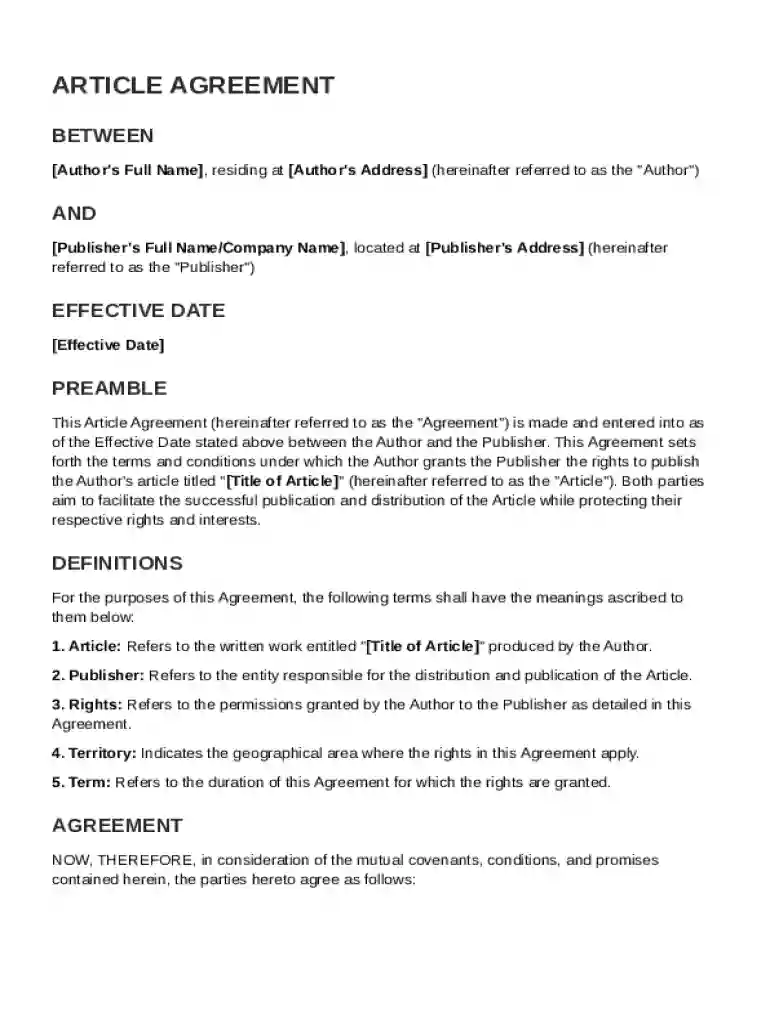
The Article Agreement Template is a legally binding document that outlines the terms and conditions under which an author grants rights to a publisher for the publication and distribution of an article. This template is particularly important in formalizing the working relationship between authors and publishers by detailing the scope of rights granted, expectations, and responsibilities of both parties. It serves as a safeguard to ensure that the interests of both the author and the publisher are protected and that the publication process is clearly defined.
Key Elements of the Article Agreement Template
The template encompasses several critical sections essential for its function.
- Grant of Rights: Specifies the rights that the author is granting to the publisher, which could include exclusive or non-exclusive rights to publish, distribute, and reproduce the article.
- Author Obligations: Details the author's responsibilities, such as delivering the work by a specified deadline and adhering to quality and editorial standards.
- Publisher Responsibilities: Outlines the publisher’s duties, including timely publication and distribution of the work.
- Compensation: States the financial arrangements, such as royalties or flat fees, and the payment schedule.
- Revisions and Edits: Defines the process for revisions and the degree of editorial control retained by the publisher.
- Termination Conditions: Lists the grounds under which the agreement can be terminated by either party.
- Governing Law and Indemnification: Specifies the legal jurisdiction that governs the agreement and outlines indemnification clauses to handle potential legal disputes.
Steps to Complete the Article Agreement Template
Completing the Article Agreement Template involves several precise steps:
- Review the Template: Carefully read through each section of the template to ensure understanding.
- Fill in Party Details: Insert the complete legal names and contact information for both the author and the publisher.
- Detail the Grant of Rights: Clearly specify the rights being granted, including the type and duration.
- Specify Compensation Terms: Write down the agreed financial terms, including payment methods and schedules.
- Outline Obligations: Ensure that both author and publisher obligations and responsibilities are clearly documented.
- Discuss Revisions: Determine how revisions will be handled and document these details.
- Include Legal Clauses: Verify that legal clauses such as termination, governing law, and indemnification are adequately covered.
Each step should be meticulously done to safeguard the interests of both parties and to ensure a mutual understanding of the agreement’s terms.
Important Terms Related to Article Agreement Template
Understanding specific legal and industry terms is crucial when dealing with Article Agreement Templates:
- Exclusive Rights: Rights granted to only one publisher, prohibiting the author from publishing the article elsewhere.
- Non-Exclusive Rights: Allows authors the freedom to publish the article with multiple publishers.
- Royalties: Earnings paid to the author as a percentage of sales or revenue generated from the article.
- Indemnification: A clause where one party agrees to compensate the other for any harm, liability, or loss arising from the agreement.
Each of these terms carries specific legal implications that should be well-understood before signing the agreement.
Legal Use of the Article Agreement Template
The Article Agreement Template is designed to comply with legal standards and practices within the United States, following essential laws and regulations that govern such agreements:
- ESIGN Act Compliance: Signatures obtained electronically via platforms like DocHub are legally binding.
- Jurisdictional Laws: The governing law section specifies which state’s laws will be applied, ensuring that any legal disputes are handled appropriately.
Consulting with legal experts during the drafting and completion of the template can ensure that the terms comply with applicable laws and provide adequate protection for both parties.
Examples of Using the Article Agreement Template
Several scenarios can illustrate the use of Article Agreement Templates:
- Freelance Journalism: A journalist writes an investigative piece, and the magazine seeks exclusive rights to publish and distribute it nationally.
- Academic Paper Publication: A researcher seeks to publish findings in a scientific journal, which specifies non-exclusive rights to allow wider academic sharing.
- Online Content Creation: A blogger contributes content to various media sites, requiring clear non-exclusive publication agreements.
These examples highlight the flexibility and necessity of having a structured agreement to outline rights and responsibilities clearly.
Software Compatibility and Integration
While traditionally completed on paper, DocHub allows the Article Agreement Template to be filled out digitally. This software solution offers several advantages:
- Electronic Signatures: Legally binding signatures can be added with ease.
- Real-Time Collaboration: Multiple parties can review and edit the document simultaneously, ensuring that all are on the same page.
- Cloud Integration: Documents can be stored and accessed across various platforms, including Google Drive and Dropbox, facilitating seamless workflows.
Utilizing such software enhances efficiency and accuracy in managing legal documents.