
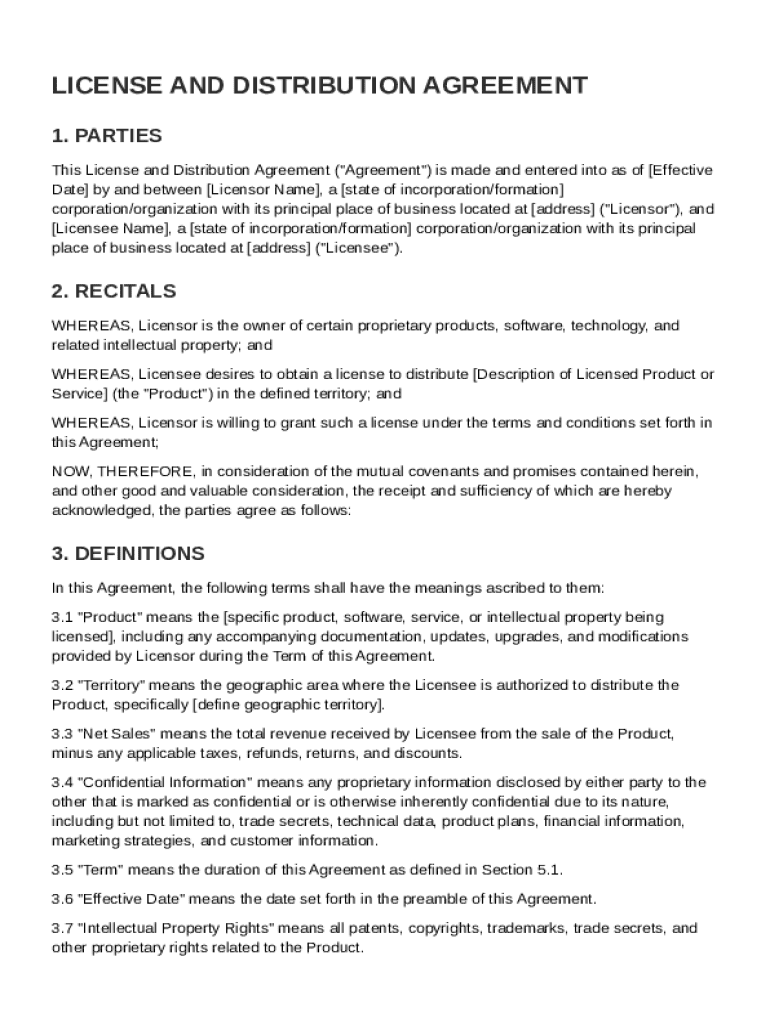







Definition & Meaning
A License and Distribution Agreement is a legal document that defines the rights and obligations between a licensor and a licensee. This agreement enables the licensee to distribute a particular product within a designated territory under specified conditions. The primary purpose is to clearly delineate responsibilities, limiting ambiguities and potential disputes between the parties. This agreement typically includes sections that cover the scope of the license, the nature of the distribution rights granted, and any financial compensations such as royalty payments. These components ensure a structured and formalized engagement that protects both entities involved, helping to uphold the product's value and the licensor's intellectual property rights.
Key Elements of the License and Distribution Agreement Template
The License and Distribution Agreement Template is structured to encompass several critical elements, each serving to clarify the expectations and obligations of both parties. These elements include:
- Grant of License: Specifies the rights being granted, such as whether the licensee can sell, market, or otherwise promote the product.
- Distribution Rights: Details the geographic and market segments where the licensee is authorized to distribute.
- Financial Arrangements: Includes terms around fees, royalties, and payment schedules, which can vary depending on distribution performance.
- Intellectual Property Rights: Addresses ownership and usage rights, ensuring the licensor's IP is protected and clearly understood by the licensee.
- Confidentiality Obligations: Mandates how proprietary and sensitive information should be handled to prevent unauthorized disclosure.
These components form the bedrock of the agreement, each playing a pivotal role in safeguarding mutual interests.
How to Use the License and Distribution Agreement Template
Using this template involves following a series of systematic steps to ensure comprehensiveness and clarity. Begin by reviewing the entire document to understand its components and tailor them according to your specific needs:
- Customize Legal Language: Adapt legal terms to suit the specific product and parties involved.
- Define Scope Clearly: Be precise about territories and distribution channels to avoid overstepping boundaries.
- Specify Financial Terms: Clearly state payment obligations to prevent future disputes.
- Review Intellectual Property Clauses: Ensure they adequately protect the owner's rights.
By meticulously adjusting each section to reflect actual business arrangements and legal requirements, the template becomes a powerful tool that simplifies agreement creation.
Steps to Complete the License and Distribution Agreement Template
Completing the template necessitates careful attention to detail across various sections:
- Input Party Information: Fill out details for both the licensor and the licensee, ensuring all contact information is up-to-date.
- Outline Product Details: Describe the product being licensed, including any specifications or relevant features.
- Set License Duration: Define the term of the license, considering renewals and termination clauses.
- Draft Confidentiality Clauses: Identify what constitutes confidential information and the obligations for protecting it.
- Finalize Governing Law Section: Choose the jurisdiction's laws that will apply, reflecting the location or most relevant legal setting for both parties.
By following these steps with precision, the agreement successfully aligns with specific legal and commercial requirements.
Who Typically Uses the License and Distribution Agreement Template
The License and Distribution Agreement Template is most frequently utilized by businesses expanding product reach through third-party distributors. Typical users include:
- Manufacturers: Seeking partnerships to distribute products in new markets.
- Software Companies: Allowing distribution of software products or licenses.
- Publishing Houses: Authorizing other entities to distribute their media.
- Brands: Leveraging local distributors to penetrate regional markets.
These users find the template essential for formalizing relationships that support growth and market diversification without compromising control over their product distribution strategy.


Important Terms Related to License and Distribution Agreement Template
Key terminology within this agreement framework includes:
- Licensor: The party that owns the product rights and is granting distribution permissions.
- Licensee: The distributor receiving rights to distribute the licensor's products.
- Territory: Geographic area where the licensee is allowed to distribute.
- Royalty: Payment structure tied to product sales or distribution performance.
- Indemnification: Legal protection against potential liabilities, typically provided by the licensee to the licensor.
Understanding these terms is crucial for ensuring that both parties share a consistent interpretation of their mutual obligations and rights.
Examples of Using the License and Distribution Agreement Template
Real-world applications of the License and Distribution Agreement Template showcase its versatility:
- Technology Companies: Licensing a software product to a distributor for sales in Asia, using specific clauses to manage updates and technical support.
- Apparel Brands: Entering U.S. retail channels by granting regional distributors rights to sell branded clothing, specifying retail spaces and online platforms.
- Food Producers: Approving local distributors to market exclusive gourmet items in specified American towns, leveraging distribution insights for broader market success.
Each example represents a strategic move to capitalize on the distributor's market insights and capabilities while preserving the brand's core values and proprietary knowledge.
Legal Use of the License and Distribution Agreement Template
Legally, utilizing this template provides a robust framework for compliance and operational harmony. It fundamentally serves to:
- Establish Legal Boundaries: Ensuring activities adhere to regional and federal laws regarding distribution practices.
- Clarify Recourse: Should disputes arise, the agreement outlines clear procedures for resolution, such as mediation or arbitration.
- Support Contractual Fidelity: Encourages adherence to determined terms, reducing the likelihood of breaches and increasing accountability.
These legal protections are crucial for maintaining a stable and mutually beneficial business relationship that focuses on long-term success.




