






Definition & Meaning
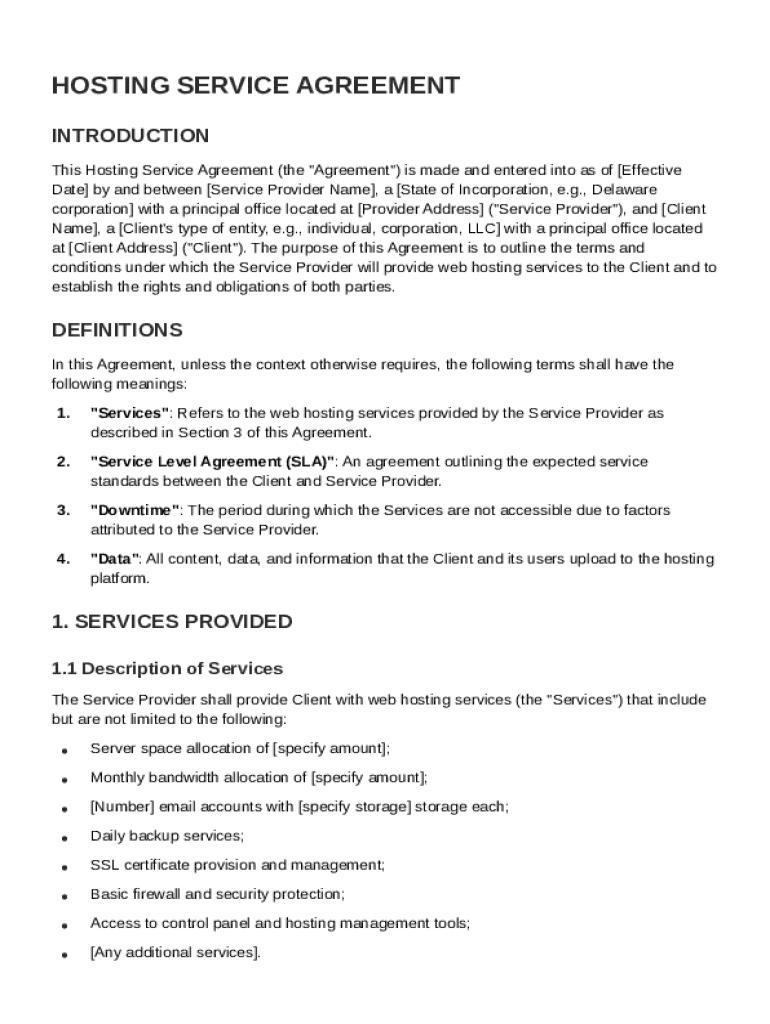
A Hosting Service Agreement Template is a formally structured document that outlines the terms and conditions under which a web hosting service provider offers hosting services to a client. This template serves as a foundational agreement that delineates various aspects such as service scope, fees, and responsibilities. By providing a pre-defined structure, the template ensures that both the service provider and the client are on the same page regarding their rights and obligations. The document enhances clarity by defining key terms involved in the hosting service and setting the framework for a professional relationship.
Key Components
- Service Descriptions: Clearly articulated details about the services being offered, which may include storage capacity, bandwidth limits, and uptime guarantees.
- Payment Terms: Specifications regarding billing cycles, payment methods, and any applicable late fees.
- Obligations: Responsibilities of both parties, such as maintenance tasks by the provider and timely payments by the client.
- Confidentiality and Security: Clauses that protect sensitive information and ensure compliance with data protection laws.
Key Elements of the Hosting Service Agreement Template
The Hosting Service Agreement Template includes several critical components that ensure it meets legal standards while providing comprehensive coverage for both parties.
Detailed Sections
- Service Level Agreement (SLA): This portion specifies performance benchmarks like uptime percentages and response times for technical support, setting expectations for service quality.
- Data Management Policies: Outlines how client data will be stored, accessed, and backed up, emphasizing the provider’s commitment to data integrity and security.
- Termination Conditions: Clearly defines circumstances under which the agreement can be terminated by either party, including breach scenarios and notice requirements.
Practical Examples
For instance, if a client fails to meet payment deadlines, the termination clause may allow the provider to suspend services until the account is settled. Conversely, if the provider fails to meet SLA metrics consistently, the client may have grounds to terminate the agreement without penalty.
Legal Use of the Hosting Service Agreement Template
The legal framework ensures that the Hosting Service Agreement Template is not merely a formality but a binding contract with enforceable terms.
Compliance and Legal Standards
- Liability Limitations: These detail the extent to which the provider is liable for service failures or data breaches, often limiting liability to a specific monetary cap.
- Dispute Resolution: Methods for resolving disagreements, such as negotiation, mediation, or arbitration, are well-defined, offering clear paths to dispute resolution.
- Jurisdiction Clauses: The template will typically specify the governing law and jurisdiction, usually aligning with the provider's operational base.
Important Terms Related to Hosting Service Agreement Templates
Several specific terms are crucial for understanding and executing a Hosting Service Agreement.
Glossary of Common Terms
- Bandwidth: Refers to the data transfer rate, which dictates how much data can be transferred over a network within a given period.
- Uptime: Percentage of time that the hosting service is operative and available, often a critical aspect of SLAs.
- Redundancy: Mechanisms in place to ensure service continuity, such as backup power supplies or data replication strategies.
Steps to Complete the Hosting Service Agreement Template
Completing a Hosting Service Agreement Template involves several systematic steps to ensure accuracy and compliance.
Step-by-Step Process
- Review the Terms: Thoroughly read all sections of the template to understand the service scope and obligations.
- Customize Details: Modify sections to reflect specific services, fees, and responsibilities unique to the client-provider relationship.
- Add Signatures: Both parties sign to acknowledge agreement to the terms, validating the contract’s enforceability.
- Review Legal Compliance: Ensure legal clauses—such as those concerning data protection—comply with applicable laws.
Example Scenario
For example, a business might review and adjust the payment terms to align with its accounting cycles or negotiate SLA terms to ensure alignment with critical business operations.
State-Specific Rules for Hosting Service Agreement Templates
Although these templates are designed with a broad application in mind, certain state-specific legal nuances can impact their usage.
State-by-State Considerations
- California: May require additional consumer protection clauses due to stringent data privacy laws like the CCPA.
- New York: Might mandate specific language pertaining to electronic transactions and services under state electronic transactions regulations.
Understanding these differences is crucial, especially for companies that operate in multiple jurisdictions, ensuring full legal compliance and avoiding potential legal pitfalls.
Who Typically Uses the Hosting Service Agreement Template
The Hosting Service Agreement Template is widely applicable across different industries and use cases.


Common Users
- Web Hosting Companies: Use this template to formalize the terms under which they provide services to clients, ensuring legal protection.
- Startups and Small Businesses: Often utilize these agreements when they are engaging a web hosting service for the first time.
- Large Enterprises: Leverage these templates when negotiating hosting services to ensure specific corporate compliance requirements are met.
Understanding who uses these templates helps in tailoring the document to meet diverse needs, ranging from simple web hosting agreements for small businesses to complex service agreements for large enterprises.

Examples of Using the Hosting Service Agreement Template
Real-world usage of the Hosting Service Agreement Template varies, illustrating its flexibility and utility.
Illustrative Cases
- Small Tech Startup: A startup might detail rapid scaling capabilities in the agreement to accommodate anticipated growth, ensuring the hosting service can meet evolving needs.
- E-commerce Platform: Utilizes clauses focused on high availability and robust security measures to assure customers of service reliability and data protection.
These examples demonstrate the versatility of the Hosting Service Agreement Template, catering to different business models and operational priorities.