







Definition & Meaning
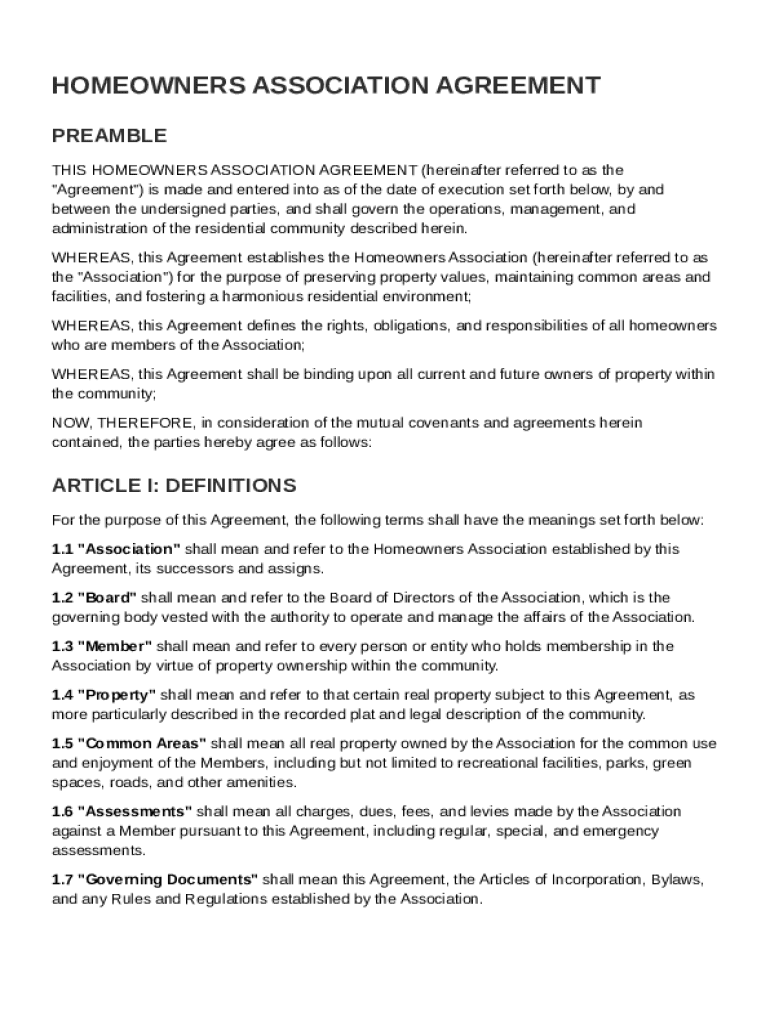
A Homeowners Association Agreement Template serves as the foundational document that outlines the governance, rights, and responsibilities of homeowners within a residential community. It is crucial for establishing the framework by which a Homeowners Association (HOA) operates. The agreement typically includes clauses on maintaining property values, managing shared spaces, and ensuring a harmonious living environment. In essence, this template provides the standardized basis for drafting custom agreements tailored to specific communities, ensuring all residents understand their obligations and rights.
Key Elements of the Homeowners Association Agreement Template
The template encompasses several fundamental components to ensure comprehensive and effective governance:
- Membership Eligibility: Specifies criteria for homeowners to become members of the HOA.
- Assessment Procedures: Details how fees are calculated, billed, and collected, crucial for the association's financial stability.
- Governance Structure: Outlines the roles and responsibilities of the Board of Directors, including election processes and term limits.
- Enforcement of Rules: Describes procedures for handling violations and the imposition of fines or other penalties.
- Amendments: Provides guidelines for modifying the agreement to adapt to evolving community needs.
- Indemnification: Offers protection for board members against legal liability for actions taken in good faith.
- Legal Compliance: Ensures adherence to local, state, and federal laws, reinforcing the document's enforceability.
How to Use the Homeowners Association Agreement Template
Using the template effectively involves several methodical steps to tailor it to the specific community's needs:
- Initial Review: Begin by thoroughly reviewing the entire template to understand its scope and structure.
- Community Assessment: Conduct a detailed evaluation of the community's unique characteristics and needs, such as size and specific amenities.
- Customization: Tailor sections of the template to reflect the community's particular rules, financial policies, and governance structure.
- Legal Consultation: Collaborate with a legal professional to ensure all modifications are legally compliant and enforceable.
- Draft Review: Present the draft to existing HOA members or stakeholders for feedback.
- Finalization: Integrate any necessary changes and finalize the document for adoption.
- Approval: Hold a formal vote among homeowners, as required, to officially adopt the agreement.
Important Terms Related to Homeowners Association Agreement Template
Understanding key terminologies used in the agreement is vital for efficient application and compliance:
- Covenants, Conditions, and Restrictions (CC&Rs): These are the fundamental rules and guidelines governing what homeowners can and cannot do within their properties and community.
- Assessments: Fees collected by the HOA to cover maintenance of common areas and community expenses.
- Quorum: The minimum number of members required to hold a valid meeting or conduct HOA business.
- Proxy Vote: Allows a member to delegate their voting rights to another individual if unable to attend an HOA meeting.
- Common Areas: Shared spaces within the community, such as parks, pools, or clubhouses, that are maintained by the HOA.
Steps to Complete the Homeowners Association Agreement Template
To complete the agreement template precisely:
- Identification: Accurately identify the HOA and specify the community's name and location.
- Board Details: List the current board members, including titles and contact information.
- Financial Details: Fill in all relevant sections concerning fee structures and budgeting.
- Legal Clauses: Ensure all legal provisions are relevant to the state or local jurisdiction.
- Review Procedures: Define procedures for ongoing review and amendment of the agreement.
- Signature Sections: Include spaces for signatures by authorized representatives of the HOA and, if applicable, notaries.
Legal Use of the Homeowners Association Agreement Template
The legal framework provided by the template ensures the agreement holds up in legal settings:
- Compliance Requirements: Must adhere to state-specific regulations governing HOAs.
- Legal Precedents: Should reflect any pertinent legal precedents that might affect the HOA's operation.
- Board Training: Board members may need to undergo training on the legal implications of the agreement.
- Litigation Preparedness: Clauses should cover procedures for addressing potential legal disputes with homeowners or external parties.
Who Typically Uses the Homeowners Association Agreement Template
The primary users are communities aiming to establish or formalize a Homeowners Association:
- New Developments: Developers and real estate investors who need to create a foundational governance document for new residential communities.
- Existing Associations: HOAs that require updating or revising their current agreements to better fit current standards or new regulatory requirements.
- Legal Counsel: Attorneys specializing in real estate law may use the template when advising community associations.
- Property Management Companies: Often responsible for administering the daily operations of HOAs and need to reference the agreement regularly.


State-Specific Rules for the Homeowners Association Agreement Template
HOAs must consider state-specific regulations that may affect the template's implementation:
- Registration Requirements: Some states mandate that HOAs be registered with a state agency.
- Financial Transparency: Varying requirements on financial disclosures and audits across states.
- Dispute Resolution: State-specific guidelines may dictate how disputes within the HOA are to be mediated or arbitrated.
- Amendment Procedures: States may have distinct requirements for how amendments to the HOA agreement should be proposed and approved.


