
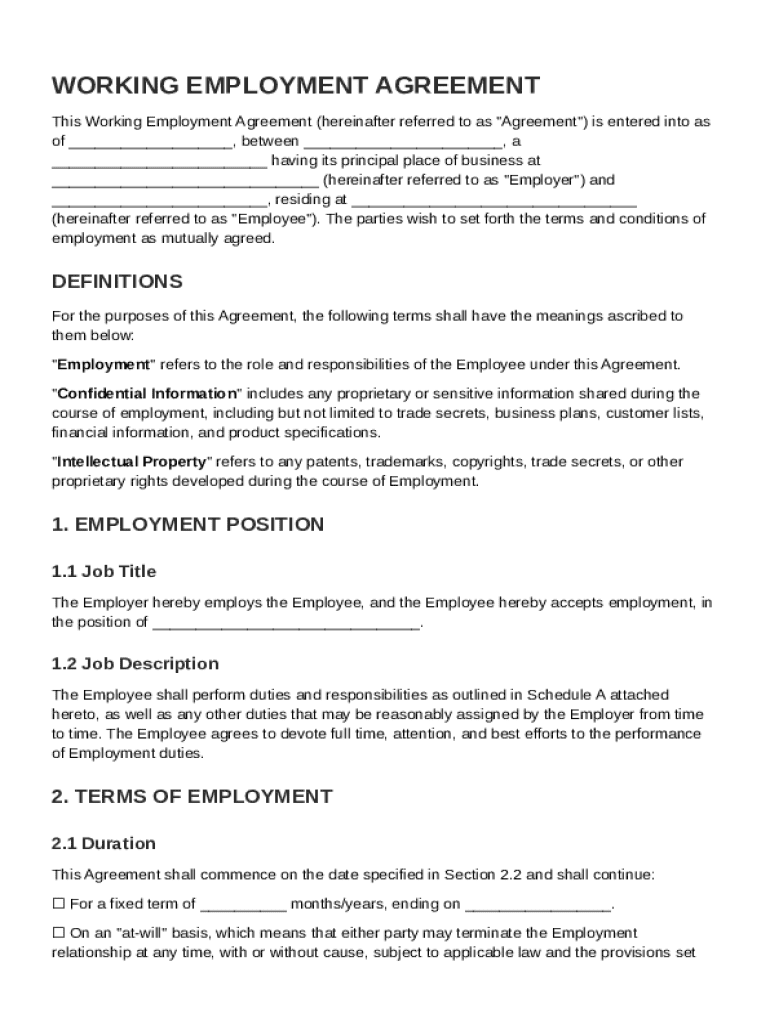







Key Elements of the Working Employment Agreement Template
A Working Employment Agreement Template establishes a clear understanding of the employment relationship between the employer and the employee. This document is crucial for outlining the terms of employment, compensation, and responsibilities. Below are the key elements included in the template:
-
Definitions and Job Position Details
- This section outlines the job title and provides a detailed description of duties and responsibilities.
- It includes specific tasks, reporting lines, and work location.
- The agreement might specify whether the position is full-time, part-time, or temporary.
-
Terms of Employment
- The duration of employment, including start date and end date (if applicable).
- Conditions for renewal or extension of the contract.
- Probationary period terms, if applicable.
-
Compensation Structure
- Details on salary, payment frequency, and method of payment (e.g., direct deposit).
- Information on bonuses, overtime pay, and commission structures if relevant.
- Non-monetary benefits like health insurance and retirement plans.
-
Responsibilities of Both Parties
- Employee duties, performance expectations, and reporting obligations.
- Employer obligations to provide a safe work environment and necessary resources.
- Process for performance evaluations and feedback mechanisms.
-
Confidentiality Obligations
- Clauses pertaining to the protection of trade secrets and proprietary information.
- Employee agreements on non-disclosure of sensitive company information.
- Duration and geographical scope of confidentiality obligations.
-
Termination Conditions
- Grounds for termination, including "for cause" and "without cause".
- Notice periods required for termination by either party.
- Severance pay and related conditions.
-
Dispute Resolution Procedures
- Processes for resolving employee-employer disputes, such as mediation and arbitration.
- Jurisdiction and governing law applicable to disputes.
- Steps to be taken before escalating to legal proceedings.
-
Miscellaneous Provisions
- Clauses on non-compete and non-solicitation agreements.
- Policies on intellectual property rights related to employee work.
- Conditions for agreement amendments and notices.
How to Use the Working Employment Agreement Template
Using the Working Employment Agreement Template involves several key steps. Here's a guide to efficiently completing the template:
-
Review the Template Thoroughly
- Ensure you understand all sections and terms present in the agreement.
- Identify specific areas that need customization based on the employee and job role.
-
Customize for Specific Employment Terms
- Modify job titles, descriptions, and compensation details to fit the specific role.
- Adjust sections to align with company policies and legal requirements.
-
Include Parties' Details
- Provide full names and contact information for both the employer and employee.
- Specify the legal entity of the employer and its registered address.
-
Ensure Compliance with Applicable Laws
- Verify state-specific requirements and adapt the template to conform to them.
- Consult legal counsel to ensure that all legal obligations are met.
-
Obtain Required Approvals
- Review and approve the agreement internally as required by company policy.
- Get written confirmation and agreement from all relevant parties.
Legal Use of the Working Employment Agreement Template
The Working Employment Agreement Template serves as a legally binding document. Here are considerations for its legal use:
-
Compliance with the Employee’s Rights
- Ensure the agreement respects employee rights under labor laws, including wage, working conditions, and discrimination laws.
- Include disclaimers or disclosures required by law.
-
Clarity and Precision
- Use clear language to ensure terms and conditions are understandable to both parties.
- Avoid ambiguous terms which could lead to misinterpretations.
-
Regular Review and Update
- Keep the template updated with changes in employment law and company policy.
- Regularly review agreements to ensure ongoing compliance and relevance.
Important Terms Related to Working Employment Agreement Template
Understanding specific terms is essential for the effective use and management of the Working Employment Agreement Template:
-
Probationary Period
- A trial phase at the beginning of employment to assess the employee's suitability for the role.
-
Non-Disclosure Agreement (NDA)
- A legal contract outlining confidentiality terms for proprietary information.
-
Severance Pay
- Compensation provided to an employee upon termination, beyond the employer's statutory obligations.
Examples of Using the Working Employment Agreement Template
Various scenarios illustrate the practical application of the Working Employment Agreement Template:
-
Hiring for a New Position
- Drafting an agreement for a newly created role, with defined terms for compensation and scope of work.
-
Onboarding Remote Employees
- Customizing terms to address remote work policies, digital communication tools, and online collaboration expectations.
-
Temporary or Project-Based Employment
- Structuring an agreement to define project timelines, deliverables, and compensation based on project milestones.
Steps to Complete the Working Employment Agreement Template
Creating a comprehensive Working Employment Agreement involves several steps:
-
Drafting the Initial Agreement
- Begin with a draft based on the template, filling in sections with general company information and job-specific details.
-
Internal Review and Adjustments
- Have managers and HR review the draft to ensure it aligns with job expectations and company policies.
-
Legal Risk Assessment
- Consult legal advisors to identify and mitigate any potential legal risks associated with the terms.
-
Signing and Documentation
- Obtain signatures from all parties involved.
- Store the signed agreement securely electronically or in hard copy.
By following these guidelines, the working employment agreement template provides a solid foundation for establishing and managing employment relationships effectively.


