






Definition and Meaning of a Construction Agreement Template
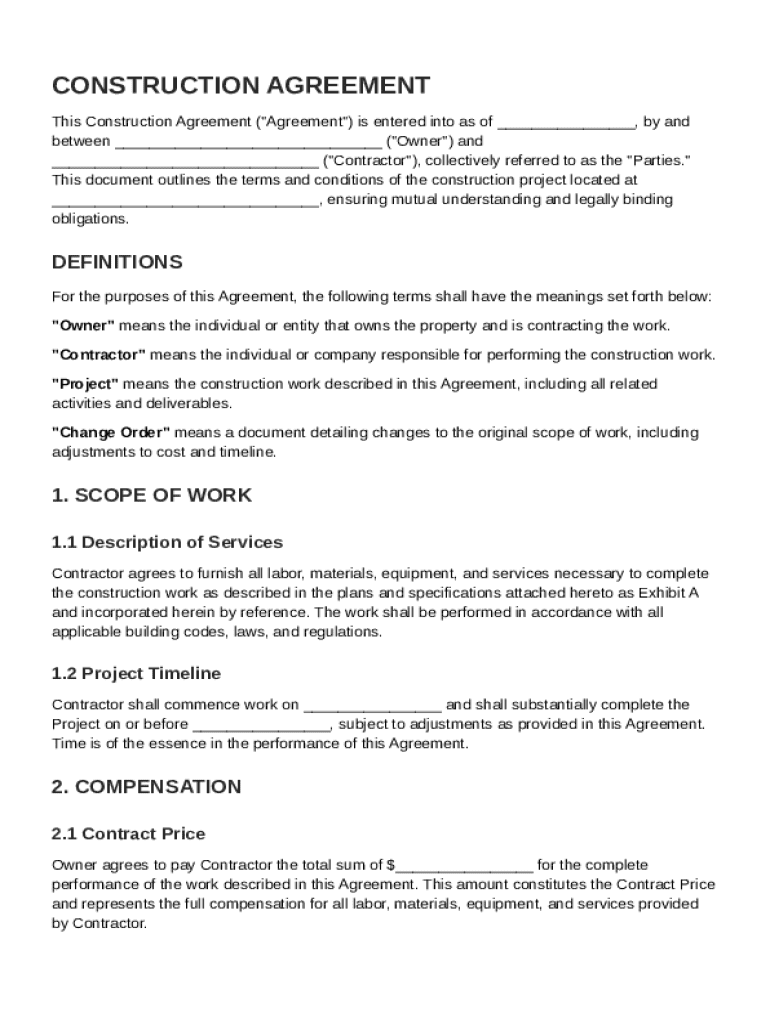
A Construction Agreement Template is a standardized document that outlines the terms and conditions agreed upon by the owner and contractor in a construction project. This template ensures that both parties have a clear understanding of their responsibilities and rights concerning the construction work. It incorporates various aspects including project scope, timeline, payment obligations, risk management, and compliance with relevant legal requirements. Utilizing a template simplifies the process by providing a comprehensive structure that can be customized to fit specific project needs while maintaining legal rigor and precision.
Key Features of a Construction Agreement
- Scope of Work: Clearly defines the tasks and responsibilities of the contractor to avoid any ambiguity.
- Payment Terms: Details the compensation structure, including payment schedules, amounts, and methods.
- Change Orders: Provides guidance on how alterations to the project scope can be requested and approved.
- Insurance Requirements: Outlines mandatory insurance coverage for both parties to mitigate potential risks.
- Dispute Resolution: Describes the mechanisms for addressing disagreements that may arise during the project.
- Termination Conditions: Specifies the circumstances under which the agreement can be ended prematurely.
How to Use the Construction Agreement Template
Step-by-Step Instructions
- Review the Template: Familiarize yourself with the entire content of the agreement to understand the legal terminology and structure.
- Enter Details:
- Insert the project specifics such as location, parties involved, and description of the work.
- Customize clauses to reflect the project’s unique requirements.
- Consult Professionals: Engage with a legal expert to ensure modifications are compliant with local laws and regulations.
- Mutual Agreement: Discuss the terms with the contractor, making sure both parties agree on every aspect before signing.
- Finalize and Sign: Execute the agreement with signatures from both the owner and contractor to make it legally binding.
Practical Considerations
- Make sure to double-check all entered data for accuracy.
- Keep all discussions and agreements transparent to prevent misunderstandings.
Important Terms Related to the Construction Agreement Template
Key Terminology Explained
- Contractor: The individual or company hired to execute the construction project.
- Owner: The party commissioning and funding the construction project.
- Subcontractor: Firms or individuals hired by the contractor to perform specific tasks.
- Lump Sum Contract: A fixed pricing agreement for the entire scope of work outlined.
- Time and Materials Contract: An agreement where the contractor is paid based on time spent plus material costs.
Legal Use of the Construction Agreement Template
Ensuring Legal Compliance
- Review state-specific legal requirements for construction agreements to ensure full compliance.
- Engage with a licensed attorney to verify that the contract meets all legal standards and conditions to be enforceable in court.
- Ensure signature procedures meet ESIGN standards for electronic documents if using DocHub for digital signing.
Common Legal Clauses
- Indemnification Clause: Protects the owner from liabilities due to contractor actions.
- Force Majeure: Releases parties from liability due to unavoidable events like natural disasters.
- Warranty: Defines the guarantees regarding the quality of materials and workmanship.
Key Elements of the Construction Agreement Template
Essential Information Required
- Project Timeline: Start and completion dates, including milestones.
- Budget: Total cost estimates and provisions for unforeseen expenses.
- Materials and Equipment: Specifications for materials to be used, ensuring quality and compliance.
- Quality Assurance: Methods and standards for evaluating work completed.
- Signatures: Spaces for both the owner’s and the contractor's signatures to validate the agreement.
Real-World Example
A construction company in New York was engaged in a residential project with specific environmental compliance needs. The Construction Agreement Template was modified to include an environmental clause, ensuring all construction activities adhered to local eco-friendly standards, reducing the risk of legal issues and enhancing the project's sustainability focus.
Examples of Using the Construction Agreement Template
Application Scenarios
- Residential Construction: Homeowners use the template to detail renovations or new builds, ensuring clarity in deliverables from the contractor.
- Commercial Projects: Businesses contract with reliable firms, using the template to outline complex requirements for office buildings or retail spaces.
- Municipal Projects: Local governments applying the template for public infrastructure projects like roads or bridges, ensuring transparency and accountability.
Case Study
A municipal authority employed the Construction Agreement Template to contract a firm for bridge reconstruction. The agreement ensured that deadlines were met and the required legal and safety standards were upheld, while flexible provisions for change orders allowed adjustments without project derailment.
State-Specific Rules for the Construction Agreement Template
Tailoring to Regional Requirements
- Recognize that each U.S. state may have unique construction laws impacting contract formulation.
- California: Includes stringent environmental and worker safety regulations that must be incorporated.
- Texas: Focus on lien law compliance to protect owner interests in construction projects.
- Consult a local legal expert to ensure that regional differences are adequately addressed in the template.
Applying State Rules
- Adjust insurance and indemnity clauses to reflect state jurisdictional requirements.
- Include regional certifications or permits that may be necessary prior to commencing work.
Digital vs. Paper Version of the Construction Agreement Template
Weighing Format Options
- Digital Advantages: Faster distribution, easy amendments, integration with cloud storage like DocHub.
- Paper Advantages: Tangible record keeping, preferred by parties favoring traditional contract methods.
- Digital Security: Maintain data integrity and confidentiality with features like password protection and SSL encryption from platforms like DocHub.
Implementing the Right Version
- Use a digital format for swift interactions with geographically dispersed stakeholders.
- Opt for paper when digital access is limited or when higher levels of client assurance are required.
By following these detailed insights on the Construction Agreement Template, users can effectively tailor their agreements to specific needs while ensuring cost efficiency, legal compliance, and quality assurance in construction projects.