






Definition & Meaning
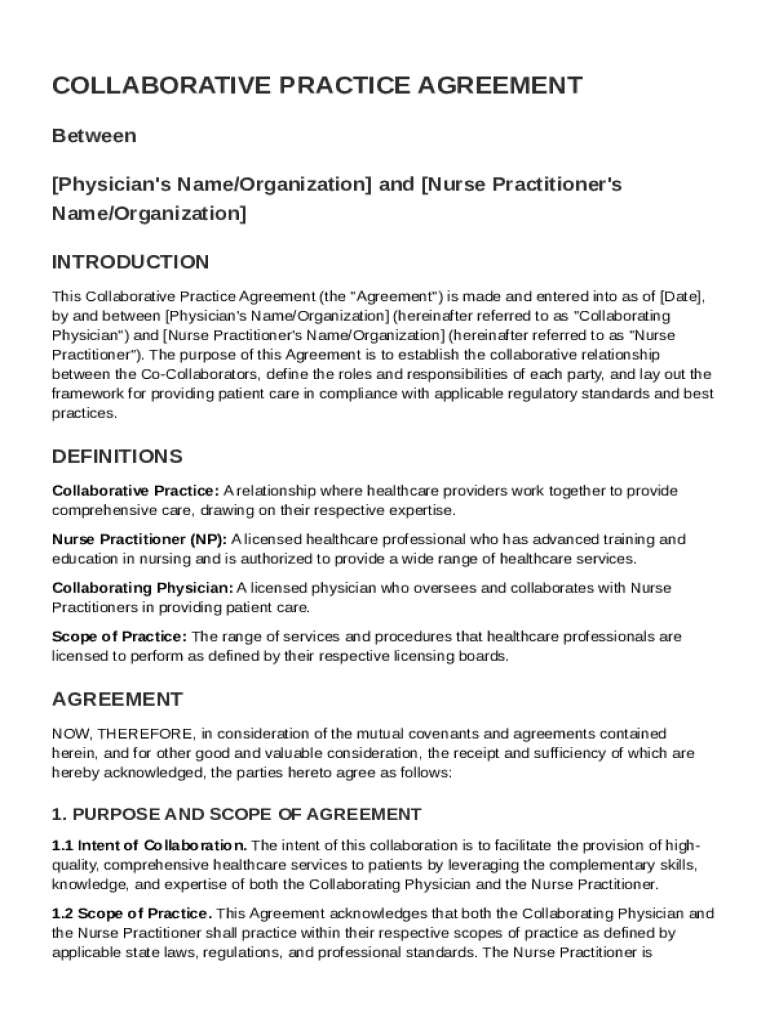
A Collaborative Practice Agreement (CPA) is a legally binding document that outlines the working relationship between a physician and a nurse practitioner. It specifies the roles, responsibilities, and mutual expectations of both parties involved in patient care. By clearly defining collaborative practice, this agreement ensures a structured framework for sharing tasks, streamlining communication, and adhering to legal and regulatory standards. The CPA sets the boundaries for the nurse practitioner's scope of practice and must align with state and federal laws.
- Roles and Responsibilities: The agreement establishes who is responsible for what duties, be it patient diagnosis, treatment planning, or follow-up.
- Communication Protocols: Clear communication guidelines help in maintaining consistency in patient care and avoid potential misunderstandings.
How to Use the Collaborative for Nurse Practitioners Agreement Template
Using the Collaborative Practice Agreement template involves understanding its sections and filling it out in accordance with your specific practice requirements. This template is a comprehensive tool to detail the working relationship between medical professionals.
- Review the Template: Familiarize yourself with each section, from the roles and responsibilities to the legal requirements.
- Customize According to Practice Needs: Adapt the template to reflect the unique dynamics of the physician-nurse practitioner relationship.
- Ensure Legal Compliance: Verify that the filled template complies with current state laws and healthcare regulations.
- Filing and Archiving: Once completed, ensure the agreement is signed by all parties, and keep copies for legal and professional reference.
Key Elements of the Collaborative for Nurse Practitioners Agreement Template
The CPA template includes several critical elements necessary for establishing a functional and legal collaborative relationship.
- Scope of Services: Defines the range of medical services the nurse practitioner is authorized to provide.
- Quality Assurance Measures: Outlines procedures for maintaining and assessing healthcare quality.
- Compliance Provisions: Ensures that all parties adhere to relevant healthcare laws and regulations.
- Dispute Resolution: Methods for resolving any conflicts that may arise during the execution of the agreement.
Each of these elements plays a vital role in shaping a functional collaborative practice.
Steps to Complete the Collaborative for Nurse Practitioners Agreement Template
Completing the CPA template requires a systematic approach to ensure accuracy and compliance.
- Gather Required Information: Collect necessary details about the involved parties, including credentials and licensure.
- Fill Out the Template Sections: Provide information for each section, such as practice setting, patient population, and supervision levels.
- Review For Accuracy: Double-check the filled information for consistency and accuracy.
- Finalizing the Agreement: After completion, ensure that all parties review the document, make necessary amendments, if any, and sign to validate the agreement.
Legal Use of the Collaborative for Nurse Practitioners Agreement Template
The CPA serves a legal function by delineating responsibilities and ensuring compliance with healthcare laws. It acts as a safeguard for both parties by setting clear legal boundaries and expectations.
- Ensuring Legal Protection: The agreement acts as a record in legal proceedings and protects parties against liability.
- State Compliance: Reflects adherence to state-specific requirements, which is crucial as laws governing collaborative practice vary by state.
Legal review by a healthcare attorney can further ensure that the CPA stands up to scrutiny.
State-Specific Rules for the Collaborative for Nurse Practitioners Agreement Template
Different states have unique rules governing Collaborative Practice Agreements, which may affect scope, supervision, and prescriptive authority.
- Supervision Requirements in Different States: Some states require direct supervision by a physician, while others allow more autonomy.
- Prescriptive Authority: State laws also dictate what medications a nurse practitioner can prescribe independently.
It is essential to stay informed about state-specific legislation to maintain compliance and optimally utilize the CPA.
Examples of Using the Collaborative for Nurse Practitioners Agreement Template
The CPA template can be applied across various healthcare settings, and examples can illustrate its practical applications.
- Pediatric and Family Care: Utilize the CPA in a family practice setting to outline the roles related to child and adult care.
- Specialized Medical Clinics: Applied in a specialty clinic context, highlighting the nurse practitioner's specific role in managing chronic diseases.
These examples demonstrate how diverse medical settings can adapt the CPA to suit their practice structure and patient care models.
Who Typically Uses the Collaborative for Nurse Practitioners Agreement Template
CPAs are primarily used by healthcare professionals working collaboratively in diverse medical environments.
- Nurse Practitioners and Physicians: Used extensively in primary care and specialty settings to define their collaborative dynamics.
- Healthcare Administrators and Legal Teams: They often draft or refine these agreements to ensure compliance with both legal and organizational requirements.
This widespread usage highlights the CPA's role in fostering collaborative and compliant healthcare practices.