






Definition and Meaning
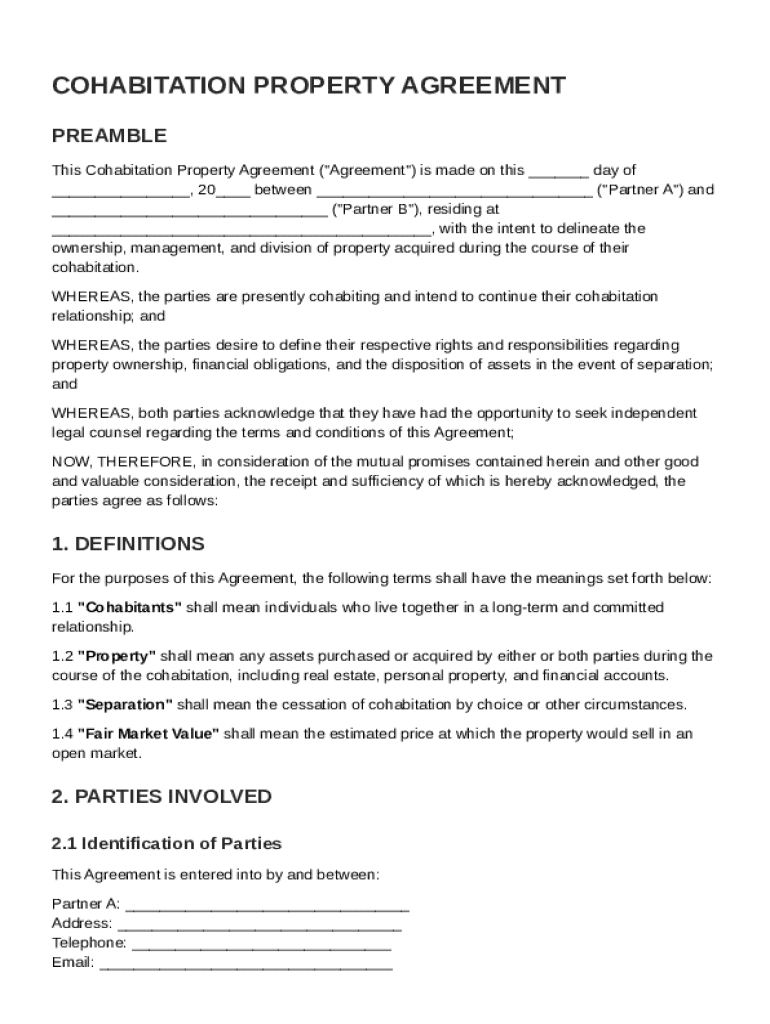
A Cohabitation Property Agreement is a legal document that outlines the terms and conditions between two parties living together regarding property ownership, financial responsibilities, and asset division in the event of separation. It serves to define how assets, including real estate and shared investments, will be handled and, importantly, specifies the rights of each party. The agreement includes critical details such as property ownership classifications, dispute resolution procedures, and emphasizes the significance of each party obtaining independent legal advice.
Key Elements of the Cohabitation Property Agreement Template
The Cohabitation Property Agreement Template includes several vital sections to ensure clarity and fairness:
- Parties Involved: Names and contact information of the individuals entering into the agreement.
- Property Ownership: Distinctions between individually and jointly owned property, including an inventory of assets and debts.
- Financial Obligations: Detailed descriptions of each party's financial responsibilities during the relationship.
- Division of Property: Procedures for dividing property upon separation, including any pre-agreed valuations or buyout terms.
- Dispute Resolution: Methods for resolving disagreements, such as mediation or arbitration, to avoid litigation.
- Amendments and Termination: Conditions under which the agreement can be modified or terminated.
- Governing Law: Indication of which state's law applies to the agreement, often linked to the parties' residence.
How to Obtain the Cohabitation Property Agreement Template
The Cohabitation Property Agreement Template can be accessed through various legal document services, including DocHub. You can download it directly to customize it according to your specific requirements. Legal platforms often offer several downloadable formats, such as PDF or DOC, to ensure compatibility with different word processing software.
Steps to Complete the Cohabitation Property Agreement Template
- Collect Information: Gather all necessary information about the assets and liabilities that will be included in the agreement.
- Customization: Modify the template to fit your particular situation. Ensure all relevant sections are filled accurately.
- Seek Legal Advice: It is crucial to consult with an attorney to review the agreement and provide legal guidance.
- Review and Revise: Both parties should read the agreement thoroughly, make any needed revisions, and ensure mutual understanding.
- Sign and Notarize: Finally, each party must sign the agreement, preferably in front of a notary public to verify the signatures.
State-Specific Rules for the Cohabitation Property Agreement Template
Different states may have varying legal requirements for cohabitation agreements. Certain jurisdictions have specific statutes regarding cohabitation agreements or recognize them under contract law. For example:
- California: Recognizes non-marital agreements provided they meet general contract principles.
- New York: Requires a written agreement to ensure enforceability and often suggests notarization.
- Texas: Follows the common law contract system, allowing cohabitation agreements as long as they are in writing.
Familiarizing yourself with your state's specific rules is essential to ensuring the enforceability of the agreement.
Legal Use of the Cohabitation Property Agreement Template
The legal standing of a Cohabitation Property Agreement depends on proper execution and adherence to state laws. These agreements are used for:
- Asset Protection: Protecting individual assets from being claimed by the other partner in the event of separation.
- Conflict Prevention: Providing a clear framework for managing disputes over property and finances.
- Legal Clarity: Ensuring each party's rights are explicitly defined and legally recognized.
Important Terms Related to the Cohabitation Property Agreement Template
Understanding the terminology used within a Cohabitation Property Agreement is crucial:
- Joint Tenancy: A form of property co-ownership where each party has equal rights and shares.
- Community Property: Assets acquired during a relationship to which both parties are entitled an equal share.
- Separate Property: Assets owned individually, either before the relationship began or acquired independently.
Examples of Using the Cohabitation Property Agreement Template
Practical examples of when this agreement might be used include:
- Engaged Couples: Prevent disagreements over property in case of a breakup before marriage.
- Retired Partners: Couples living together who want to maintain their respective estates for their heirs.
- Co-owners of a Home: Individuals buying property together while maintaining separate financial lives.
Each scenario requires careful customization of the template to reflect the parties' intentions and circumstances.
Who Typically Uses the Cohabitation Property Agreement Template
Wide-ranging demographics use such agreements, including:
- Unmarried Couples: Those living together long-term who want to clarify their financial and property rights.
- Blended Families: Individuals who wish to secure financial assets separately, especially when children from prior relationships are involved.
- Business Partners: Co-owners of a venture who also cohabitate and want to delineate personal from business interests.
These agreements are tailored to provide clarity and protect interests without the formality of marriage.