
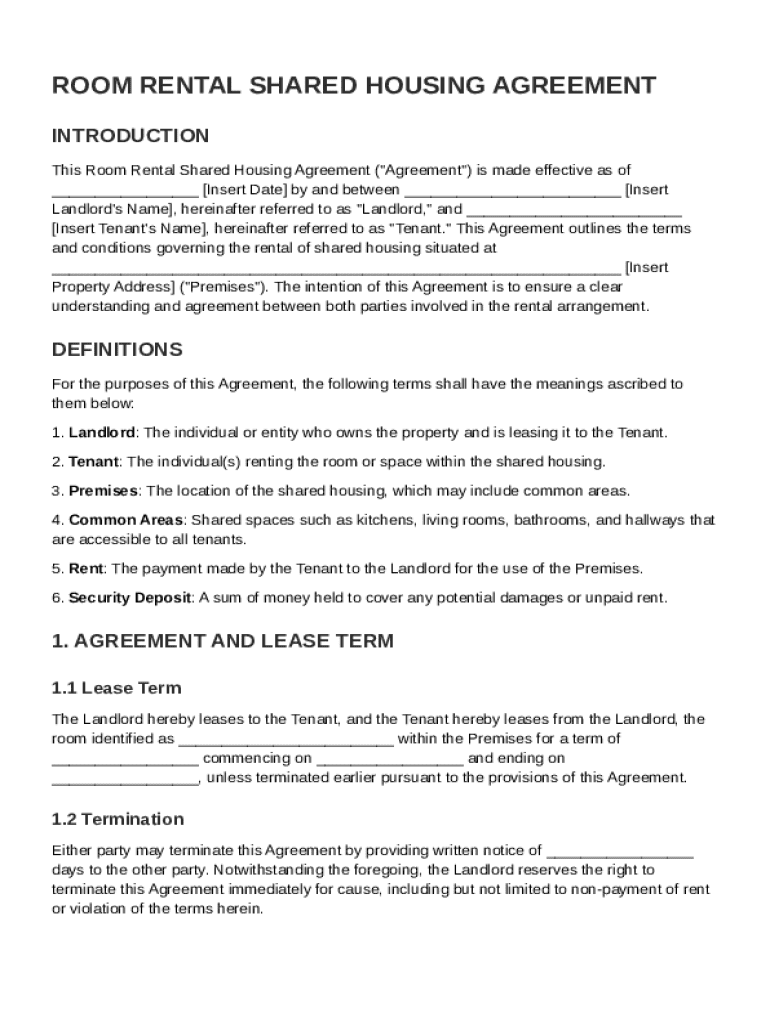







Definition and Key Elements of the Room Rental Shared Housing Agreement Template
The Room Rental Shared Housing Agreement Template is a legal document that defines the terms and conditions agreed upon by a landlord and tenant for renting a room in a shared housing arrangement. It is designed to ensure clarity and mutual understanding between both parties. The template typically includes:
- Definitions of Key Terms: Establishes a clear understanding of important terms such as "landlord," "tenant," "shared space," and "exclusive use."
- Lease Duration: Specifies the start and end dates of the lease, detailing the term of the rental agreement.
- Rent Payment Details: Outlines the monthly rent amount, payment due date, accepted payment methods, and potential late fees.
- Security Deposit Requirements: Details the amount of the security deposit, its intended use, and conditions for its return.
These elements are essential for creating a comprehensive and enforceable agreement that protects the interests of both parties involved in the room rental.
Steps to Complete the Room Rental Shared Housing Agreement Template
Completing a Room Rental Shared Housing Agreement Template involves several key steps to ensure that all necessary information is included and both parties are adequately protected:
- Gather Preliminary Information: Collect the necessary details, including the names and contact information of all parties, the property's address, and specific terms regarding the tenancy.
- Fill in the Lease Duration: Specify the commencement and termination dates of the lease to define the tenancy period clearly.
- Enter Rent and Payment Details: Record the agreed-upon rent amount, due date, and method of payment, ensuring both parties concur on any associated fees or charges.
- Complete Security Deposit Information: Document the security deposit amount and the terms regarding its refund, including conditions under which deductions may be made.
- Enumerate House Rules and Responsibilities: Detail any rules regarding the use of shared spaces, responsibilities for maintenance, and expectations for behavior within the property.
- Review with Parties Involved: Both the landlord and tenant should carefully review the completed agreement to ensure all information is accurate and satisfactory.
- Sign the Agreement: Both parties must sign the document to validate the agreement, ensuring it is legally binding.
Following these steps helps create a robust agreement that mitigates potential disputes and establishes clear expectations for all involved.
Important Terms Related to the Room Rental Shared Housing Agreement Template
Understanding the terms commonly used in a Room Rental Shared Housing Agreement Template is crucial for ensuring smooth execution and compliance. Key terms often found in these documents include:
- Premises: Refers to the room being rented as well as the shared areas accessible to tenants, such as kitchens and living rooms.
- Exclusive Use: Denotes areas or facilities that are solely for the tenant's use, as outlined in the agreement.
- Common Areas: Shared spaces within the property, such as hallways, bathrooms, and laundry facilities, that are accessible to all tenants.
- Maintenance Obligations: Specifies the responsibilities of the landlord and tenant in terms of property upkeep and necessary repairs.
- Governing Law: Identifies the state law under which the agreement will be interpreted and enforced, ensuring compliance with local regulations.
Grasping these terms helps tenants and landlords adhere to the agreement and prevent misunderstandings.
Legal Use and Compliance of the Room Rental Shared Housing Agreement Template
The Room Rental Shared Housing Agreement Template must adhere to specific legal standards to be enforceable. Compliance ensures that both parties are protected under the law:
- ESIGN Act Compliance: Ensures that electronic signatures used on the agreement are legally binding as per the Electronic Signatures in Global and National Commerce Act.
- State-Specific Regulations: The agreement must accommodate particular laws relevant to the state in which the property is located, affecting terms like security deposits and tenant rights.
- Fair Housing Regulations: The terms of the agreement must not discriminate based on race, gender, religion, familial status, or other protected characteristics under the Fair Housing Act.
- Privacy Laws: Protect the tenant's personal and financial information as per applicable privacy regulations.
Ensuring these legal requirements are met is essential to the legitimacy and enforceability of the rental agreement.
Examples of Using the Room Rental Shared Housing Agreement Template
The Room Rental Shared Housing Agreement Template is versatile, facilitating a range of room rental arrangements. Here are some examples:
- Student Housing: Used when landlords rent rooms to college students, often involving specific stipulations related to noise and guest policies.
- Short-Term Stays: Applies to situations where tenants are renting rooms for temporary or seasonal stays, requiring flexible lease terms.
- Co-Living Spaces: Useful in co-living environments where multiple tenants share communal areas, and house rules are crucial for maintaining harmony.
- Family Home Rentals: When a family rents a portion of their residence, this agreement defines expectations and boundaries between family members and tenants.
These scenarios highlight the template's adaptability to various living arrangements, tailoring the agreement to specific needs.
State-Specific Rules for the Room Rental Shared Housing Agreement Template
State regulations can significantly influence the terms of a Room Rental Shared Housing Agreement, and understanding these differences is vital:
- California: Requires detailed disclosures about the property's condition and rent control status.
- New York: Mandates specific clauses about tenant rights and emergency repair procedures.
- Texas: Often demands clarity in terms related to utilities and maintenance responsibilities.
- Florida: May dictate unique rules about security deposit handling and lease termination notices.
These state-specific regulations impact the formation and execution of rental agreements, requiring landlords and tenants to familiarize themselves with local laws.
Who Typically Uses the Room Rental Shared Housing Agreement Template
Understanding who commonly utilizes the Room Rental Shared Housing Agreement Template can provide insights into its functionality:
- Landlords: Especially those managing multiple tenants in a shared space, seeking to define clear terms and responsibilities.
- Tenants: Individuals renting a single room in a house or apartment, often in need of defined rules regarding shared space and privacy.
- Property Managers: Professionals overseeing properties with several tenants, requiring standardized agreements for consistency.
- Co-Living Arrangements: Companies offering co-living spaces use these agreements to establish community guidelines and individual responsibilities.
Being aware of these user groups highlights the template's role in creating structured and fair living arrangements in shared housing contexts.

State-by-State Differences in Room Rental Shared Housing Agreement Template
Significant variations exist in rental agreements across different states, influenced by unique regulatory environments:
- Security Deposit Handling: Varies widely, with some states capping deposits while others have detailed laws about interest and return timelines.
- Lease Termination Notice: States like Vermont require longer notice periods, affecting how lease terminations are managed.
- Rent Increase Notifications: Some states dictate specific advance notice periods for rent adjustments to protect tenants.
- Utility Responsibilities: Differing state laws can determine how utility payments should be structured and communicated in the agreement.
These differences underscore the importance of customizing the agreement to comply with state regulations, ensuring both tenants and landlords understand their rights and obligations.




