






Definition & Meaning
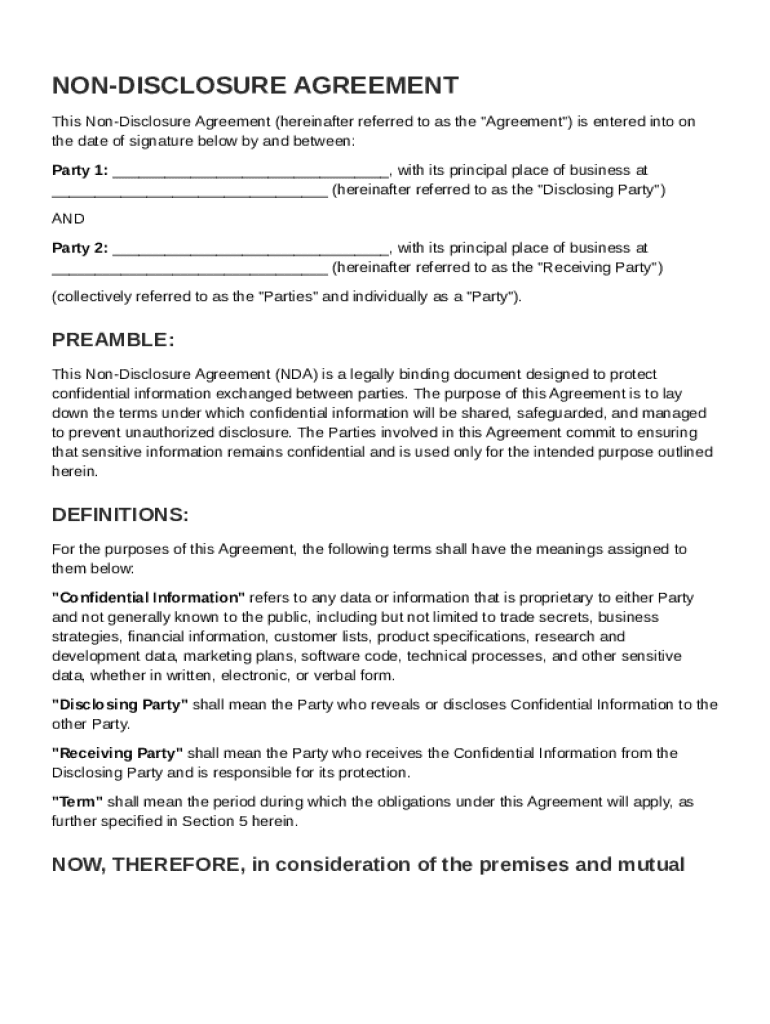
A Non Disclosure Email Agreement Template is a legal document specifically designed to facilitate the protection of confidential information shared via email between a Disclosing Party and a Receiving Party. This template outlines the types of information considered confidential, the responsibilities of the receiving party to protect this information, and the exceptions to these confidentiality rules. It also specifies the return or destruction of the information after the agreement's termination and the governing laws that apply.
Key Components
- Confidential Information: Includes proprietary data, trade secrets, and other sensitive business materials.
- Parties Involved: Defines the Disclosing and Receiving Parties.
- Duration: Specifies how long the non-disclosure obligation remains in effect.
- Return/Destruction: Outlines procedures for returning or destroying information.
- Governing Law: Identifies legal jurisdiction over the agreement.
How to Use the Non Disclosure Email Agreement Template
Using the Non Disclosure Email Agreement Template involves customizing it to fit the specific needs of the parties and the type of information being protected. Users should tailor the sections on confidentiality, party responsibilities, and applicable exceptions to ensure comprehensiveness.
Steps for Customization
- Identify Parties: Fill in details of the Disclosing and Receiving Parties.
- Define Confidential Information: Specify what constitutes confidential information.
- Duration and Jurisdiction: Set the timeline for confidentiality obligations and the legal jurisdiction.
- Amendment Provisions: Establish how changes to the agreement will be handled in the future.
Practical Example
Consider a software startup entering negotiations with a potential partner. The startup would use the template to protect its source code and proprietary algorithms during discussions.
Steps to Complete the Non Disclosure Email Agreement Template
Completing the template requires careful consideration and input of accurate information pertinent to the transaction or relationship.
Step-by-Step Instructions
- Download the Template: Obtain a reliable version from a reputable source like DocHub.
- Fill in Basic Details: Input party names, addresses, and contact details.
- Outline Confidential Materials: Clearly describe the information to be protected.
- Specify Obligations: Set out duties of the Receiving Party regarding information handling.
- Finalize Agreement Terms: Confirm the effective period and governing state laws.
- Review and Sign: Ensure all parties agree to the terms before signing.
Why Use a Non Disclosure Email Agreement Template
This template is crucial for businesses and individuals wishing to safeguard their sensitive information during various business dealings.
Benefits of Using the Template
- Standardization: Provides a consistent structure that is easy to understand.
- Time-Saving: Reduces the time spent drafting agreements from scratch.
- Legal Protection: Establishes a clear legal framework for confidentiality.
- Risk Mitigation: Reduces the risk of information leaks and misuse.
Example Scenario
A graphic design agency intends to share concept visuals with a client. By utilizing the template, the agency can ensure these designs are not used or disclosed without permission.
Important Terms Related to Non Disclosure Email Agreement Template
Understanding the terminology used within the template is essential for effective implementation and compliance.
Essential Terminology
- Non-Disclosure: The act of withholding certain information from unauthorized parties.
- Confidentiality: The principle of keeping sensitive information secure and private.
- Proprietary Information: Data or information owned by a company or individual, which holds economic value.
Common Misunderstandings
Some users may confuse non-disclosure agreements with non-compete agreements. It's vital to distinguish the focus on protecting information in NDAs as opposed to restricting professional competition.
Legal Use of the Non Disclosure Email Agreement Template
The template must be used in a lawful manner; ensuring that it complies with applicable laws and regulations.
Legal Considerations
- ESIGN Act Compliance: Ensure electronic signatures used on the document are legally binding.
- Jurisdictional Laws: Consider state-specific laws that may affect the agreement’s validity.
- Clarity in Terms: Ambiguities in terms can render portions unenforceable.
Case Study
A technology company based in California uses an NDA to protect its innovations designed for other markets. By ensuring compliance with both federal and state laws, the agreement remains enforceable.
Key Elements of the Non Disclosure Email Agreement Template
Understanding the core elements of the template is essential for its effective utilization.
Core Components
- Disclosing and Receiving Parties: Clearly defined participants and their roles.
- Confidentiality Obligations: Specific measures the Receiving Party must take.
- Exceptions: Situations where information can be disclosed without breach.
- Termination Clause: Outlines circumstances under which the NDA ends.
Detailed Breakdown
- Signatures: Binding the parties to the terms outlined.
- Confidentiality Scope: Range and limitations of confidentiality obligations.
- Remedies and Penalties: Consequences of breach and available remedies.
Disclosure Requirements
The template also includes sections that outline mandatory disclosure requirements, providing clarity on what information must be shared under certain conditions.
Specific Requirements
- Legal Exceptions: Situations requiring compulsory disclosure, such as subpoenas.
- Mutual Disclosures: When both parties need to share sensitive information.
- Recipient Acknowledgement: Confirmation of understanding and agreement to terms.
Example Situations
A pharmaceutical company, during joint research, may need to disclose certain aspects of their work to government bodies. These disclosures need to comply with the conditions set out in their NDA template.
Digital vs. Paper Version
Choosing between a digital or paper version of the agreement can impact its efficiency and accessibility.
Comparison
- Digital Format: Easier to store, retrieve, and modify; aligns with cloud-based workflows.
- Paper Format: Traditional form that some companies still prefer for record-keeping.
Advantages of Digital Versions
- Convenience: Enables remote access and modifications.
- Efficiency: Integrates with other digital workflow tools like DocHub.
Case Example
An online marketing firm opts for digital NDAs to leverage the seamless integration with their document management systems, enhancing their operational efficiency.