
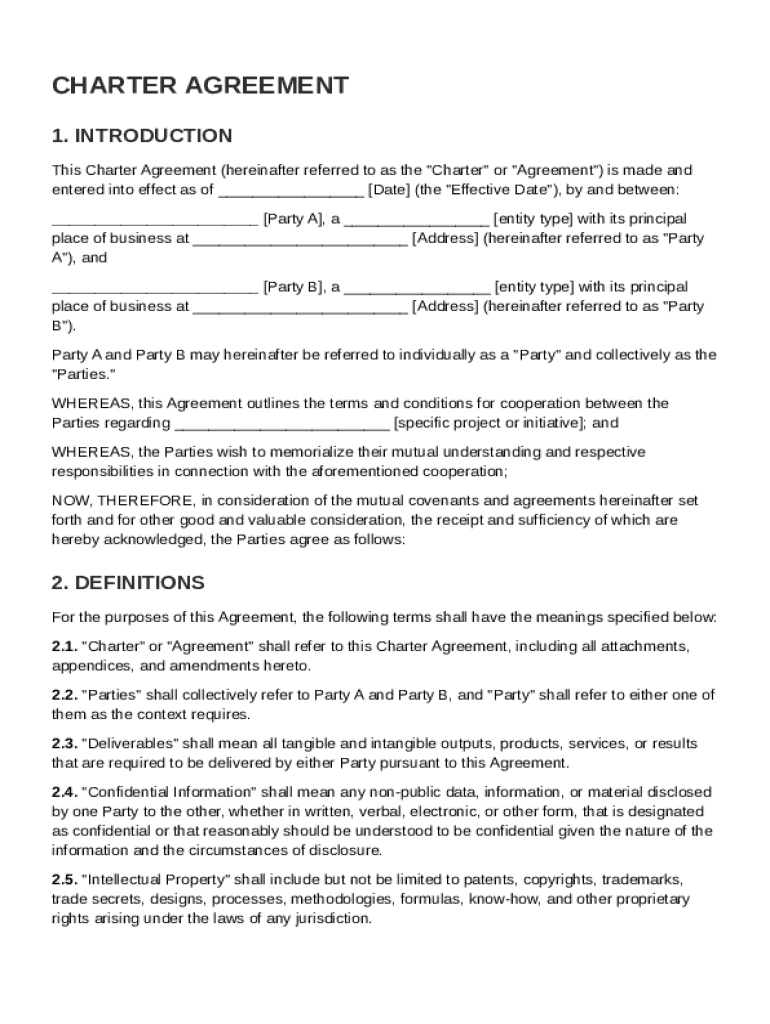







Definition and Purpose of the Charter Agreement Template
A Charter Agreement Template is a foundational document that outlines the terms and conditions of a partnership or collaboration between two entities. Typically referred to as Party A and Party B, these entities agree on specific project objectives, responsibilities, and the scope of their cooperation. The template defines key elements like the roles of each party, resource allocation, and communication protocols. Furthermore, it includes clauses related to confidentiality, intellectual property rights, and dispute resolution. This document formalizes mutual understanding, ensuring that each party is clear on their obligations and rights within the collaboration.
Key Elements of the Charter Agreement Template
The Charter Agreement Template comprises several essential components that ensure a comprehensive understanding between the involved parties:
- Definitions of Key Terms: Clear definitions help avoid misunderstandings.
- Purpose and Objectives: Articulates the goals of the partnership.
- Scope of Work: Details the tasks each party will undertake.
- Roles and Responsibilities: Outlines individual commitments and duties.
- Resource Allocation: Describes how resources will be shared or divided.
- Communication Protocols: Establishes methods and frequency of updates.
- Confidentiality and Intellectual Property: Legal protections for shared information.
- Dispute Resolution Mechanisms: Procedures for addressing disagreements.
- Amendments and Termination Clauses: Conditions under which the agreement may be altered or ended.
These elements ensure that both parties are legally protected and committed to a mutually beneficial partnership.
How to Use the Charter Agreement Template
Using the Charter Agreement Template involves a structured approach to ensure all aspects of the agreement are covered and understood. Here are the steps to effectively utilize this template:
- Identify the Involved Parties: Clearly list the names and roles of the parties involved.
- Outline the Project Details: Define what the collaboration seeks to achieve.
- Assign Responsibilities: Specify the tasks and responsibilities for each participant.
- Discuss Resource Sharing: Determine how resources like finances and manpower will be allocated.
- Draft Communication Strategies: Decide the regularity and means of communication.
- Include Legal Clauses: Ensure clauses concerning confidentiality, intellectual property, and disputes are included.
- Review and Sign: Both parties should thoroughly review the document before signing.
Utilizing the Charter Agreement Template streamlines the creation of a legally sound and mutually beneficial agreement.
Who Typically Uses the Charter Agreement Template
Charter Agreement Templates are commonly used by various types of organizations and partnerships, including:
- Businesses: Small to large enterprises partnering for projects.
- Non-Profits: Collaborations between NGOs for joint initiatives.
- Government Agencies: Partnerships for community or public service projects.
- Educational Institutions: Collaboration between schools and universities for research or programs.
- Startups and Entrepreneurs: Partnerships for product development or market expansion.
The template is flexible and can be adapted for various collaborative efforts across different industries.


Important Terms Related to Charter Agreement Template
Understanding the terminology within a Charter Agreement Template is crucial for both parties. Some important terms include:
- Parties: The entities entering into the agreement.
- Term: The duration the agreement covers, including start and end dates.
- Consideration: What each party agrees to contribute (monetary or service-wise).
- Confidential Information: Data and details that must remain private.
- Force Majeure: Circumstances that release parties from obligations due to events outside their control.
Familiarity with these terms helps in drafting and comprehending the document.
Legal Use of the Charter Agreement Template
The Charter Agreement Template serves as a legally binding document ensuring that all agreed terms are enforceable under U.S. law. Its use is guided by:
- Compliance with Local Laws: Ensuring alignment with federal and state regulations.
- Incorporation of Necessary Legal Clauses: Including mediation or arbitration settings.
- Confidentiality Agreements: Protective measures for sensitive information.
Legal counsel is often recommended to ensure all legal aspects are adequately covered and compliant with applicable laws.
Steps to Complete the Charter Agreement Template
Completing a Charter Agreement Template requires detailed attention to each section:
- Collect Necessary Information: Gather all relevant details about both parties and the project.
- Draft the Agreement: Carefully document each section with precise and clear language.
- Review and Revise: Both parties should evaluate the draft and suggest modifications.
- Finalize Terms: Agree upon the final conditions and ensure clarity on all points.
- Sign the Agreement: Officially sign the document in the presence of witnesses if necessary.
These steps ensure that the agreement is comprehensive and accurately reflects the intentions of both parties.
Examples of Using the Charter Agreement Template
Real-world scenarios often illustrate the versatility of the Charter Agreement Template:
- Technology Companies: Two IT companies forming a partnership for software development.
- Construction Firms: Collaboration between contractors for a large infrastructure project.
- Healthcare Providers: Hospitals partnering with clinics for community health programs.
- Research Institutions: Universities collaborating on a joint research initiative.
These examples show how diverse sectors can utilize the template to enhance collaboration and achieve shared goals.




