
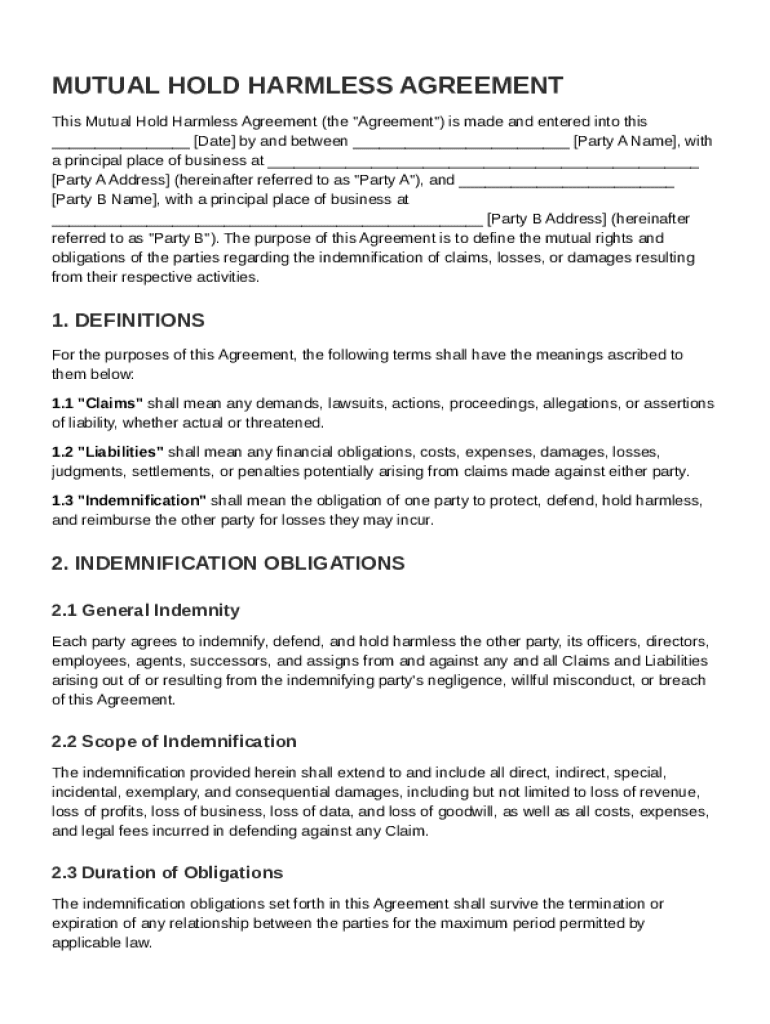







Definition & Meaning
A Mutual Hold Harmless Agreement, also known as a cross-indemnity agreement, is a legally binding contract where two parties, typically referred to as Party A and Party B, agree to indemnify and protect each other from liabilities, claims, and losses arising from their respective actions. This agreement is crucial in various business transactions and collaborations, providing a safety net against potential legal claims or damages that may result from each party's conduct. The purpose is to share the risk associated with liabilities and ensure each party's actions do not unfairly burden the other. Terms like 'Claims' and 'Liabilities' are defined to clarify what constitutes indemnifiable actions, ensuring both parties understand the breadth of protection offered.
Key Elements of the Mutual Hold Harmless Agreement Template
The Mutual Hold Harmless Agreement Template consists of several key components designed to outline the responsibilities and protections of each party. First, it establishes mutual indemnification obligations, allowing both parties to be protected against claims arising from the other’s actions. Second, it details exclusions for intentional acts where negligence or willful misconduct removes protection under the agreement. Third, it includes procedures for claim notification and defense, outlining how parties should communicate and respond to potential claims. Additionally, the agreement is governed by the laws of a specified state, which affects how disputes are resolved. Provisions for amendments and severability ensure the contract remains valid even if parts are modified or invalidated.
Steps to Complete the Mutual Hold Harmless Agreement Template
- Read the Template Thoroughly: Begin by reading through the entire template to understand the terms and conditions.
- Identify the Parties Involved: Clearly specify Party A and Party B, including their legal names and addresses.
- Define Scope and Application: Detail the activities or transactions covered by the agreement.
- Determine Governing Law: Select the state law that will govern the agreement to address potential disputes.
- Specify Exclusions: List actions or liabilities not included under the hold harmless provisions.
- Set Procedures for Notifications: Establish how claims or incidents will be reported between parties.
- Review and Sign: Ensure both parties review the agreement with legal counsel before signing.
Who Typically Uses the Mutual Hold Harmless Agreement Template
This template is commonly employed across various sectors, including construction, event planning, and business partnerships. In construction, for instance, contractors and subcontractors use it to protect against claims related to job-site incidents. Event organizers use it to shield against liabilities arising from venue-related injuries. In general business partnerships, companies use it to align risk-sharing when collaborating on projects that could potentially lead to legal claims.


Legal Use of the Mutual Hold Harmless Agreement Template
The legal validity of a Mutual Hold Harmless Agreement depends on its proper execution according to applicable state laws. It must clearly outline mutual indemnification terms to ensure enforceability. Legal counsel should review the agreement to ensure it does not violate public policy or statutory law. When properly executed, such agreements are legally binding, offering recourse in the event of disputes or claims between parties.
State-Specific Rules for the Mutual Hold Harmless Agreement Template
State laws can significantly influence how Mutual Hold Harmless Agreements are interpreted and enforced. Some states have specific stipulations regarding indemnity clauses, especially concerning construction contracts. For example, certain states may limit the scope of indemnity or require additional disclosures. It is essential to consult state-specific legal counsel to tailor the agreement according to local legal requirements, ensuring compliance and enforceability.
Important Terms Related to Mutual Hold Harmless Agreement Template
- Indemnify: To compensate for harm or loss.
- Liability: Legal responsibility for one's actions or omissions.
- Exclusion Clause: Provisions that specify actions or circumstances not covered by the agreement.
- Governing Law: Legal jurisdiction whose laws govern the agreement.
- Severability: A clause that ensures the remainder of the agreement remains valid if part of it is invalidated.
Examples of Using the Mutual Hold Harmless Agreement Template
Consider a scenario where two businesses, one providing catering services and the other renting equipment for an event, enter into a Mutual Hold Harmless Agreement. If a guest suffers an injury due to a faulty equipment setup, the agreement ensures both parties shoulder the risk equally without attributing full legal responsibility solely to the rental company. Another example is a partnership between a software developer and a distribution company, where indemnification clauses protect both parties against claims related to intellectual property infringement.
Versions or Alternatives to the Mutual Hold Harmless Agreement Template
Variations of the Mutual Hold Harmless Agreement exist to suit different enterprises or legal requirements. Standard forms may be adapted to create unilateral agreements where only one party provides indemnification, depending on the nature of the transaction or partnership. Additionally, alternatives like limited indemnity agreements offer more specific coverage tailored to particular liabilities. Legal advisors can help customize the agreement to align with specific business needs and jurisdictional restrictions.


