
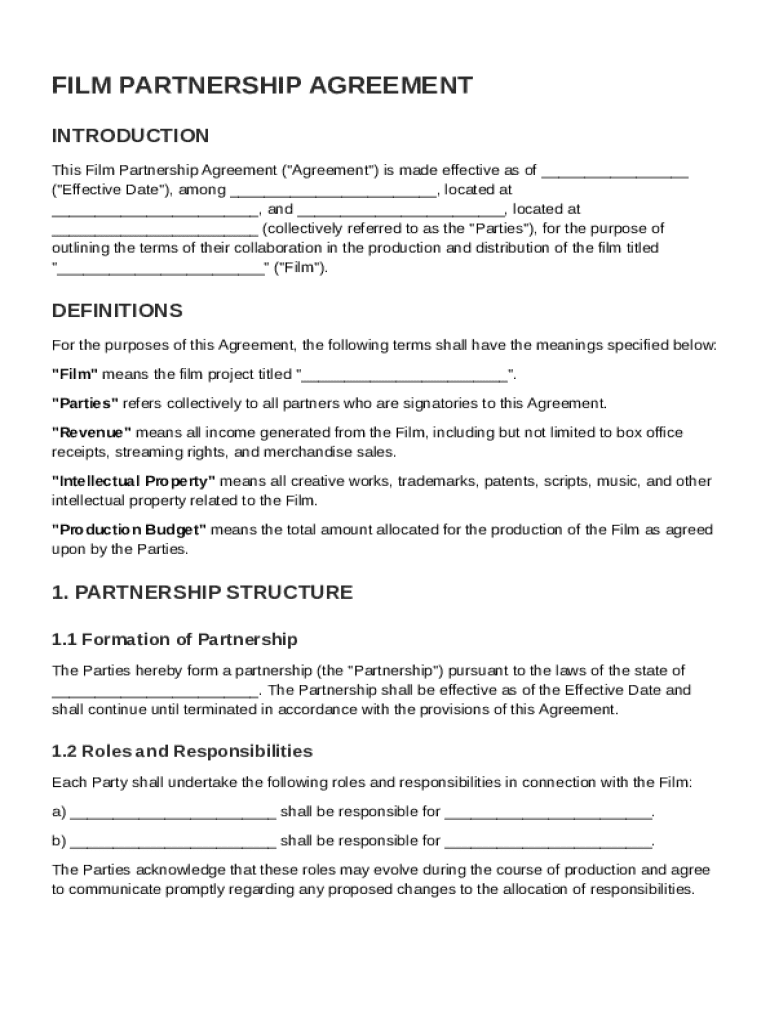







Definition and Meaning of a Film Partnership Agreement Template
A Film Partnership Agreement Template serves as a foundational document that sets out the terms of collaboration between multiple parties involved in the production and distribution of a film. This legal framework defines key elements such as partnership roles, financial contributions, revenue sharing, intellectual property rights, decision-making processes, and confidentiality obligations. The template ensures that all parties are aware of their responsibilities and protects their respective interests, fostering a climate of transparency and equitable distribution of profits. By formalizing these details, the agreement seeks to minimize potential conflicts and misunderstandings during the filmmaking process.
How to Use the Film Partnership Agreement Template
Using a Film Partnership Agreement Template effectively requires a clear understanding of each section included in the document. Start by reviewing the template thoroughly to comprehend the standard clauses and their significance. Identify areas where specific information related to your project, such as financial contributions and revenue sharing percentages, needs to be input. Users should customize fields to fit the unique aspects of their film production, ensuring that all stakeholders’ roles and responsibilities are accurately reflected. Additionally, consult with legal professionals to ensure compliance with industry standards and legal requirements, making necessary adjustments as advised.
Customizing Sections
- Partnership Details: Provide full names and contact information for all partners involved.
- Financial Contributions: Clearly state the financial inputs each party commits to the production.
- Revenue Sharing: Define how profits will be divided among partners.
- Roles and Responsibilities: Assign specific tasks and decision-making powers to each partner, tailored to their expertise.
Steps to Complete the Film Partnership Agreement Template
Completing a Film Partnership Agreement Template involves several critical steps to ensure accuracy and legal compliance.
- Collect Required Information: Gather all necessary details, including partner names, contact information, and financial commitments.
- Review Template Sections: Carefully read each section of the template to ensure understanding.
- Consult Legal Counsel: Seek professional legal advice to ensure all legal criteria are adequately addressed.
- Input Specific Data: Customize the template by filling in specific data regarding financial splits, roles, and obligations.
- Review and Finalize: Check the document thoroughly for accuracy and completeness before final signatures.
- Signature and Agreement: Ensure all relevant parties sign the agreement to make it legally binding.
Key Elements of the Film Partnership Agreement Template
The Film Partnership Agreement Template contains several key elements crucial for establishing a solid legal foundation for film production collaborations.
- Financial Contributions and Revenue Sharing: Outlines the monetary input and profit distribution arrangements.
- Decision-making Structures: Specifies how decisions are to be made and the extent of influence each partner holds.
- Intellectual Property Rights: Clarifies ownership rights concerning the film’s intellectual property, ensuring creative works are protected.
- Confidentiality Agreements: Enforces confidentiality regarding sensitive project details.
- Dispute Resolution Mechanisms: Provides a structured approach to resolving disagreements that may arise.
Legal Use of the Film Partnership Agreement Template
The legal use of a Film Partnership Agreement Template is designed to ensure that collaborations among film production partners operate within a clear legal framework. The document adheres to regulatory standards governing partnerships and film production, providing a legally enforceable structure. It’s advisable to consult legal experts to tailor the template in compliance with both federal and state-specific laws. This ensures that the agreement is not only comprehensive but also legally binding and enforceable in court should disputes occur.
Who Typically Uses the Film Partnership Agreement Template
The Film Partnership Agreement Template is most commonly used by producers, directors, investors, and other key stakeholders involved in the creation of a film. It caters to both independent filmmakers and larger production companies seeking to streamline collaboration procedures. The template is ideal for partnerships spanning a diverse range of film genres and production scales, accommodating varying numbers and types of partners. Each party involved in the film project benefits from the document’s legal clarity on roles, financial expectations, and rights.


Important Terms Related to Film Partnership Agreement Template
Understanding the specific terminology in a Film Partnership Agreement Template is essential to grasp its full implications.
- Partnership Roles: Definitions and distinctions of duties among partners.
- Intellectual Property: Rights concerning original content and film materials.
- Revenue Sharing: The division of profits derived from the film.
- Confidentiality Obligations: Requirements to safeguard sensitive information.
- Termination Conditions: Circumstances under which the partnership can be dissolved.
Examples of Using the Film Partnership Agreement Template
There are numerous ways the Film Partnership Agreement Template can be applied in real-world scenarios, providing clarity and structure to the filmmaking process.
- Independent Film Projects: An indie filmmaker partners with a scriptwriter and actor, using the template to outline contributions and share profits.
- Documentary Productions: Producers partner with sponsors who provide funding, detailing the financial stakes and intellectual property rights.
- International Collaborations: A U.S.-based production company teams up with foreign investors requiring explicit clauses to handle cross-border production complexities.
Each example underscores the template's utility in ensuring all parties have a mutual understanding and agreement of their roles and expectations, crucial for the successful completion of a film project.




