
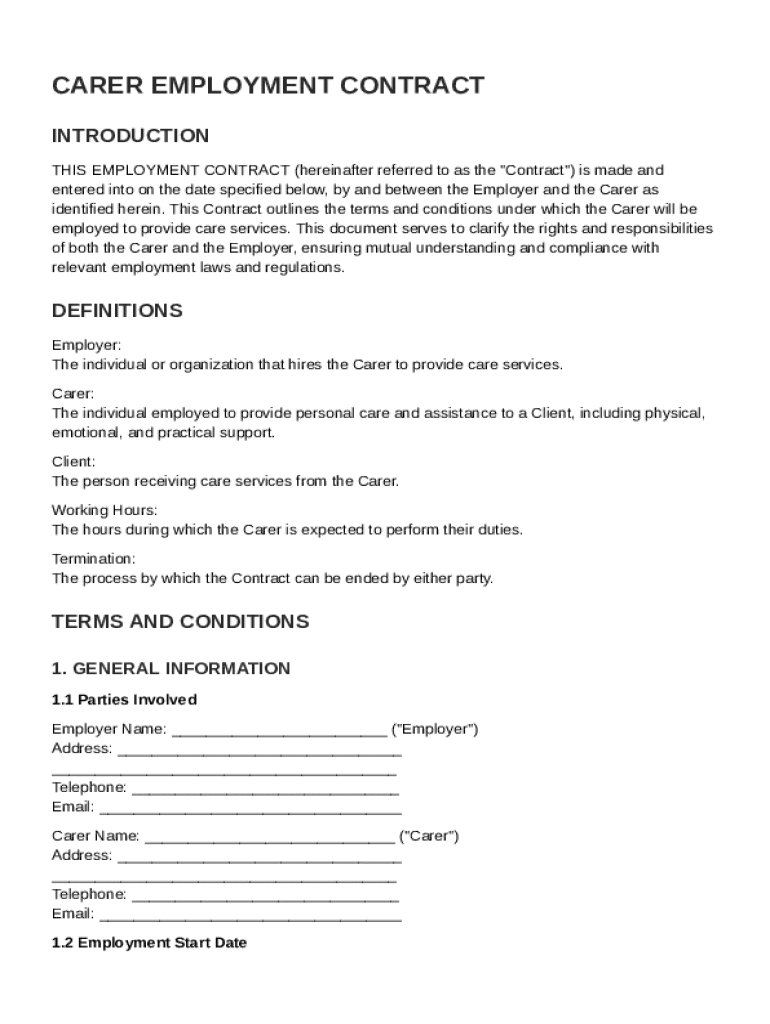







Key Elements of the Carer Employment Contract Template
The Carer Employment Contract Template is a foundational document that sets out the essential terms and conditions of employment for carers. It provides a structured framework that includes:
-
Definitions of Key Roles: Clearly outlines the responsibilities and duties of both the employer and the carer, ensuring mutual understanding of each party's obligations.
-
Compensation Details: Specifies the salary, benefits, and compensation structure, including any overtime pay or bonuses, creating transparency in financial arrangements.
-
Working Hours: Establishes standard working hours and outlines conditions for overtime, ensuring clarity on scheduling.
-
Code of Conduct: Details the expected behavior and professional standards for carers, promoting a respectful and safe work environment.
-
Performance Reviews: Describes the process and frequency of performance evaluations, which helps in maintaining high standards of care.
-
Termination Procedures: Provides guidelines for contract termination, including notice periods and conditions under which termination may occur.
Steps to Complete the Carer Employment Contract Template
Completing the Carer Employment Contract Template is a straightforward process. Here’s how you can systematically fill out the form:
-
Gather Necessary Information: Collect personal details of the carer and employer, including names, addresses, and contact information.
-
Define Job Responsibilities: Clearly state the specific duties and responsibilities of the carer based on the needs of the employer.
-
Outline Compensation and Benefits: Detail the agreed salary, payment frequency, and any additional benefits like health insurance or paid leave.
-
Specify Working Conditions: Outline standard working hours, days off, and procedures for requesting time off or handling emergencies.
-
Establish Conduct and Performance Standards: Incorporate expectations concerning behavior, dress code, and performance measurement criteria.
-
Draft Termination Terms: Include provisions for voluntary or involuntary termination, including notice periods.
Who Typically Uses the Carer Employment Contract Template
This template is primarily used by:
-
Private individuals and families: Hiring domestic carers for personal use, such as elder care, child care, or special needs care.
-
Home care agencies: Formalizing employment terms with caregivers to ensure compliance with legal and professional standards.
-
Non-profit organizations: Offering community care services that require standardized employment contracts for their caregiving staff.
-
Hospitals and assisted living facilities: Employing private carers to supplement in-house staff.


Legal Use of the Carer Employment Contract Template
The Carer Employment Contract Template ensures legal compliance with employment laws by:
-
Aligning with federal and state labor laws: Covers aspects like minimum wage, overtime, and non-discriminatory practices.
-
Establishing clear terms: Reduces misunderstandings and legal disputes by providing a written agreement of employment terms.
-
Facilitating dispute resolution: Includes clauses that outline procedures for handling grievances or disagreements between the parties involved.
-
Governing Law Clause: Identifies the jurisdiction under which disputes will be resolved, typically the state where care is provided.
Important Terms Related to the Carer Employment Contract Template
Understanding specific terminology is crucial for interpreting and filling out the contract accurately:
-
"Employer": Refers to the person or organization hiring the carer.
-
"Employee/Carer": The individual providing care services under the employment terms specified in the contract.
-
"Compensation": Describes the total remuneration package, including salary, benefits, and other financial rewards.
-
"Notice Period": The time frame required by either party to end the employment contract, usually stipulated in weeks.
-
"Confidentiality": A clause ensuring the protection of sensitive information about the client and their family.
State-Specific Rules for the Carer Employment Contract Template
While the template provides a general framework, specific state laws may influence details:
-
Minimum Wage and Overtime Laws: Vary from state to state, affecting payment terms.
-
Employment Classification: Determines whether the carer is an independent contractor or an employee, impacting tax responsibilities.
-
Leave Entitlements: Different states may have specific regulations regarding paid sick leave or family leave that need to be included.
-
Background Checks: Some states require background checks for carers, which should be disclosed in the contract.
Examples of Using the Carer Employment Contract Template
Real-world scenarios illustrate the flexibility and utility of the template:
-
Family Hiring a Live-In Nanny: A New York family uses the template to establish terms for a live-in caregiver, including accommodation details and privacy expectations.
-
Senior Citizen Needing Home Assistance: A Californian elderly person’s family uses the contract to formalize the arrangement with a daytime carer, specifying duties such as meal preparation and medication reminders.
-
Disabled Individual’s Care Team: A disabled person in Texas creates a structured agreement with multiple carers, ensuring consistency in care standards across different shifts.
Versions or Alternatives to the Carer Employment Contract Template
Several alternatives exist if additional customization or different formats are needed:
-
Custom Legal Contracts: Tailored by legal professionals to address specific needs beyond the standard template’s scope.
-
Industry-Specific Templates: Specialized contracts designed for particular types of care, such as pediatric or geriatric care.
-
Digital Contract Tools: Platforms like DocHub offer interactive templates that can be modified and signed electronically, offering convenience and flexibility.
This comprehensive exploration of the Carer Employment Contract Template aims to provide a thorough understanding of its components, utility, and relevance in various caregiving scenarios.


