






Definition & Meaning
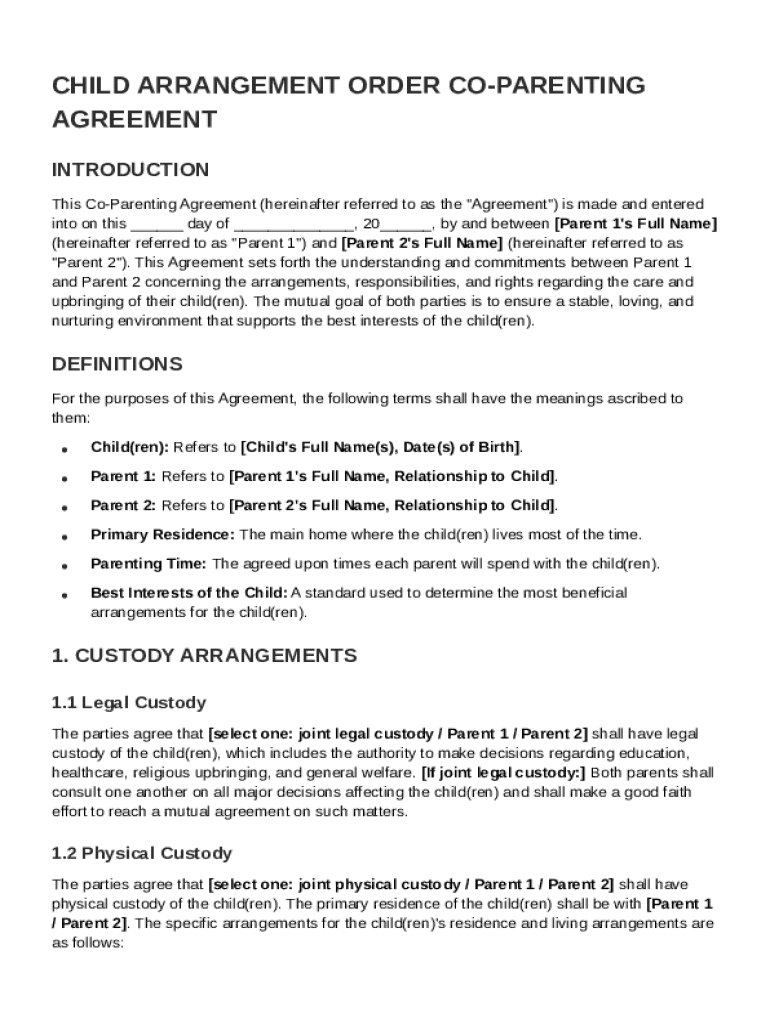
A Child Arrangement Order Co-Parenting Agreement Template is a structured document designed to outline the parenting responsibilities and arrangements between two parents. It establishes the legal and physical custody agreements for children, ensuring that both parents have a clear understanding of their roles in the upbringing and care of their child. This type of agreement serves as a foundation for maintaining a stable and nurturing environment, promoting effective communication and cooperation between the parents.
How to Use the Child Arrangement Order Co-Parenting Agreement Template
-
Understand the Provisions: Familiarize yourself with all sections of the template to ensure you comprehend each clause, including custody arrangements, visitation schedules, and communication protocols.
-
Customize the Agreement: Adapt the template to fit your specific needs by inserting relevant details about your family situation, such as your child's special needs or any unique family dynamics.
-
Seek Legal Advice: It may be beneficial to consult with a family law attorney to ensure the agreement complies with state laws and meets your family's needs.
-
Sign and Store: Once both parents agree on the terms, sign the document to make it legally binding. Store the signed agreement in a safe and accessible location for future reference.
Steps to Complete the Child Arrangement Order Co-Parenting Agreement Template
-
Input Basic Information: Start by entering the names, addresses, and contact details of both parents involved in the co-parenting agreement.
-
Define Custody Arrangements: Clearly outline the physical and legal custody arrangements. Specify which parent the child will live with and how decisions regarding their welfare will be made.
-
Establish Visitation Schedules: Draft a parenting time schedule encompassing weekdays, weekends, holidays, and vacations, ensuring equitable time distribution between parents.
-
Detail Child Support: Include information regarding any financial support, indicating the amount, payment method, and frequency.
-
Set Communication Protocols: Define how and when parents will communicate about the child, whether through phone calls, emails, or a specific co-parenting app.
-
Include Modification Terms: Identify conditions under which the agreement can be modified and the process for making any changes.
-
Final Review and Signatures: After completing the document, both parents should review it thoroughly before signing. It is advisable to have it notarized for added legal validity.
Who Typically Uses the Child Arrangement Order Co-Parenting Agreement Template
This template is commonly used by:
- Divorced or Separated Parents: To delineate shared parenting responsibilities.
- Unmarried Parents: Seeking to formalize child-rearing commitments.
- Legal Guardians: Assisting in drafting agreements on behalf of parents.
- Mediators or Family Law Attorneys: Facilitating fair and balanced parental arrangements.


Key Elements of the Child Arrangement Order Co-Parenting Agreement Template
-
Definition of Terms: Clarifies all legal terminologies used within the agreement to ensure mutual understanding.
-
Custody and Parenting Time: Details how custody is divided and outlines the specific schedule for when each parent will have the child.
-
Decision-Making Powers: Allocates responsibility over significant decisions in the child's life, such as education and health care.
-
Financial Support: Specifies child support obligations, including the amount, frequency, and method of payment.
-
Dispute Resolution: Provides methods for resolving disagreements, such as mediation, counseling, or court intervention.
Legal Use of the Child Arrangement Order Co-Parenting Agreement Template
The template must adhere to state laws, ensuring its enforceability in legal settings. It should reflect the best interests of the child and be designed to minimize conflicts and facilitate a stable co-parenting environment. Legal validity hinges on mutual agreement, clear language, and in some jurisdictions, judicial approval.
State-Specific Rules for the Child Arrangement Order Co-Parenting Agreement Template
Family laws differ significantly by state, affecting:
- Child Support Calculations: Varies based on state-specific formulas and income definitions.
- Custody Presumptions: Some states have a bias towards joint custody unless evidence suggests otherwise.
- Modification Procedures: Rules on how and when an agreement can be legally amended.
- Enforcement Mechanisms: State-specific processes for managing violations or disputes.
Examples of Using the Child Arrangement Order Co-Parenting Agreement Template
- Scenario 1: Parents living in different states create a custom visitation schedule to accommodate travel needs.
- Scenario 2: Families with children with special needs incorporate specific educational and medical care responsibilities.
- Scenario 3: Recently divorced parents utilize the agreement to establish initial child custody and support arrangements while transitioning to coparenting.