






Definition & Meaning
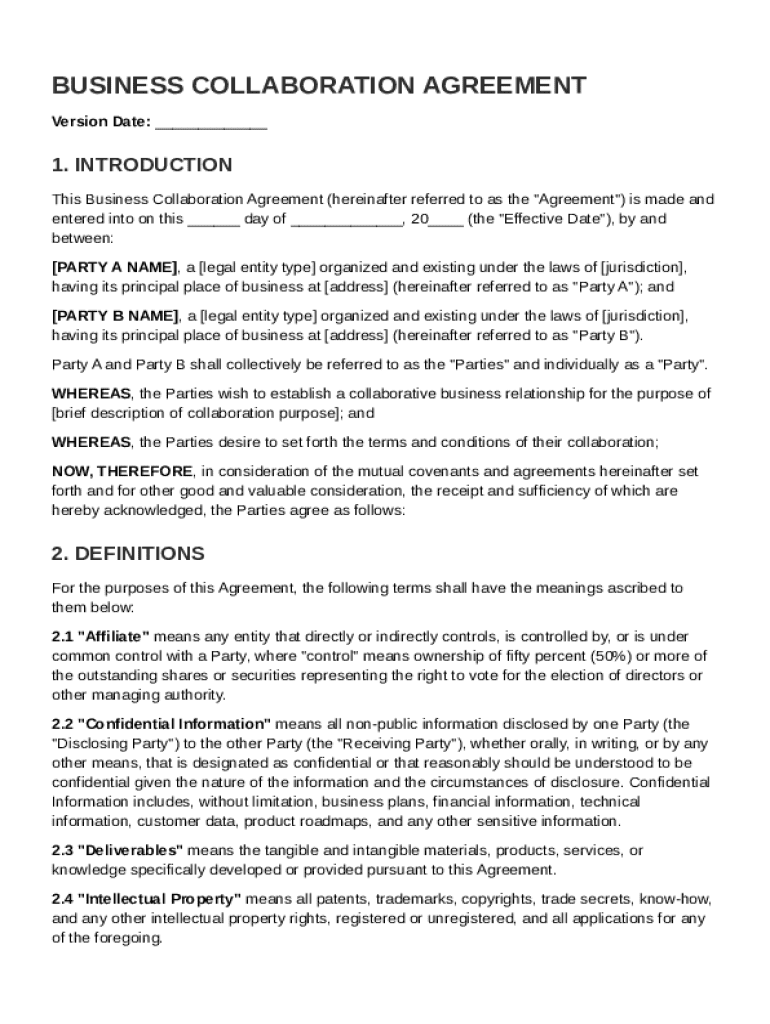
The Business Collaboration Agreement Template serves as a foundational document that outlines the partnership terms between two entities, often referred to as Party A and Party B. This document delineates the purpose of the collaboration, providing a structured framework to facilitate joint efforts. By defining the expectations and obligations of each party, it ensures a clear understanding of responsibilities, deliverables, and other critical aspects, thereby promoting a harmonious and productive relationship. This legal template is essential for parties looking to safeguard their interests while working toward mutual goals.
How to Use the Business Collaboration Agreement Template
To make the most of the Business Collaboration Agreement Template, begin by identifying the parties involved and clearly stating the objectives of your collaboration. Familiarize yourself with the sections dedicated to defining responsibilities and deliverables. Consider practical scenarios where the agreement would be applicable, such as joint product development or marketing campaigns. By tailoring the template to fit your specific situation, you ensure comprehensive coverage and relevance. Remember to consult a legal professional to confirm compliance with applicable laws.
Key Steps in Customization:
- Identify and detail the roles and responsibilities of each party.
- Define the scope and objectives of the collaboration.
- Draft sections dealing with financial arrangements and payment structures.
- Specify confidentiality obligations and intellectual property rights.
- Establish dispute resolution mechanisms and governance structures.
Key Elements of the Business Collaboration Agreement Template
Several vital components form the backbone of this agreement, each crucial for operational clarity and legal protection. Frequently included elements are:
- Responsibilities and deliverables: Detailed descriptions of what each party is expected to provide.
- Financial arrangements: Payment mechanisms, funding obligations, and cost-sharing agreements.
- Confidentiality obligations: Provisions to protect sensitive information and trade secrets.
- Intellectual property rights: Clauses specifying ownership and usage rights for any newly developed products or IP.
- Dispute resolution: Defined processes for handling conflicts, including mediation or arbitration procedures.
Practical Scenarios:
- Collaborative product development initiatives.
- Joint service offerings or co-branded marketing efforts.
Steps to Complete the Business Collaboration Agreement Template
Successfully completing the Business Collaboration Agreement Template involves several clear steps, ensuring that no critical detail is overlooked.
- Detail Parties Involved: Provide full legal names and contact details for both parties.
- Objective Description: Clearly describe the collaboration's purpose and goals.
- Define Responsibilities: Specify each party's roles and expected deliverables.
- Outline Financials: Detail any financial commitments or compensation structures.
- Define Terms: Set confidentiality, intellectual property, and amendment clauses.
- Address Legalities: Include dispute resolution methods and applicable jurisdiction.
Considerations:
- Ensure mutual understanding of all terms.
- Involve legal counsel to validate the agreement's enforceability.
Important Terms Related to Business Collaboration Agreement Template
Understanding terminology often used in business collaboration agreements is crucial for effective communication and execution. Commonly used terms include:
- Partnership: A formal arrangement by two or more parties to manage and operate a business.
- Liability: Legal responsibility for damages or losses.
- Jurisdiction: The legal authority under which the agreement is governed.
- Force Majeure: Provisions for unexpected events preventing contract fulfillment.
- Amendment Clause: Guidelines on how the agreement can be altered.
Including a glossary within the template can aid in clarifying complex legal language.
Legal Use of the Business Collaboration Agreement Template
This template is used to establish legally binding agreements that clarify the relationship between parties and outline each party's obligations. It aims to mitigate risks by defining liability limits and providing mechanisms for conflict resolution. By ensuring all terms are explicitly stated, the document protects both parties from potential legal disputes.
Legal Considerations:
- Adhere to contract laws specific to the jurisdiction governing the agreement.
- Ensure the agreement aligns with any relevant industry-specific regulations.
Who Typically Uses the Business Collaboration Agreement Template
The template is a versatile tool utilized by various business entities for formalizing partnerships and joint ventures. Typical users include:
- Startups and Entrepreneurs: Engaging in joint product launches or innovations.
- Corporations: Partnering on international projects or research initiatives.
- Nonprofits: Collaborating with partners on community-focused programs.
- Small Businesses: Exploring co-marketing efforts or shared distribution channels.


Business Types That Benefit:
- Technology firms leveraging co-development.
- Retail businesses engaging in co-branding.
State-Specific Rules for the Business Collaboration Agreement Template
While the template provides a robust framework, customization to comply with state-specific regulations is essential. Variations in contract law can affect elements like enforceability and required disclosures.
State Considerations:
- Consider reviewing state contract laws for compliance.
- Verify any state-specific provisions regarding confidentiality or dispute resolution.
- Adapt provisions to accommodate regional business practices or legal requirements.
Examples:
- California: May require specific disclosures relating to intellectual property rights.
- New York: Might demand adherence to particular confidentiality norms during business collaborations.
Building a comprehensive understanding of these requirements ensures that the agreement remains enforceable and effective.