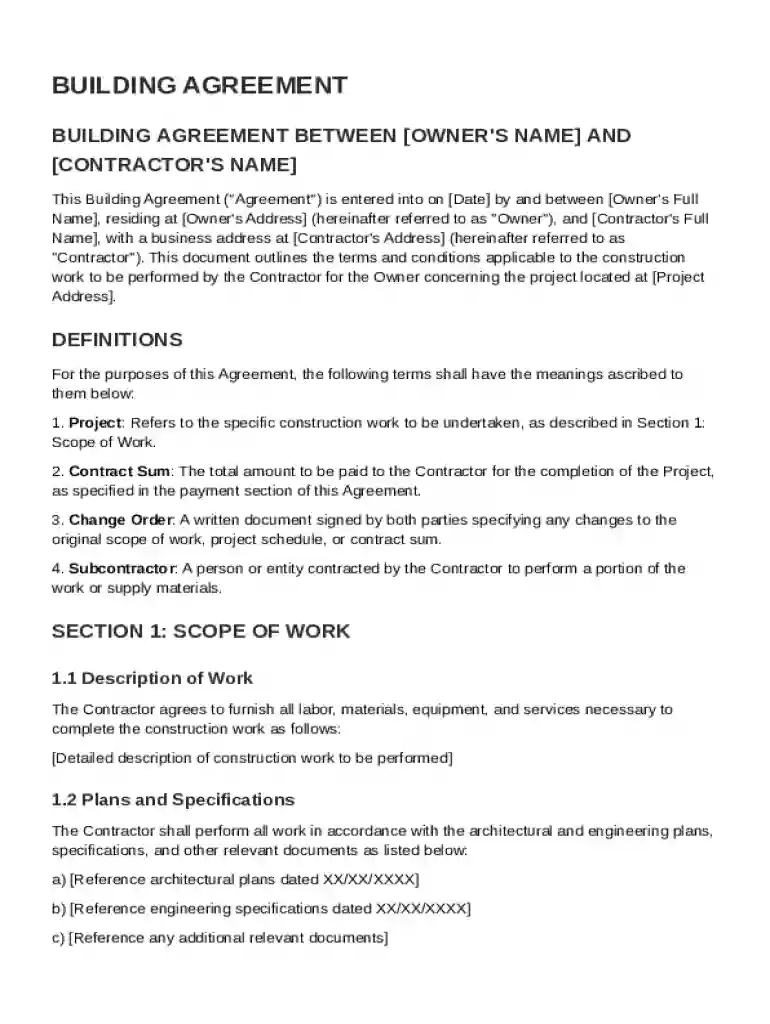
Building Agreement Template 2026

Get Form
Building Agreement Template Preview on Page 1

Here's how it works

01. Edit your form online
Type text, add images, blackout confidential details, add comments, highlights and more.

02. Sign it in a few clicks
Draw your signature, type it, upload its image, or use your mobile device as a signature pad.

03. Share your form with others
Send it via email, link, or fax. You can also download it, export it or print it out.

Definition and Purpose of a Building Agreement Template

A Building Agreement Template serves as a foundational document outlining the terms and conditions agreed upon by an Owner and a Contractor for a construction project. The purpose of this template is to ensure clarity and mutual understanding between both parties, covering aspects such as the scope of work, payment terms, project timelines, and specific responsibilities. This template helps streamline the negotiation process by providing a structured format in which all necessary details are systematically covered, offering a reference point for handling disputes and ensuring compliance with legal requirements.

Key Features and Components

  • Scope of Work: Clearly defines the tasks and responsibilities of the Contractor, including any specified materials, labor, and services required to complete the project.
  • Contract Sum: Outlines the agreed financial compensation for the completion of the project, including any stages or milestones for partial payments.
  • Project Timeline: Sets forth the expected start and end dates of the project, along with any crucial milestones and schedules for periodic reviews.
  • Change Order Process: Describes procedures for handling changes to the original scope of work, including cost adjustments and approval requirements.

Legal Considerations and Compliance

Contractual Obligations

Building Agreement Templates are legally binding documents that outline the rights and duties of each party involved. The agreement must comply with local, state, and federal laws to ensure its enforceability and to protect all parties’ interests. This includes adherence to construction codes, safety regulations, and environmental laws.

Warranties and Liabilities

The template typically includes warranty provisions that address the quality of materials used and workmanship involved. The Contractor may provide assurances about the durability and standards of their work, while both parties might agree on liability terms in case of unforeseen issues or defects that arise following project completion.

How to Use the Building Agreement Template

Preparing the Document

  1. Collect Initial Information: Gather necessary details about the Owner, Contractor, and specifics of the construction project.
  2. Review Standard Clauses: Familiarize yourself with the template’s pre-set clauses to understand which sections need adjustments based on your project's requirements.
  3. Customize Specific Sections: Modify sections such as project scope, payment terms, and timelines, ensuring they are tailored to the particular needs of your project.
  • Consult Legal Counsel: Have a legal professional review the document to ensure all clauses are comprehensive and enforceable.

Execution and Signatures

Upon finalization, execute the agreement by obtaining signatures from both parties. Signatures can be captured electronically through platforms like DocHub for a streamlined process and record-keeping.

Key Elements of the Building Agreement Template

Detailed Description of Work

Outlines the exact nature of the construction work to be performed, the standards to be maintained, and the responsibilities of each party.

Payment and Financial Management

Covers not only the contract sum but also details the schedule of payments, any deposits required, and the method of payment (e.g., wire transfer, check).

Dispute Resolution Methods

Specifies the process for resolving disputes, which might include mediation or arbitration options, and the jurisdiction under which any legal proceedings would be conducted.

Practical Examples of Using a Building Agreement Template

Case Study: Residential Construction

An owner wanting to build a custom home may use the Building Agreement Template to outline the specific design, materials, and completion timeline. This ensures both parties agree on the expectations and provides a roadmap for addressing any changes during the construction process.

Commercial Projects

For a commercial building, the template can set forth the use of specific, under-contract suppliers for building materials. It can also stipulate performance bonds and penalties for delayed completion, which are common provisions in large-scale projects.

Steps to Complete the Building Agreement Template

  1. Fill in Basic Information: Include party names, addresses, and roles.
  2. Define Project Scope: Clearly articulate tasks, materials, and deliverables.
  3. Set Financial Terms: Specify payment schedules and total cost.
  4. Establish Timeline: Provide detailed scheduling including start, completion, and review dates.
  5. Outline Responsibilities: Clarify duties for both Owner and Contractor, including insurance and permits.
  6. Include Legal Provisions: Write out terms for changes, cancellation, and disputes.
  7. Review and Sign: Finalize the document, ensuring both parties have reviewed everything.

Important Terms Related to the Building Agreement Template

  • Subcontractor: A party hired by the primary Contractor to perform specific tasks as part of the larger project.
  • Force Majeure: Clauses addressing acts of God or unavoidable circumstances that may delay project completion without penalty.
  • Retainage: A portion of the contract sum withheld until satisfactory project completion and resolution of any issues.

Approval and Execution of the Building Agreement Template

Finalization Process

Once the template is completed and reviewed by both parties, it should be signed, often in the presence of witnesses or a notary, for added legal validity. Each party should receive a copy of the signed agreement for their records, ensuring transparency and accountability.

Use of Electronic Signatures

Electronic signature platforms such as DocHub provide a convenient, legally recognized method for completing this step, enabling efficient processing without the need for physical document handling.

be ready to get more

Complete this form in 5 minutes or less

Get form

Got questions?

We have answers to the most popular questions from our customers. If you can't find an answer to your question, please contact us.
Contact us
Elements of a construction contract Name of contractor and contact information. Name of homeowner and contact information. Describe property in legal terms. List attachments to the contract. The cost. Failure of homeowner to obtain financing. Description of the work and the completion date. Right to stop the project.
Write the contract in six steps Start with a contract template. Open with the basic information. Describe in detail what you have agreed to. Describe how the contract will end. Say which laws apply and how disputes will be resolved. Include space for signatures.
To that end, before you sign anything and start working, make sure your contract has these 5 key elements. A Detailed Scope of Work. Project Cost and Payment Schedule. Construction Timeline. Change Order Process. Project Issues and Dispute Resolution.
A construction contract can be drafted as per the agreed terms which mention Construction cost, Construction materials used, Basic Cost of materials, Project completion time frames, etc.
An agreement between an owner or lessee and a building contractor, setting forth terms relative to the construction of a proposed structure.

Security and compliance

At DocHub, your data security is our priority. We follow HIPAA, SOC2, GDPR, and other standards, so you can work on your documents with confidence.

Learn more
ccpa2
pci-dss
gdpr-compliance
hipaa
soc-compliance

People also ask

A contract should contain everything agreed upon by you and your licensed contractor. It should detail the work, price, when payments will be made, who gets the necessary building permits, and when the job will be finished. The contract also must identify the contractor, and give their address and license number.
What Are The Stages Of A Construction Project? Step 1: Design. The design phase is a critical stage in any construction project, laying the foundation for the entire build. Step 2: Pre-Construction. Step 3: Procurement. Step 4: Construction. Step 5: Commissioning. Step 6: Owner Occupancy. Step 7: Project Closeout.

Related links