
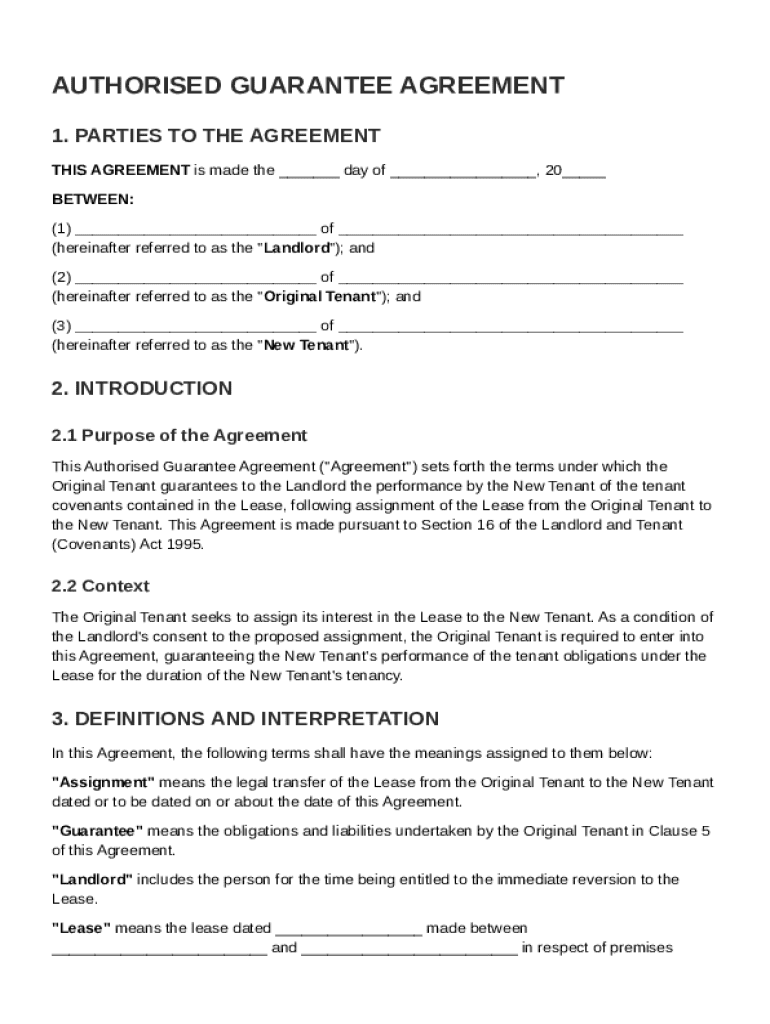







Definition & Meaning
The Authorised Guarantee Agreement (AGA) is a legal document used in real estate transactions, specifically during the assignment of a lease. It serves as a guarantee by the Original Tenant to the Landlord that the New Tenant will fulfill all obligations set forth in the lease agreement. The AGA is invoked when the Original Tenant assigns their lease to another party. This agreement assures that if the New Tenant defaults, the Original Tenant will be liable for the lease's terms, ensuring continuity and security for the Landlord. The AGA typically includes clauses covering indemnity, liability, and performance standards.
Who Typically Uses the Authorised Guarantee Agreement Template
The primary users of the AGA template include landlords, original tenants, and new tenants involved in a lease assignment process. Landlords utilize it to secure their interests and ensure ongoing lease obligations are met, while Original Tenants use it to legally commit to covering any potential defaults by the New Tenant. It is particularly beneficial for property management companies and real estate attorneys who oversee lease assignments and wish to maintain robust contractual agreements. Additionally, real estate investors and commercial property owners frequently use AGAs to minimize risk during tenant transitions.


Key Elements of the Authorised Guarantee Agreement Template
A comprehensive AGA template contains several crucial components to ensure legality and clarity:
- Parties Involved: Identification of the Landlord, Original Tenant, and New Tenant.
- Lease Details: Specifics about the lease being assigned, including duration, rental amounts, and key terms.
- Guarantee Provisions: Clauses that outline the scope of the Original Tenant's guarantee, covering all obligations and liabilities.
- Indemnity Clause: This protects the Landlord against losses resulting from the New Tenant's default.
- Amendment Procedures: Processes for modifying terms within the agreement if necessary.
- Notice Requirements: Protocols for communication between all parties regarding lease matters.
- Governing Law: The state laws by which the agreement will be governed, ensuring legal conformity.
Legal Use of the Authorised Guarantee Agreement Template
The legal use of an AGA template requires adherence to specific guidelines to maintain enforceability. The document must be properly executed, meaning that all parties involved need to sign the agreement in accordance with state law. This often involves notarization or witnessing, depending on local requirements. The AGA should clearly delineate each party's responsibilities, and obligations and any provisions for dispute resolution. Legal advice from an attorney specializing in real estate is recommended to ensure the AGA complies with relevant legal standards and adequately protects the Landlord's interests.
Steps to Complete the Authorised Guarantee Agreement Template
Filling out an AGA template involves several detailed steps:
- Gather Information: Collect all necessary details regarding the lease, including parties involved and lease terms.
- Fill Out Parties Section: Enter the names and contact information of the Landlord, Original Tenant, and New Tenant.
- Detail Lease Terms: Clearly document the specifics of the lease assignment, including any special conditions or exceptions.
- Specify Guarantee Obligations: Outline the extent of the Original Tenant's responsibilities should the New Tenant default.
- Include Indemnity Details: State the terms under which the Original Tenant will indemnify the Landlord.
- Final Review and Legal Validation: Have an attorney review the completed document for accuracy and legal sufficiency.
- Execute the Agreement: All parties sign the document in the presence of a notary or witnesses as required by law.
Important Terms Related to Authorised Guarantee Agreement Template
Several terms are vital for understanding and utilizing an AGA template:
- Assignor: The Original Tenant who transfers the lease rights.
- Assignee: The New Tenant who receives the lease rights.
- Covenants: Legally binding promises within the lease agreement.
- Default: Failure of the New Tenant to meet lease obligations.
- Indemnification: Compensation for loss or damage.
Understanding these terms ensures clarity for all parties involved and supports the proper execution and enforcement of the AGA.
State-Specific Rules for the Authorised Guarantee Agreement Template
Each state in the U.S. may have specific rules affecting the execution and enforcement of an AGA. For example:
- California: Requires AGAs to comply with the state's Civil Code, which covers lease assignments.
- New York: Emphasizes the inclusion of specific performance guarantees.
- Texas: Enforces strict notice requirements for modifications or terminations.
Consulting local regulations and, if necessary, legal professionals knowledgeable in state-specific landlord-tenant law is essential for ensuring the validity of an AGA.
Examples of Using the Authorised Guarantee Agreement Template
Several real-world scenarios highlight the importance of using an AGA:
- Commercial Property Lease Transfer: A retail business sells its operation to a new owner, requiring lease reassignment to include a rental guarantee.
- Corporate Office Space: A corporation relocates but needs to sublet its existing office; the AGA ensures the corporation backs the sublease.
- Residential Lease Assignment: A tenant moving out assigns the lease to another individual, and the landlord requires the AGA to safeguard against tenant turnover uncertainty.
These examples illustrate how AGAs effectively manage risk and ensure compliance in various leasing situations.




