
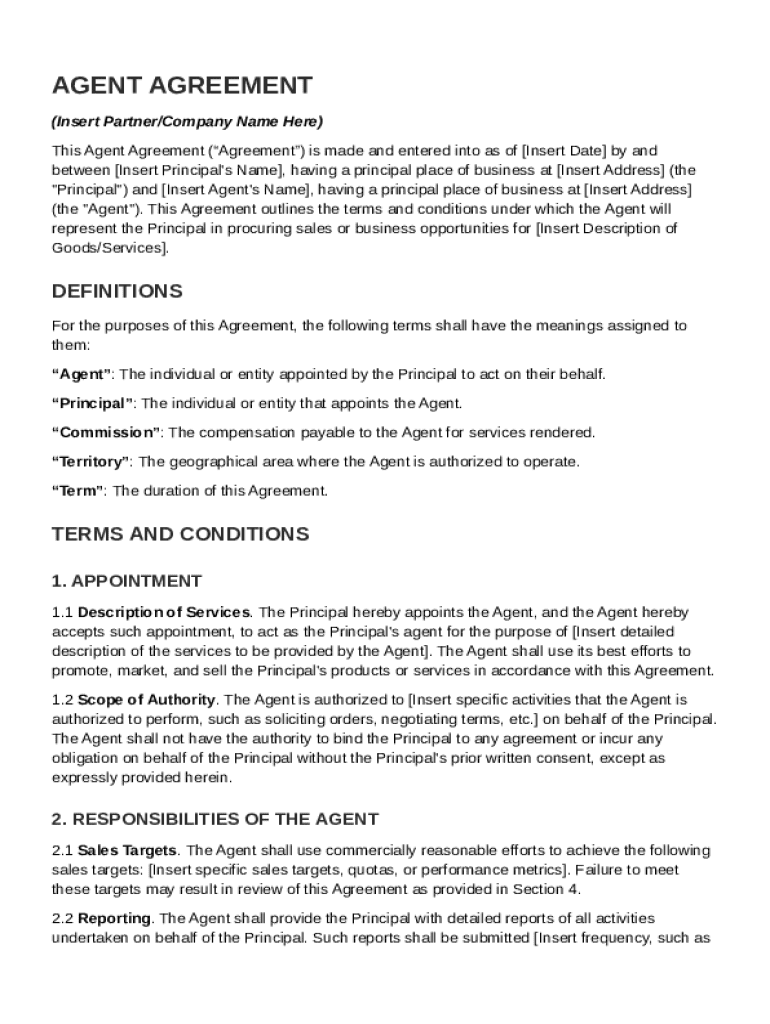







Definition & Meaning of an Agent Agreement Template
An Agent Agreement Template is a foundational document that formalizes the relationship between a Principal and an Agent. The template serves as a framework for outlining the terms and conditions under which an Agent will act on behalf of a Principal to secure sales or business opportunities. By using this template, parties can ensure that they have a mutual understanding of their responsibilities and obligations. This type of agreement typically includes definitions of key terms, roles, responsibilities of both parties, compensation structures, confidentiality obligations, indemnification clauses, and any other miscellaneous provisions necessary to protect interests.
Understanding this template's significance is crucial because it helps in distinguishing the legal relationship as being independent, thereby clearly demarcating roles in professional settings. It is particularly significant in scenarios where collaboration between different organizations or individuals is essential to achieve business objectives.
Key Elements of the Agent Agreement Template
The Agent Agreement Template is structured around several key elements that guide the relationship between the Principal and the Agent. These include:
-
Definitions and Interpretations: To avoid ambiguity, the agreement clarifies the meaning of essential terms such as ‘Principal’, ‘Agent’, and ‘Business Opportunities’. This ensures both parties are on the same page regarding expectations.
-
Scope and Responsibilities: The document details the scope of the Agent's authority and the specific business activities the Agent will undertake. It also outlines the agent's responsibilities, including any limits on their authority to bind the Principal to agreements.
-
Compensation and Payment Terms: This section explains how the Agent will be compensated for their services. It might include commission structures, payment schedules, and any performance incentives.
-
Confidentiality Obligations: To safeguard sensitive information, the agreement usually includes clauses that restrict the Agent from disclosing proprietary information about the Principal or their business.
-
Termination Provisions: Conditions under which the agreement can be terminated by either party are enumerated. This includes notice periods and grounds for termination such as breach of contract or failure to meet performance metrics.
-
Governing Law: Specifies the jurisdiction whose laws will govern the contract, which is important for resolving disputes. This section is important in U.S. contexts given varying state laws.
Steps to Complete the Agent Agreement Template
Completing an Agent Agreement Template involves several procedural steps to ensure comprehensive coverage of all necessary terms:
-
Identify Parties Involved: Start by clearly identifying the Principal and the Agent, including legal names and contact information.
-
Define the Scope of Work: Be explicit about what the Agent is authorized to do and any limitations on their authority.
-
Detail Compensation Arrangements: Clearly specify how and when the Agent will be compensated, including any commission rates or salary.
-
Establish Confidentiality Terms: Outline the expectations concerning confidentiality, specifying what constitutes proprietary information.
-
Outline Performance Metrics: Set benchmarks for performance and criteria by which the Agent’s work will be evaluated.
-
Draft Termination Clauses: Clearly define situations that could lead to contract termination, ensuring both parties understand their exit rights.
-
Include Governing Law: Conclude with stipulations about which state’s laws will apply to the contract, which can assist in mitigating legal disputes later on.
-
Seek Legal Review: Have a legal professional review the agreement for completeness and compliance with local laws.
How to Use the Agent Agreement Template
The Agent Agreement Template can be adapted to various business environments to formalize the relationship between the Principal and the Agent. It serves not only as a protective measure but also as an instrument for ensuring efficiency and clarity:
-
Customizing the Template: Adjust the template to suit specific business needs by adding, removing, or amending clauses as appropriate to the nature of the business relationship.
-
Integrating with Business Processes: Once completed, the agreement should be integrated with broader business processes and actions, such as onboarding or partnership reporting frameworks.
-
Facilitating Business Operations: Use the template to create a structured approach to managing agency relationships, making it easier to track performance and compliance.
-
Documentation and Record Keeping: Maintain the agreement alongside other contractual documents for easy reference in the event of audits or legal queries.
This way, businesses can ensure clarity and efficiency without unnecessary legal challenges or misunderstandings.
State-Specific Rules for the Agent Agreement Template
In the United States, while there are broad principles applicable to agency agreements, individual states may have specific rules or requirements:
-
California: Requires clear language regarding representations and indemnity, often implying explicit consent for modifications.
-
New York: Stresses the importance of written consent for any changes in scope, often focusing on comprehensive disclosure.
-
Texas: Emphasizes detailed compensation documents and often enforces non-compete clauses more strictly.
Understanding these state-specific nuances is critical for businesses operating across multiple jurisdictions to ensure compliance and minimize legal risk.
Examples of Using the Agent Agreement Template
Real-world scenarios elucidate how the Agent Agreement Template is applied in different sectors:
-
Real Estate: An Agent secures property sales for a Principal developer, involving territory and compensation agreements.
-
Sales & Distribution: A technology company uses an Agent to represent its products to potential buyers, detailing commissions and performance metrics.
-
Franchising: A franchise uses an Agent to expand business opportunities, detailing territory rights and responsibilities.
By adapting the template to diverse contexts, businesses streamline negotiation processes and foster transparent relationships.
Legal Use of the Agent Agreement Template
For legality, the form ensures all contractual obligations are explicitly documented. The template supports compliance with the ESIGN Act for legally binding digital signatures, crucial for enforceability in many jurisdictions. Additionally, the template incorporates confidentiality and indemnity clauses, strengthening legal protection.
Addressing these legal uses and protections helps mitigate potential disputes while safeguarding business interests in alignment with U.S.-centric legal standards.
Important Terms Related to the Agent Agreement Template
Understanding associated terms enriches comprehension:
-
Principal: The party delegating authority to the Agent.
-
Agent: The party receiving authority to act on behalf of the Principal.
-
Indemnification: A provision protecting one party from claims or damages incurred by the other party’s actions.
-
Confidentiality: Relates to an obligation to keep specified information secret and secure.
Having clarity on these terms ensures accurate interpretation and execution of the agreement.




