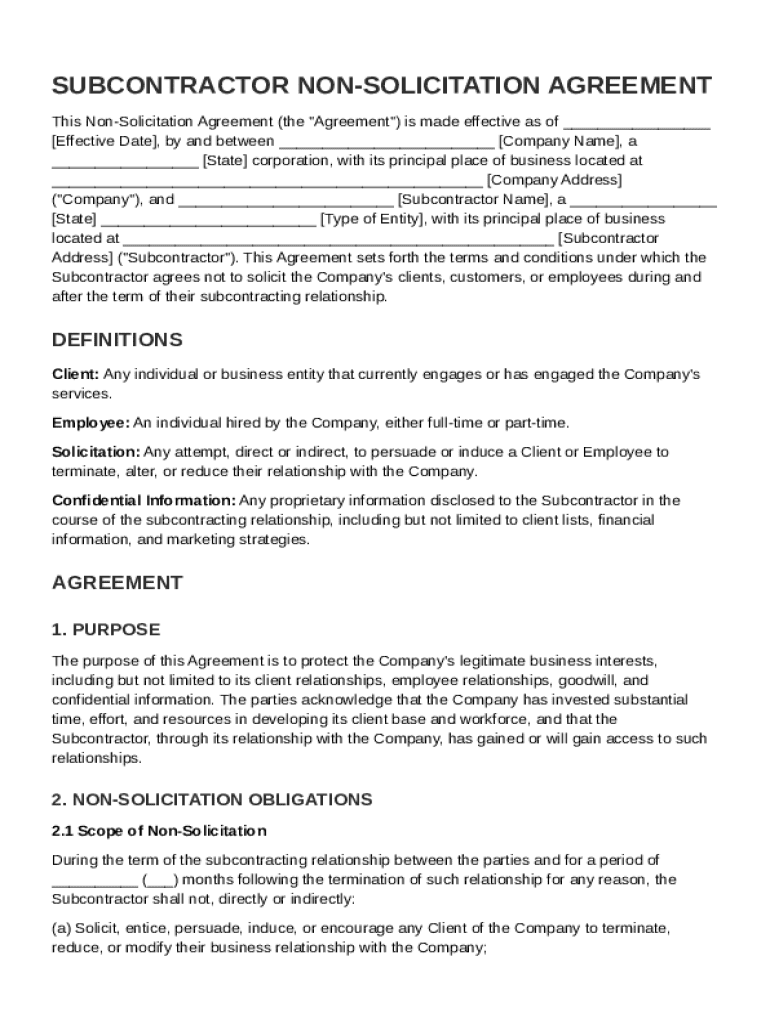







Definition & Meaning
The Subcontractor Non-Solicitation Agreement Template is a legal document that outlines the conditions under which a subcontractor agrees not to solicit the clients, customers, or employees of the hiring company both during and after the term of their subcontracting relationship. The goal is to safeguard the company's business interests and maintain confidentiality.
Key terms defined within the agreement often include:
- Client: Refers to a person or entity with which the company has a contractual or ongoing business relationship.
- Employee: Encompasses any individual employed by the company during the term of the agreement.
- Confidential Information: Refers to proprietary data or sensitive information that is not publicly available and is crucial to the company's operations.
Key Elements of the Subcontractor Non-Solicitation Agreement Template
This template includes essential elements to ensure comprehensive protection for the company's interests:
- Scope of Non-Solicitation: Specifies the extent to which the subcontractor is restricted from contacting the company’s clients, customers, or employees.
- Duration: Defines the time frame during which non-solicitation obligations are enforced, often extending beyond the termination of the subcontractor’s contract.
- Confidentiality Clause: Mandates the subcontractor to maintain the confidentiality of any sensitive information acquired during the relationship.
- Breach Remedies: Outlines the consequences for violating the agreement, which may include injunctive relief and monetary damages.
How to Use the Subcontractor Non-Solicitation Agreement Template
To effectively utilize the template, follow these steps:
- Draft the Agreement: Begin by customizing the template to fit the specifics of the business relationship and the subcontractor's role.
- Define Key Parties: Clearly identify the company and the subcontractor involved, along with any subsidiaries or affiliates that fall under the protection of the agreement.
- Customize the Terms: Adjust the duration, scope, and any specific clauses according to the company’s requirements and in compliance with relevant state laws.
- Legal Review: It is prudent to have a legal professional review the document to ensure compliance with applicable laws and to enhance enforceability.
- Sign Off: Obtain signatures from both the company and the subcontractor, ensuring that each party receives a copy of the signed agreement.
Legal Use of the Subcontractor Non-Solicitation Agreement Template
The legal enforceability of this agreement hinges on:
- Consideration: Both parties must benefit from the agreement, such as through financial compensation or continued opportunity for work.
- Reasonableness: Terms and restrictions must be reasonable concerning geographic scope, duration, and specific activities prohibited.
- State Compliance: Adhering to local laws where the company and subcontractor operate is crucial for the enforceability of the agreement.
Who Typically Uses the Subcontractor Non-Solicitation Agreement Template
This agreement template is commonly used by businesses that rely on subcontractors to perform specific tasks or projects. It is valuable across multiple sectors, including:
- Construction Firms: Protecting client lists and ongoing projects.
- Consulting Businesses: Safeguarding proprietary methodologies and client relationships.
- IT and Software Companies: Preventing the poaching of technical talent and clients.


Important Terms Related to the Subcontractor Non-Solicitation Agreement Template
Understanding these terms is crucial for effective use of the template:
- Governing Law: The jurisdiction whose laws will be applied to interpret and enforce the agreement.
- Severability: A clause ensuring that if one part of the agreement is invalid, the rest remains enforceable.
- Entire Agreement: Acknowledgement that this document represents the complete agreement between parties and supersedes prior communications or agreements.
Steps to Complete the Subcontractor Non-Solicitation Agreement Template
Completing the template involves several precise steps:
- Gather Basic Information: Collect details about the company and subcontractor for initial sections.
- Input Specific Details: Input the exact terms of restrictions, including who, what, and the time frame.
- Include Legal Provisions: Add necessary legal language that aligns with state laws and business needs.
- Review and Revise: Carefully examine the document for any errors or areas needing clarification.
- Finalize the Document: Secure signatures from all involved parties and distribute executed copies.
State-Specific Rules for the Subcontractor Non-Solicitation Agreement Template
State laws may influence the formation and enforceability of such agreements:
- California: Generally restricts non-solicitation agreements and favors employee mobility.
- New York: Allows reasonable non-solicitation agreements if they protect legitimate business interests.
- Texas: Requires that non-solicitation agreements be ancillary to or part of an otherwise enforceable agreement.
Understanding these nuances ensures that the agreement remains valid and enforceable across state lines.