






Definition and Meaning
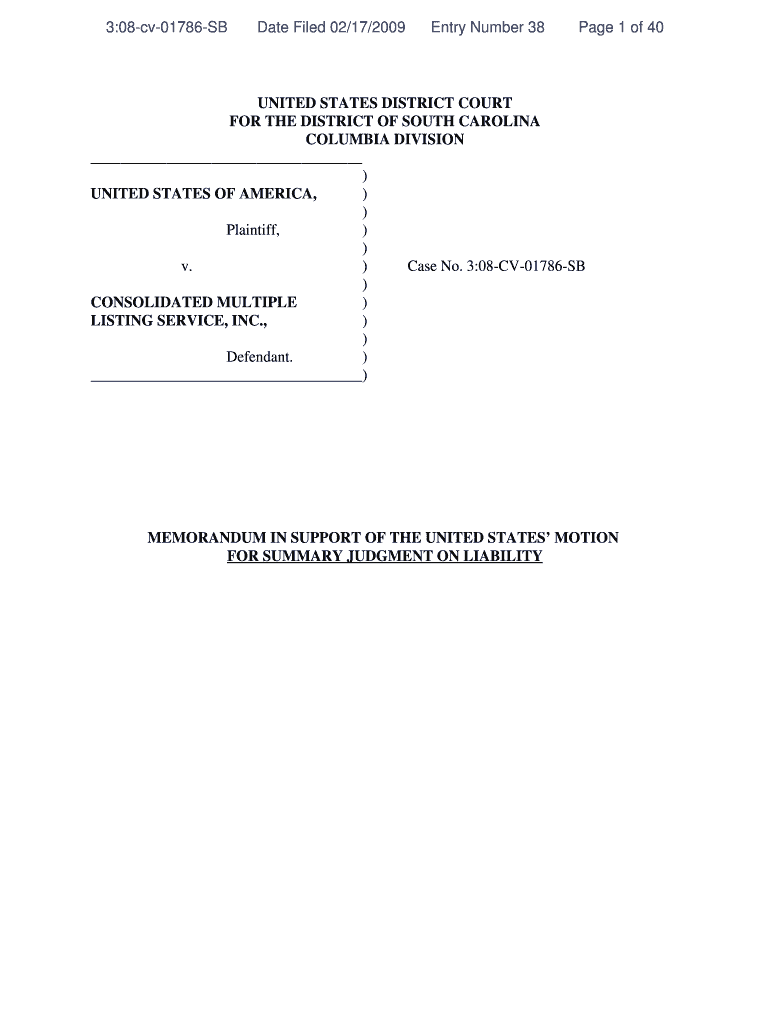
A "Memorandum in Support of the United States' Motion for Summary Judgment on Liability" is a legal document filed by the U.S. government. Its purpose is to support a motion for summary judgment, requesting that the court rule in favor of the government on the issue of liability without proceeding to a full trial. This document is critical in cases where the United States believes that the opposing party's actions have violated specific laws, such as antitrust legislation. For instance, in cases involving the violation of Section 1 of the Sherman Act, the memorandum outlines the legal and factual basis for the government's arguments, aiming to expedite a favorable court decision by demonstrating that there is no genuine dispute of material fact and that the government is entitled to judgment as a matter of law.
How to Use the Memorandum
The memorandum is utilized by legal practitioners representing the United States in court cases involving allegations of unlawful conduct by individuals or organizations. Attorneys prepare this document to present a cohesive argument backed by legal precedence and factual evidence. To use this memorandum effectively:
- Thorough Preparation: Legal professionals must compile comprehensive evidence and legal references that support the summary judgment motion.
- Legal Framework: The memorandum should clearly articulate the legal standards applicable to the case, such as how the defendant’s actions constitute a violation of the law.
- Argument Development: Lawyers develop persuasive arguments that align the applicable laws with the facts of the case, demonstrating that the defendant is liable without necessitating further court proceedings.
Legal Use and Implications
In legal contexts, this memorandum serves as a critical tool for achieving swift legal resolutions. The United States often employs it in civil litigation, particularly where timely enforcement of law is crucial. Depending on the case, various legal principles may guide the drafting of the memorandum:
- Antitrust Legislation: Highlighting how restrictive practices harm competition and consumer choice.
- Judicial Efficiency: Arguing for summary judgment to save court resources by avoiding unnecessary trials when facts are undisputed.
- Legal Precedents: Citing past court decisions that reinforce the government's position and strategy.
The implications of submitting this memorandum successfully can result in expedited rulings, enforcement of regulatory standards, and deterrence of future violations by other entities.
Key Elements of the Memorandum
A well-crafted memorandum typically includes several core elements:
- Introduction: Provides an overview of the case, the parties involved, and the motion being supported.
- Statement of Facts: Outlines the relevant facts underpinning the government's argument, establishing the groundwork for the legal rationale.
- Legal Standards: Details the legal criteria that justify granting a summary judgment, referencing statutory provisions or judicial precedents.
- Arguments: Presents detailed legal arguments demonstrating why the government's motion should be granted, often supported by evidence and expert testimonies.
Steps to Complete the Memorandum
Crafting the memorandum involves systematic steps to ensure legal robustness and coherence:
- Research: Conduct in-depth legal research to gather pertinent laws and precedents supporting the government’s claim.
- Fact Compilation: Assemble all relevant facts, evidence, and testimonies that relate to the defendant’s alleged misconduct.
- Drafting: Develop a logical structure for the document, marrying facts with legal principles.
- Review: Engage in thorough review processes, including peer or supervisory assessments, to identify potential weaknesses and errors.
- Finalization: Finalize the memorandum, ensuring legal, grammatical, and factual accuracy before submission.
Examples of Usage
In practice, this memorandum sees application across various legal scenarios where the government moves to enforce national laws efficiently:
- Antitrust Actions: Cases against corporations like CMLS, where market practices are deemed monopolistic or anti-competitive.
- Environmental Regulations: Situations where industrial actions threaten compliance with environmental laws.
- Consumer Protection: Issues involving fraudulent practices impacting consumers’ rights.
Each case utilizes the memorandum to expedite judicial decision-making, emphasizing legal and factual clarity to meet summary judgment requirements.
Who Typically Uses the Memorandum
The memorandum is a tool primarily employed by attorneys representing the federal government, particularly those within the Department of Justice. These attorneys specialize in areas like antitrust, environmental law, and other regulatory fields where governmental oversight seeks enforcement through litigation. Additionally, it can be utilized by legal advisors or consultants engaged by federal agencies requiring expert legal argumentation to influence court outcomes successfully.


Important Terms and Concepts
Understanding this memorandum involves familiarity with several legal terms and concepts:
- Summary Judgment: A legal determination made by a court without a full trial, based on evidence indicating clear liability or lack thereof.
- Liability: The state of being accountable for legal infractions, necessitating remedy or penalty.
- Antitrust Law: Legislation aimed at maintaining competition and preventing monopolies or anti-competitive practices.
These concepts form the memorandum's backbone, guiding its creation and application in seeking judicial orders that support the United States' legal positions.