






Definition and Key Concepts of City History and City Form - salisburync
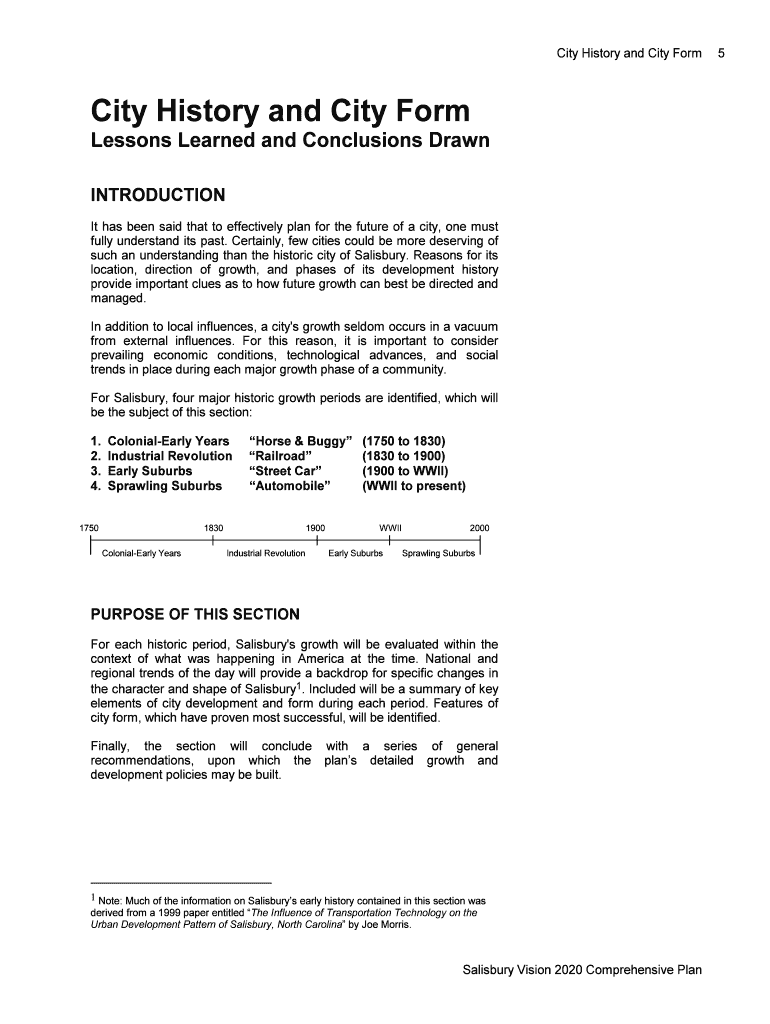
The "City History and City Form - salisburync" primarily delves into the transformative phases of Salisbury, North Carolina, emphasizing its significance in urban planning. This document identifies four principal growth periods: Colonial-Early Years, Industrial Revolution, Early Suburbs, and Sprawling Suburbs. Each era is crucial in understanding how economic conditions and technological advancements shaped Salisbury's current urban landscape.
Detailed Insights into Growth Periods
- Colonial-Early Years: Focuses on the initial settlement patterns and foundational development.
- Industrial Revolution: Highlights infrastructure advancements and industrial growth.
- Early Suburbs: Examines the suburbanization trend post-World War II.
- Sprawling Suburbs: Discusses modern suburban expansion and its implications.
How to Use the City History and City Form - salisburync
Utilizing this form involves a strategic approach to interpreting historical data for urban planning. Stakeholders can leverage the insights to formulate future policies that respect Salisbury's historical context. This form can guide city planners, historians, and policymakers in informed decision-making.
Obtaining the City History and City Form - salisburync
To access the "City History and City Form - salisburync," interested parties should contact the planning department of Salisbury, North Carolina. It may also be available through city archives or related governmental websites. Ensuring access to this form is essential for those involved in urban planning and public policy.
Steps to Complete the Analysis Using the Form
- Review Historical Context: Begin by thoroughly examining each growth period detailed in the form.
- Identify Key Influences: Highlight the economic and technological factors presented in the form.
- Extract Urban Planning Recommendations: Focus on recommendations provided for future city growth.
- Document Insights: Record observations and potential applications in current urban planning.
Who Typically Uses the City History and City Form - salisburync
This form is mainly used by urban planners, historians, government agencies, and academic researchers focusing on urban development and planning. Each stakeholder can utilize the form to support various initiatives, from academic research to policy formulation.


Key Elements Highlighted in the Form
- Historical Growth Stages: Analyzes periods within Salisbury's developmental timeline.
- Economic and Technological Influences: Discusses how these factors impacted city form.
- Urban Planning Recommendations: Provides strategies for sustainable and informed growth.
Examples of Practical Applications
Urban planners might use insights from the "City History and City Form - salisburync" to design comprehensive development plans. For instance, understanding past suburban trends can help in addressing current urban sprawl issues. Similarly, historians may use the form as a basis for publications or educational material that reflects on Salisbury's urban evolution.
Digitization and Modern Usage
In the modern context, digitizing the "City History and City Form - salisburync" can enhance accessibility and analysis efficiency. Digital versions enable easier cross-referencing with other urban planning documents and integration into software used by urban planners. Whether accessed digitally or in paper form, the insights remain invaluable.
State-Specific Considerations
While the form provides a broad understanding of urban growth applicable to many regions, Salisbury-specific factors such as local ordinances, cultural heritage, and regional economic conditions must be considered. This localized approach ensures the recommendations align with the city’s unique characteristics and needs.