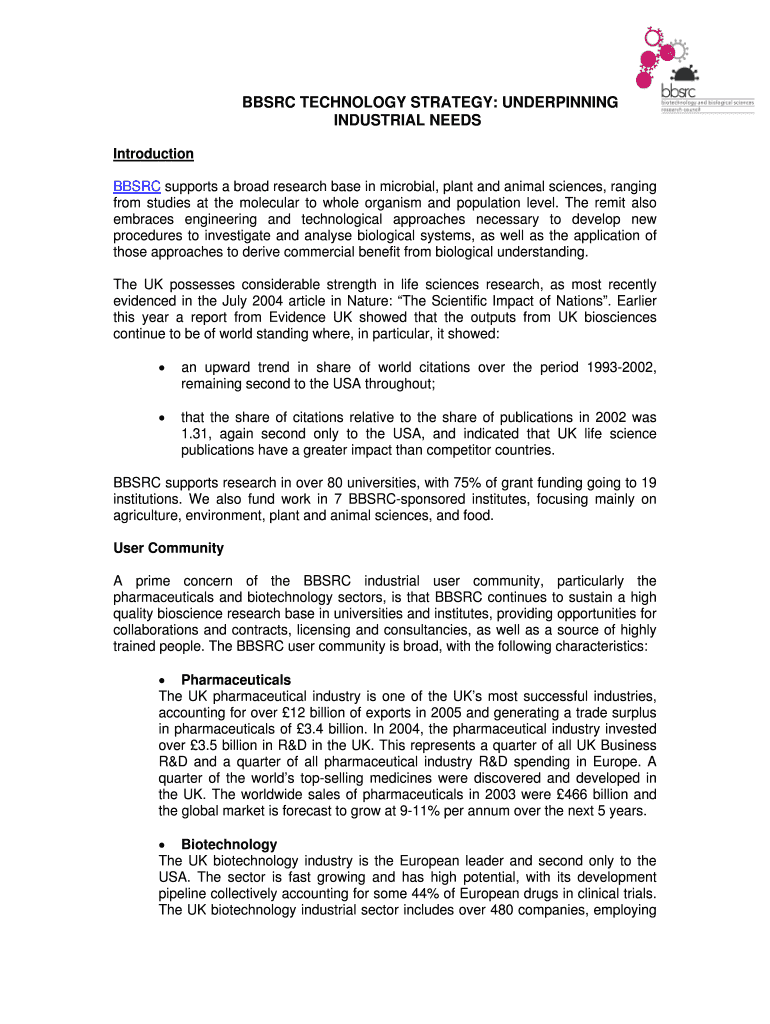







Definition and Meaning
The "BBSRC Technology Strategy" from the National Archives UK is a strategic framework designed to advance bioscience research in the United Kingdom. It aims to address industrial needs by promoting collaboration across various sectors like pharmaceuticals, biotechnology, agriculture, and food production. The strategy's main focus is on encouraging innovation and commercial benefit by targeting key research areas. Examples include bioprocessing, genomics in healthcare, and crop production. By promoting these research priorities, the BBSRC Technology Strategy seeks to sustain a high-quality bioscience base while tackling global challenges and fostering economic growth.
How to Use the BBSRC Technology Strategy
To effectively leverage the BBSRC Technology Strategy, stakeholders in the biosciences need to familiarize themselves with its priority areas and framework. This involves:
- Identifying Relevant Sectors: Determine how your sector, whether it’s pharmaceuticals or agriculture, aligns with the strategy's focus areas like bioprocessing or food research.
- Collaboration: Engage in interdisciplinary approaches and form partnerships with academia, industry, and other stakeholders that are emphasized in the strategy.
- Research Investment: Allocate resources to the strategy's prioritized research areas to maximize innovation.
- Compliance and Integration: Ensure that ongoing projects align with the designated goals and frameworks of the BBSRC.
Important Terms Related to the BBSRC Technology Strategy
Familiarity with the key terms associated with the BBSRC Technology Strategy ensures a comprehensive understanding:
- Bioscience: The study of biological processes that underpin living organisms and their interactions with the environment.
- Bioprocessing: Using biological materials to develop new products, services, or processes.
- Genomics: The study of genomes, crucial in improving healthcare by identifying disease-related genes.
- Bionanotechnology: The application of nanotechnology to biological systems.
- Interdisciplinary Approach: A method of research involving collaboration across various fields to achieve a common goal.
Key Elements of the BBSRC Technology Strategy
The strategy outlines several core components essential for fulfilling its objectives:
- Research Prioritization: Specific areas like systems biology or bionanotechnology are selected based on their potential impact on industry and society.
- Sector Collaboration: Emphasis on the synergistic partnership between governmental bodies, research institutions, and industries.
- Funding and Investment: Allocation and management of financial resources to support the strategic research areas.
- Impact Assessment: Evaluating the contributions of research on economic growth and global challenges.
Examples of Using the BBSRC Technology Strategy
To illustrate the practical application of the BBSRC Technology Strategy, consider these scenarios:
- A biotech company partners with a university to develop new biocatalysis techniques, boosting product efficiency.
- A pharmaceutical company invests in genomics research, leading to breakthroughs in personalized medicine.
- An agricultural firm collaborates with a food research institute to enhance crop production using innovations derived from the strategy.
Key Takeaways
The BBSRC Technology Strategy is pivotal in steering UK bioscience research towards addressing industrial and societal challenges. By focusing on strategic research areas, it encourages innovation and collaboration between academia and industry. Understanding and engaging with the strategy can provide long-term benefits, such as improved commercial prospects and contributions to global solutions. Stakeholders in the biosciences should align their objectives with the strategy to harness its full potential.