






Definition & Meaning
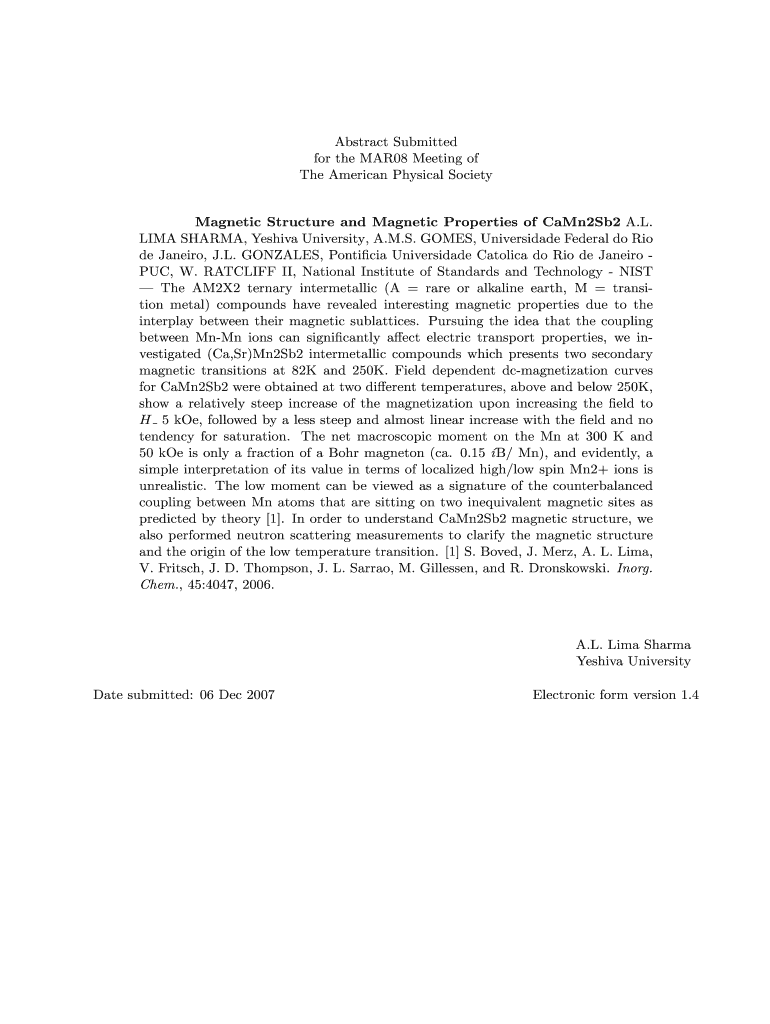
The document titled "Magnetic Structure and Magnetic Properties of CaMn2Sb2 A - absimage aps" refers to a scientific study that delves into the characteristics of the intermetallic compound CaMn2Sb2. This study is specifically focused on understanding the compound's magnetic structure and how it influences its magnetic properties and behavior under varying conditions. Such documents are typically part of broader research presentations or submissions, such as an abstract for meetings like the American Physical Society's conference. The compound is noted for unique magnetic transitions and the effects of Mn-Mn ion coupling on electrical transport properties.
How to Use the Data from the Document
Researchers and scientists often utilize findings from such studies to further their knowledge of intermetallic compounds. The data could be used for comparing magnetic properties between similar compounds or inferring potential applications in materials science and engineering. This document may also serve as a reference point for researchers looking to replicate the study or explore additional questions that could arise from its conclusions.
Key Elements of the Study
The investigation emphasizes several key aspects:
- Magnetic Structure: Understanding the arrangement of magnetic moments in CaMn2Sb2.
- Magnetic Transitions: Notable transitions occur at low temperatures, specifically at 82K and 250K, influencing the compound's properties.
- Mn-Mn Ion Coupling: Explores how the interaction between manganese ions affects the material's conductivity and magnetic characteristics.
- Methodologies Used: The document discusses methodologies such as field-dependent magnetization measurements and neutron scattering to derive conclusions about the magnetic structure.
Steps to Conduct Similar Research
- Literature Review: Gather existing studies on similar compounds to understand current knowledge and methodologies.
- Formulate Hypotheses: Based on existing data, develop hypotheses regarding magnetic behaviors and structures.
- Choose Methodologies: Select appropriate measurement and analysis techniques, such as magnetization measurement and neutron scattering.
- Data Collection: Conduct experiments under controlled conditions, gathering data on magnetic transitions and structures.
- Analysis: Use computational models to interpret experimental data and validate hypotheses.
- Peer Review and Publication: Share findings in scientific forums and journals for validation and feedback from the scientific community.
Examples of Using the Study
Examples of practical applications for this research include:
- Material Innovation: Developing new types of magnets for industrial applications.
- Electronic Devices: Enhancing magnetic storage devices through improved understanding of magnetic materials.
- Quantum Computing: Exploring new qubits materials that rely on magnetic properties for their function.
Important Terms Related to the Study
- Intermetallic Compounds: Materials composed of two or more metallic elements with distinct ordered structures.
- Magnetic Transition: A change in the magnetic order of a material, often tied to temperature changes.
- Neutron Scattering: An experimental technique used to determine structures at the atomic level.
- Field-Dependent Magnetization: Measurement of how a material's magnetization changes in response to an external magnetic field.
Legal Use of the Data
Data and findings from studies are generally open for use in further scientific research and development, provided proper citation and accreditation are given. Researchers should ensure compliance with intellectual property laws and practices, avoiding data misuse or misrepresentation. Moreover, if using data in concert with commercial interests, research objectives and potential conflicts of interest should be transparently disclosed.
State-Specific Rules for Research Application
Depending on the U.S. state where research is conducted, there may be differing regulations concerning laboratory safety, research funding, and data sharing. Institutions must adhere to both federal guidelines and specific state laws regarding research ethics, hazardous material handling, and publication requirements. It's important for researchers to consult both institutional review boards (IRB) and local regulatory bodies to ensure compliance.