




01. Edit your neck disability index printable online
Type text, add images, blackout confidential details, add comments, highlights and more.

Type text, add images, blackout confidential details, add comments, highlights and more.

Draw your signature, type it, upload its image, or use your mobile device as a signature pad.

Send neck disability index scoring via email, link, or fax. You can also download it, export it or print it out.
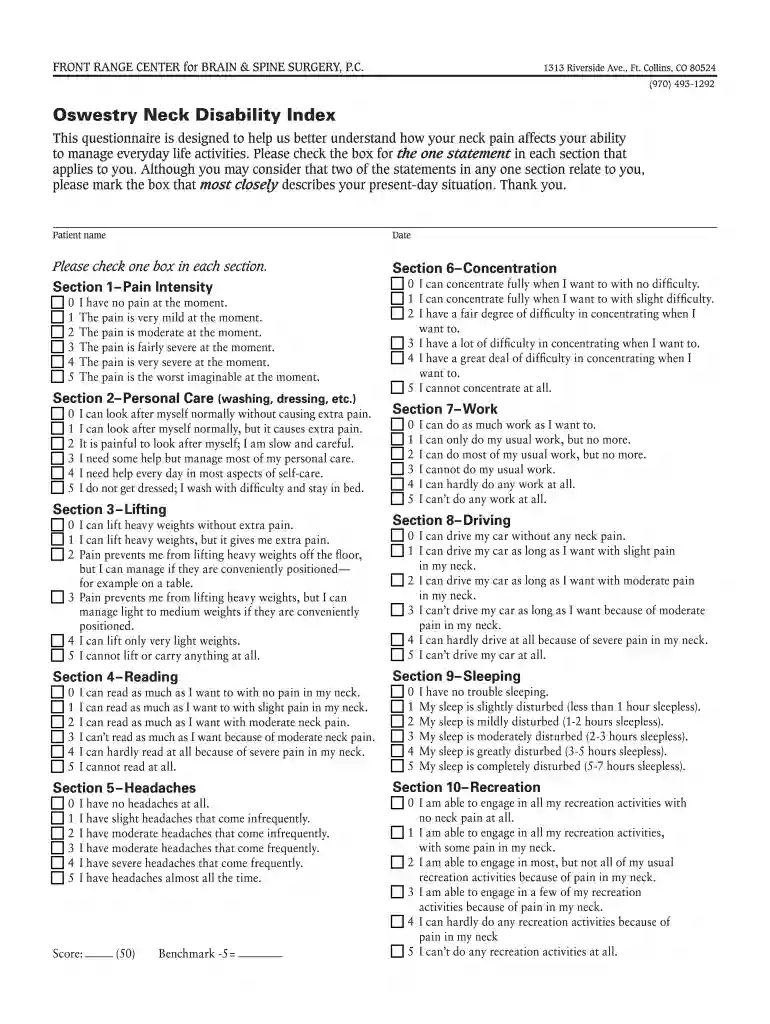
The Neck Disability Index (NDI) is a specific questionnaire designed to assess the impact of neck pain on an individual’s daily activities and functional capabilities. This standardized instrument is commonly used by healthcare professionals to gauge the severity of neck-related disabilities in patients. The responses from the questionnaire enable clinicians to determine how neck pain affects various aspects of life, including work, personal care, and recreational activities.
The primary purpose of the NDI is to quantify the degree of functional impairment a patient experiences due to neck pain. The questionnaire consists of several categories, each focusing on different functional areas, such as pain intensity, personal care, lifting, and recreational activities. This comprehensive approach provides a detailed understanding of the patient’s difficulties and assists in developing tailored treatment plans.
The NDI typically includes a series of statements that patients must evaluate based on their current condition. Each section is related to specific daily activities, with patients selecting the statement that best represents their situation. The scoring system reflects the severity of symptoms and function, allowing for a clear assessment of the patient's overall impact from neck pain.
Using the Neck Disability Index is straightforward, making it accessible for both patients and healthcare providers. The process involves complete and accurate responses to the questionnaire to reflect day-to-day challenges accurately.
Healthcare professionals, including physiotherapists and chiropractors, frequently use the NDI to monitor treatment effectiveness and make informed decisions regarding patient care.
Understanding key terms associated with the Neck Disability Index enhances the clarity of its application and interpretation.
The NDI scoring range typically varies from zero to 100, with higher scores indicating greater disability. Clinicians may use this scoring system to track changes over time, assess treatment outcomes, or compare patient data across different demographics.
Completing the Neck Disability Index accurately is vital for obtaining reliable results that reflect a patient's condition.
Accurate completion of the NDI is crucial, as it informs healthcare providers about the severity of neck-related issues and shapes the treatment landscape for the patient.
The Neck Disability Index is utilized by various professionals across healthcare settings, reflecting its significance in clinical practice.


The NDI is commonly administered to individuals suffering from chronic neck pain, post-injury recovery, and those undergoing rehabilitation after surgical procedures.
The Neck Disability Index can have legal implications, particularly in personal injury cases and disability claims where neck pain is a factor.
Clinicians should follow established standards when utilizing the NDI in legal contexts, ensuring valid administration and scoring practices for reliable results.
With DocHub, it’s quite simple. The platform offers users an add-on called DocHub for Gmail, which you can locate in the Google Workspace Marketplace free of charge. Set it up and give it access to your Google account. Open your email with your neck disability index calculator attached and click on the add-on button in the right-side panel. Sign in to your DocHub account, and import the form to our editor, where you can fill it out and sign.
You need only an internet connection and a browser to fill out your neck disability index on an iOS phone. Open the DocHub website and authenticate. Then, add your file or select it from the list in your dashboard. Then use our editing instruments to fill out your form and preserve all your changes. You may also send it to a dedicated recipient straight away.
At DocHub, your data security is our priority. We follow HIPAA, SOC2, GDPR, and other standards, so you can work on your documents with confidence.
by H Vernon 1991 Cited by 4724 A modification of the Oswestry Low Back Pain Index was conducted producing a 10-item scaled questionnaire entitled the Neck Disability Index (NDI).Read more
This questionnaire has been designed to give us information as to how your neck pain has affected your ability to manage in everyday life.Read more


