






Definition and Meaning
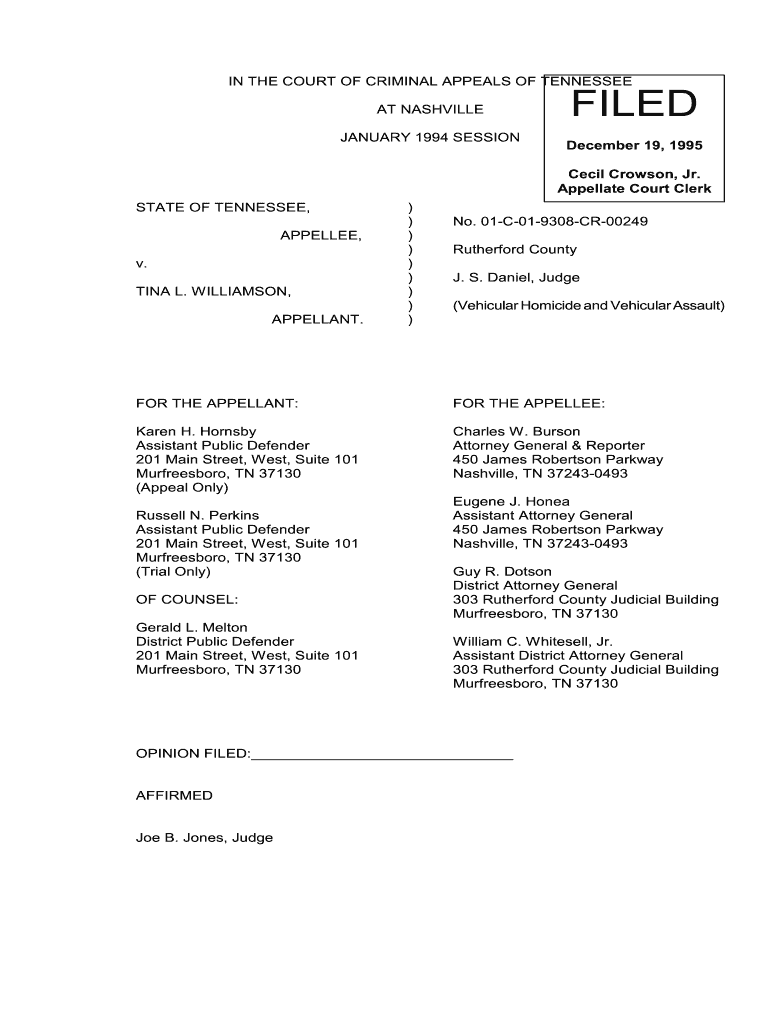
The "December 19, 1995 Cecil Crowson, Jr Appellate Court Clerk IN" refers to a specific document or court opinion from the Tennessee Court of Criminal Appeals. The document's significance lies in its judicial rulings and decisions, particularly related to the case involving vehicular homicide and assault charges. It serves as an official record of the court's decision and the legal reasoning behind affirming the trial court's judgment. Understanding the context and implications of this document is crucial for legal professionals and individuals involved in or studying the case.
Components of the Document
- Judgment Affirmation: The Appellate Court's role in affirming the trial court's decision.
- Legal Standards: Discussion of legal standards for criminal responsibility and sentencing.
- Case Context: Details of the accidents, such as intoxication levels, forming the basis of the charges.
How to Use the Document
Legal practitioners and scholars can use this document to understand judicial decision-making in similar cases. It provides insight into how appellate courts evaluate trial court decisions and the factors considered in upholding or overturning those decisions.
Legal Analysis
- Precedent Study: Analyzing how this decision serves as a precedent for future vehicular homicide cases.
- Research: Using detailed findings and legal standards discussed for research purposes.
Steps to Complete Analysis
- Acquire a Copy: Access the document through legal databases or court archives.
- Read Thoroughly: Go through the opinion carefully, noting key legal findings and conclusions.
- Contextual Understanding: Understand the broader legal implications and the impact of the ruling.
In-Depth Study
- Critical Sections: Focus on the sections detailing the court's reasoning and any dissenting opinions.
- Comparative Analysis: Compare with similar cases to understand variations in judicial outcomes.
Why the Document Matters
The document is an essential piece of legal literature that can influence future cases and legal interpretations. By examining the court's reasoning, legal professionals can better prepare for or advise on similar cases. It holds judicial authority on legal standards applied to vehicular homicide and assault.
Influence on Future Cases
- Legal Precedents: Establishes important precedents for plea bargains and sentencing.
- Guidance: Provides guidance for both prosecutors and defense attorneys in crafting arguments.
Who Typically Uses This Document
- Lawyers: For building cases or defenses in vehicular-related incidents.
- Judges: As a reference for similar cases to ensure consistency in rulings.
- Scholars: For academic purposes, analyzing legal trends or shifts.
Targeted Professions
- Defense Attorneys: For strategy and understanding potential outcomes.
- Prosecutors: To reinforce their case strategies and pursuit of justice.
Key Elements of the Document
Important components include the circumstances surrounding the accident, intoxication levels, and the court’s articulation of legal standards. These elements help frame the legal question at the heart of the decision and establish the foundation for the judgment rendered.
Detailed Aspects
- Charge Details: Understanding of the specific charges and evidence presented.
- Rulings: The precise legal outcomes and their implications for convictions.
State-Specific Rules
Given that this document emanates from a Tennessee court, it includes state-specific interpretations of vehicular homicide and assault laws. Understanding these rules is critical for those practicing law within the state.
Relevant State Laws
- Local Statutes: How Tennessee law specifically addresses issues of intoxication and vehicular operation.
- Court Precedents: Influence of local judicial history on the ruling.
Legal Use of the Document
The document can be instrumental in appeals, understanding criminal liability, and applying legal standards across various legal contexts. It delineates the boundaries of criminal conduct and judicial responsibility.
Application in Legal Proceedings
- Appeals: Utilized in forming appeal strategies or counterarguments.
- Case Studies: Examined in academic settings to illustrate judicial reasoning and logic.
Examples of Using the Document
For practitioners, the document serves as a reference in crafting arguments or understanding the appellate court process. It offers real-world scenarios of judicial decision-making and its complexities.
Practical Scenarios
- Case Preparation: Insightful for preparing defense or prosecution in similar cases.
- Judicial Training: Assists new judges in grasping how appellate courts review and rule on cases.