







Definition and Meaning
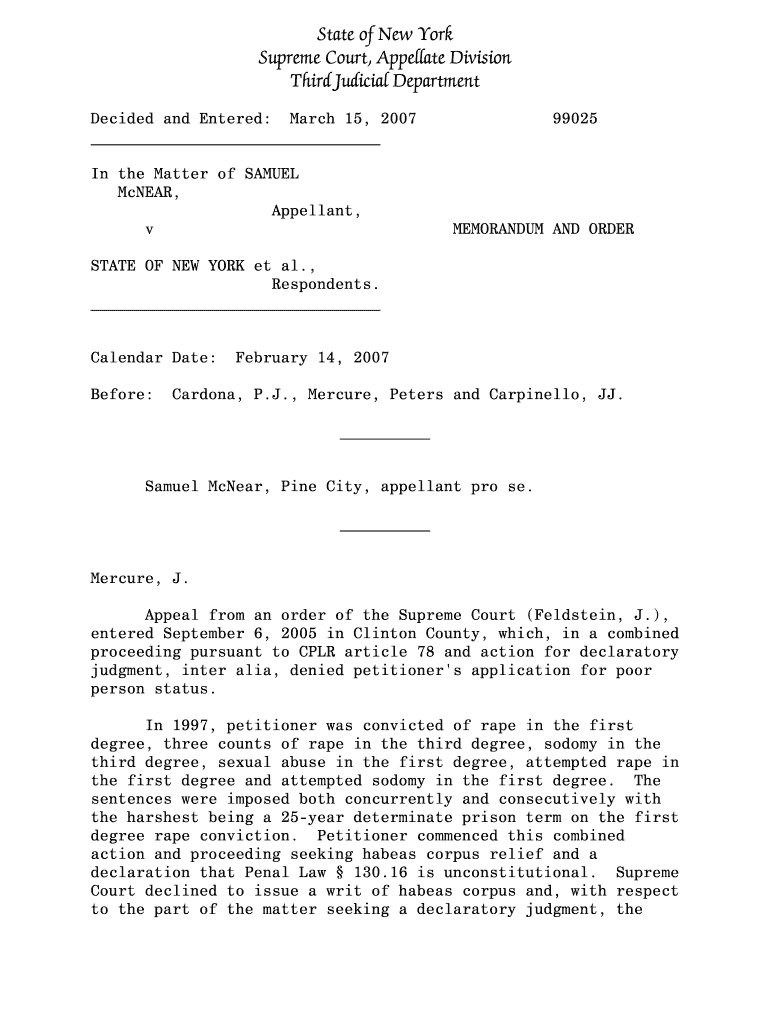
The "State of New York Supreme Court, Appellate Division Third Judicial Department Decided and Entered: M" form is integral to the appellate process within the New York court system. It details decisions and orders entered by the Appellate Division, providing a formal record of outcomes on appeals from lower courts. This form is used to document cases where decisions are challenged, ensuring transparency and accountability in legal proceedings.
Key Components
- Appellate Division Ruling: The primary function of the form is to record decisions made by the appellate judges.
- Case Details: Includes specifics such as case number, parties involved, and nature of the appeal.
- Judicial Department: Clarification of the jurisdiction this form addresses, specifically the Third Judicial Department.
- Decision Outcome: The final ruling, including whether the previous decision was upheld, reversed, or modified.
How to Use the Form
The form serves as an official record and reference point for understanding the decisions and rationale of the Appellate Division.
Practical Application
- For Legal Counsel: Used by attorneys to analyze appellate outcomes and prepare for future litigation or further appeal.
- For Affected Parties: Provides individuals or entities involved in the case information on the court's decision affecting their status.
- For Academic Reference: Often cited in legal research and academic papers for case study analysis.
How to Obtain the Form
Accessing the form is necessary for those directly involved or with a vested interest in the respective appellate case.
Retrieval Process
- Court Clerk's Office: Visit or contact the clerk of the Appellate Division where the decision was entered to request a copy.
- Online Access: Many court decisions are available through official state court websites, allowing for digital access and download.
Steps to Complete the Form
While the form is typically completed by court officials, understanding its completion process is vital for accuracy in legal documentation.
Completion Breakdown
- Case Identification: Clearly label with the case number and parties involved.
- Decision Recording: Accurately enter the decision delivered by the court.
- Signatures and Dates: Ensure appropriate judicial endorsements and date entries for validation.
Who Typically Uses the Form
Understanding the typical users helps to grasp the form’s relevance and application.


Primary Users
- Attorneys and Legal Aid: Essential for lawyers managing appellate cases.
- Judicial Clerks: Used by court officials to maintain formal and accurate records.
- Litigants: Parties to the case require the form to understand their legal standing post-decision.
Key Elements of the Form
A comprehensive understanding of the form’s crucial components is beneficial for accurate analysis and record-keeping.
Major Sections
- Case Citation: Full details and references for citation purposes.
- Decision Details: Explains the court's reasoning and outcomes.
- Dissenting Opinions: Includes any dissent from judges for comprehensive analysis.
State-Specific Rules
The use and interpretation of this form are governed by New York's specific legal standards, ensuring consistency in appellate procedures.
Applicable Regulations
- Jurisdictional Limits: Only applicable within the confines of the New York court system.
- Procedural Requirements: Must adhere to formatting and submission rules as dictated by New York State law.
Examples of Using the Form
Providing scenarios where the form has been applied adds practical context to its use.
Case Studies
- Case A: Appeal from a criminal conviction where the decision was overturned.
- Case B: Upheld decision in a civil dispute regarding contract interpretation.
Filing Deadlines and Important Dates
Critical deadlines ensure timely processing and compliance with legal protocols.
Timetable Guidance
- Appeal Filing: Deadlines for filing an appeal can be crucial; parties must adhere strictly to these timelines following the original judgment.
- Submission Dates: Courts set specific dates for document submission which must be followed precisely.
Penalties for Non-Compliance
Failure to comply with deadlines and procedural rules can result in severe consequences.
Consequences
- Dismissal of Appeal: Non-compliance may lead to the dismissal of the appeal.
- Financial Penalties: Monetary fines may be levied for significant procedural errors or delays.
Form Variants and Alternatives
Understanding form variants helps identify applicable documentation for specific court processes.
Alternatives
- Motion for Reconsideration: A closely related form for challenging appellate decisions.
- Petition for Certiorari: Used for further appeal beyond New York’s appellate division.
Software Compatibility
Ensuring seamless integration with commonly used software streamlines document management.
Common Platforms
- Adobe Acrobat: Used for viewing and managing the form in PDF format.
- Microsoft Word: Conversion tools available for Word format editing and submission.




