Definition and Meaning
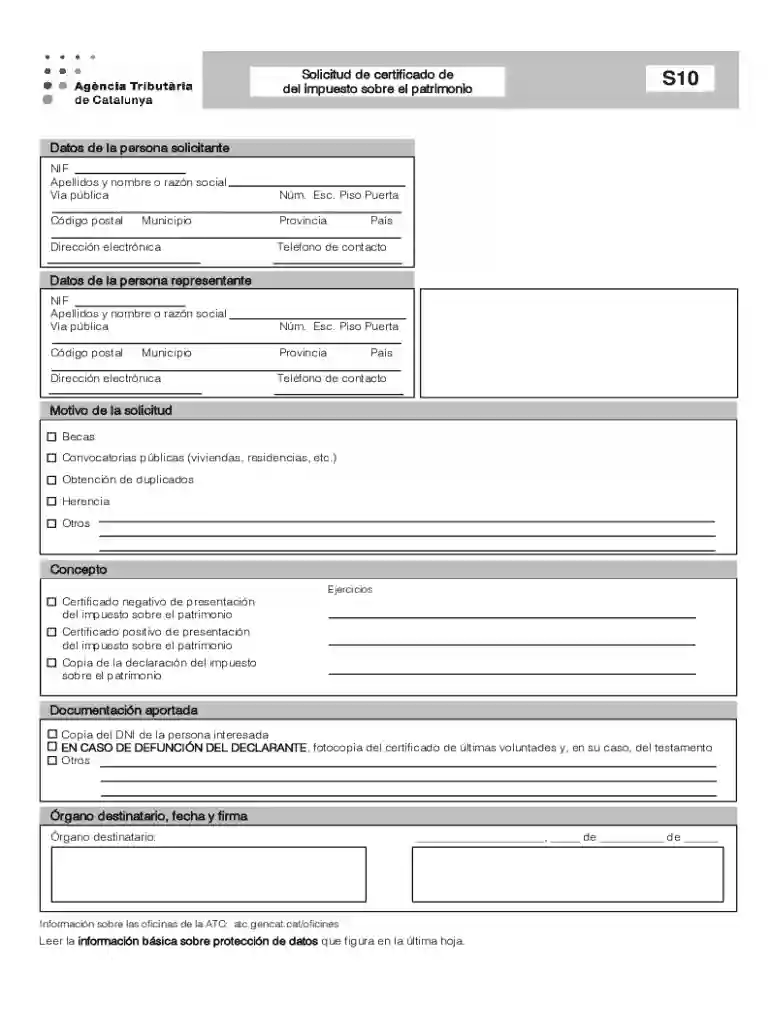
The "Solicitud De Certificado De Impuesto Sobre El Patrimonio" is a formal request form used to obtain a certificate related to wealth tax. The certificate serves as official documentation affirming an individual's or entity's tax status concerning the wealth tax, which is typically imposed on the net worth of individuals, including assets minus liabilities. This form is crucial for those needing to verify their tax compliance or to provide legal documentation for financial or legal transactions.
Purpose of the Certificate
- Verification: Confirms the applicant's wealth tax obligations and compliance.
- Documentation: Offers legal proof of tax status for various personal or business dealings.
- Financial Transactions: Required for transactions where wealth tax documentation is mandatory.
How to Use the Solicitud De Certificado De Impuesto Sobre El Patrimonio
The form serves multiple purposes depending on the applicant's needs and legal requirements. It can be used to:
- Gather Information: Collect all necessary financial information required for accurate completion.
- Document Submissions: Submit required attachments that support the details provided in the form.
- Legal Transactions: Present the certificate in situations requiring proof of tax compliance.
Practical Example
- An individual applying for a loan might need to provide this certificate to ensure the lender of their financial standing and tax obligations.
Steps to Complete the Solicitud De Certificado De Impuesto Sobre El Patrimonio
Completing this form involves several steps, ensuring accuracy and compliance with tax regulations:
- Collect Personal and Financial Information: Include all necessary personal details such as name, address, and identification number.
- Specify the Type of Certificate Needed: Indicate whether the certificate is for personal use, business transactions, or other purposes.
- Provide Financial Details: Describe assets, liabilities, and net worth relevant to the wealth tax.
- Submit Supporting Documents: Attach any necessary documentation that validates the details provided, such as tax returns or financial statements.
- Review and Sign: Carefully review all information for accuracy before signing the form.
Common Mistakes
- Omitting required information or failing to attach supporting documents can result in delays or rejection of the certificate request.
Required Documents
As part of the application process, specific documentation is necessary to support the information provided in the form:
- Identification Documents: State-issued ID or passport to verify the applicant's identity.
- Financial Statements: Recent financial statements detailing assets and liabilities.
- Previous Tax Returns: Copies of the most recent tax returns for consistency and verification.
- Legal Documents: Any additional documents required by the local tax authority.
Who Issues the Form
The form is typically issued by the relevant regional or national tax authority responsible for administering and collecting wealth taxes. In Spain, for example, the Tax Agency of Catalonia handles such requests within its jurisdiction.
Role of the Tax Authority
- Issuance and Regulation: Provides the form and ensures compliance with local tax laws.
- Processing: Reviews submitted forms and attached documents to issue the certificate.
Legal Use of the Solicitud De Certificado De Impuesto Sobre El Patrimonio
The form is legally significant as it validates an individual's or corporation's fiscal responsibilities regarding the wealth tax:
- Ensures Compliance: Verifies that the applicant is fulfilling legal tax obligations.
- Protects Against Legal Issues: Serves as proof of compliance, thereby protecting against potential legal disputes or penalties.
Legal Scenarios
- Real Estate Transactions: Often required when buying or selling property to confirm tax obligations have been met.
- Inheritance Settlements: Used to ascertain tax status and obligations upon receiving inheritance.
Software Compatibility
When handling digital submissions or storing documentation, compatibility with various software platforms ensures seamless processing:
- Accounting Software: Compatible with systems like QuickBooks or Microsoft Excel to facilitate organizing financial data.
- PDF Editors: Tools like DocHub for digital form completion and secure document signing.
Practical Software Integration
- Utilizing DocHub to import forms directly from cloud storage, edit content, and apply e-signatures before submission.
Example of Eligibility Verification
- An applicant requires residency documentation and thorough financial records to substantiate their eligibility for the certificate.
Key Takeaways
The "Solicitud De Certificado De Impuesto Sobre El Patrimonio" is essential for individuals and businesses needing to demonstrate compliance with wealth tax obligations. It requires careful preparation of detailed financial and personal information, supported by necessary documentation. The process ensures legal protection and transparency in financial dealings where proof of wealth tax status is required.
Overview of Important Points
- Collect and prepare detailed financial and personal data.
- Ensure all required documents are included.
- Form issued by regional tax authorities and serves multiple legal and financial purposes.
- Comprehension of eligibility criteria and correct submission process is crucial for timely approval and issuance of the certificate.