



Definition and Meaning
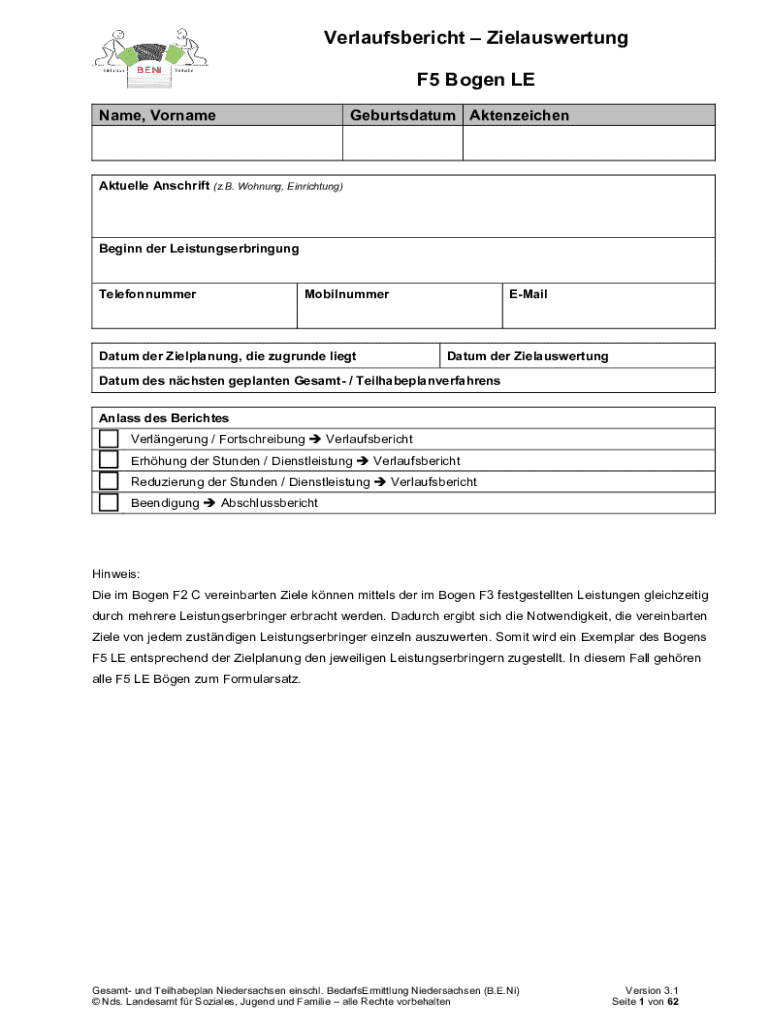
The "Verlaufsbericht Zielauswertung," which translates to "Progress Report Evaluation of Goals," is a comprehensive form used predominantly within social services, particularly in Niedersachsen, Germany. This document evaluates the attainment of goals set within individual care plans or service agreements. It not only audits the effectiveness of services provided by various organizations but also pinpoints areas where progress has been either facilitated or hindered. These insights are crucial for tailoring subsequent interventions and ensure the alignment of services with the individual's specific needs and circumstances.
Steps to Complete the Verlaufsbericht Zielauswertung
Completing the Verlaufsbericht Zielauswertung involves a structured process to maintain accuracy and ensure completeness:
-
Personal Information Section: Begin by filling in the participant's personal details, including their name, date of birth, and contact information. This ensures that the report is accurately identified with the individual receiving services.
-
Service Details: Clearly describe the services provided, including the type of service, frequency, and involved parties. This section creates a comprehensive record of the support offered over the evaluation period.
-
Goal Assessment: Evaluate each predefined goal by detailing the actions taken towards achieving them, the current status, and measures of success. This assessment may include specific metrics or subjective observations.
-
Facilitators and Barriers: Identify factors that either facilitated or hindered progress toward each goal. Understanding these elements is crucial for adjusting strategies and improving service delivery.
-
Recommendations and Adjustments: Conclude by suggesting any necessary adjustments to the service plan based on the evaluation. This proactive approach aids in redefining objectives to better meet the participant’s needs.
Key Elements of the Verlaufsbericht Zielauswertung
Several critical elements ensure the report's effectiveness and utility in monitoring progress:
-
Goal Definition and Criteria: Clear articulation of the goals being assessed, along with specific criteria for evaluation. This precision allows for objective measurement and comparison across different reports.
-
Comprehensive Documentation: Detailed records of services rendered and participant responses. Such documentation provides a rationale for recommendations and supports continuity of care.
-
Feedback Integration: Incorporates feedback from service providers, caregivers, and the participant themselves. This multi-perspective approach enriches the report's contribution to personalized care adjustments.
Who Typically Uses the Verlaufsbericht Zielauswertung
The form is primarily used by social workers, case managers, and service coordinators within the social services sector. Additionally, it is valuable for healthcare providers and therapists involved in long-term care plans. These professionals rely on the information within the form to make informed decisions about service continuation, modification, or termination, ensuring that each individual's care plan is responsive and effective.

Why It's Important to Use the Verlaufsbericht Zielauswertung
Using the Verlaufsbericht Zielauswertung fosters a systematic means of evaluating the effectiveness of social services. It serves to:
- Enhance the quality of care by ensuring that services are tailored and adjusted to the participant's evolving needs.
- Promote accountability among service providers by documenting progress and identifying areas for improvement.
- Facilitate seamless communication among different stakeholders involved in a participant's care.
Examples of Using the Verlaufsbericht Zielauswertung
Real-world scenarios illustrate the form's utility:
-
Case Study 1: A young adult with developmental disabilities receives customized educational support. The report highlights successful strategies, such as visual learning aids, and identifies barriers like limited social interaction opportunities.
-
Case Study 2: An elderly individual in a community care program shows substantial health improvements. The report attributes success to routine health check-ins and identifies potential for further improvement by integrating physical activity into the individual's plan.
Important Terms Related to Verlaufsbericht Zielauswertung
Understanding key terminology aids in the accurate completion and interpretation of the form:
- Goal Attainment Scaling: A method used to quantify the degree of progress made toward meeting specific goals.
- Facilitators: Factors that positively contribute to achieving set objectives.
- Barriers: Obstacles that impede progress and may require strategy changes.
Legal Use of the Verlaufsbericht Zielauswertung
Within its jurisdiction, adherence to legal guidelines is imperative:
- Reports must be completed and stored in accordance with local privacy and data protection laws.
- Appropriate consent must be obtained from individuals receiving services, ensuring transparency and ethical practice.
By maintaining rigor in content and process, the Verlaufsbericht Zielauswertung plays a crucial role in the adaptive management of social services, contributing to improved outcomes for all involved parties.