
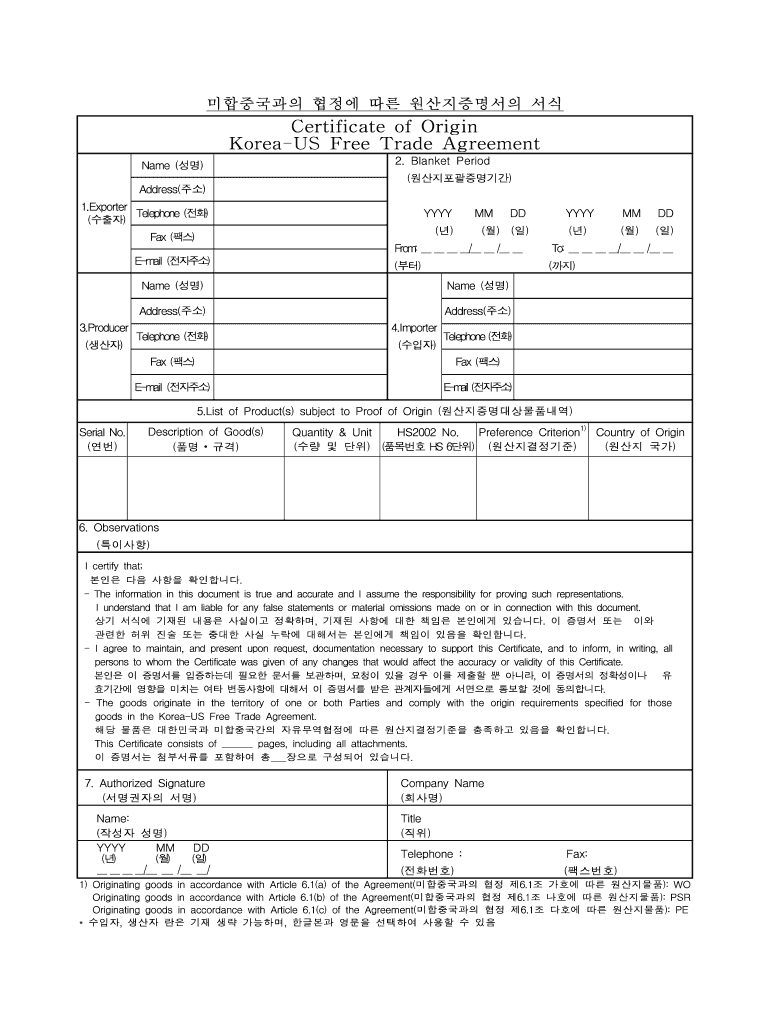







Definition & Meaning
The Certificate of Origin (CO) under the Korea-US Free Trade Agreement (KORUS FTA) is an essential document that verifies the origin of goods exchanged between the United States and South Korea. This certificate confirms that the products meet the specific origin criteria outlined in the trade agreement, allowing them to qualify for preferential tariff rates. The CO helps reduce import duties, enhancing competitive pricing for businesses engaged in cross-border trade.
- Origin Criteria: The origin criteria refer to specific conditions that goods must meet to be considered as originating in one of the participating countries. These criteria ensure that substantial transformation occurs within the exporting country, maintaining fair trade practices.
- Proof of Origin: The document serves as proof that the goods qualify for reduced tariffs under the KORUS FTA, facilitating smoother customs clearance.
How to Use the Certificate of Origin Korea Trade Agreement
To utilize the Certificate of Origin effectively, businesses must ensure their products meet the origin criteria set by the KORUS FTA. This process involves understanding and applying the rules of origin to their goods to benefit from the trade agreement.
Steps for Utilization:
- Evaluate Product Eligibility: Assess whether your products meet the necessary origin criteria specified under the KORUS FTA.
- Complete the Certificate: Fill out the CO with accurate details about the exporter, importer, and products.
- Submit to Customs: Present the completed CO to customs authorities to secure preferential tariff treatment.
How to Obtain the Certificate of Origin Korea Trade Agreement
The process of obtaining a certificate involves several steps where businesses verify their goods' eligibility and accurately complete the required documentation.
Steps for Obtaining:
- Gather Necessary Information: Collect data on exporters, importers, and product specifics.
- Complete Application Forms: Ensure all required fields in the CO are correctly filled.
- Submit for Approval: Forward the completed certificate to an authorized issuer or government body for validation.
Steps to Complete the Certificate of Origin Korea Trade Agreement
Completing the Certificate of Origin accurately is crucial to ensure compliance and benefit from tariff reductions.
Detailed Steps:
- Exporter and Importer Information: Input the names, addresses, and contact details of both parties.
- Description of Goods: Provide detailed descriptions, including the product's tariff classification and weight.
- Certification Statements: Include explicit statements certifying the goods meet origin requirements.
- Signature and Date: Ensure the document is signed and dated by an authorized representative.
Key Elements of the Certificate of Origin Korea Trade Agreement
Comprehensive understanding of the key elements in the Certificate of Origin enhances correct and efficient completion.
Key Elements:
- Signatory Certification: Confirmation by the exporter that goods comply with origin criteria.
- Description of Goods: Specific details about the products covered under the agreement.
- HS Code: Harmonized System (HS) Code classifying the goods for customs.
Why Use the Certificate of Origin Korea Trade Agreement
The certificate provides significant economic advantages and operational efficiencies for international trade participants.
Benefits:
- Tariff Reductions: Access to lower tariffs ensures cost-effectiveness and competitive pricing.
- Streamlined Customs Process: Expedites clearance, reducing delays and associated costs.
Important Terms Related to Certificate of Origin Korea Trade Agreement
Understanding essential terms associated with the CO is critical for accurate comprehension and application.
Terms:
- Preferential Treatment: Reduced tariffs provided based on the origin.
- Customs Authority: The body responsible for enforcing customs laws and trade agreements.
- Free Trade Agreement (FTA): A pact aiming to create a free market between member countries by eliminating or reducing trade barriers.
Legal Use of the Certificate of Origin Korea Trade Agreement
Legal compliance ensures that businesses correctly utilize the Certificate of Origin within the framework of international trade laws.
Legal Considerations:
- Certification Accuracy: Legal consequences may arise from inaccuracies, emphasizing the need for precise documentation.
- Verification Process: Customs authorities may verify the CO’s authenticity and accuracy, highlighting the necessity for truthful submission.
By understanding these elements and guidelines, businesses can leverage the Certificate of Origin to optimize their cross-border trade activities between the United States and South Korea.




