






Definition and Implications of Chemistry: The Central Science
The phrase "Chemistry: The Central Science" underscores the foundational role that chemistry plays in bridging various scientific disciplines. Chemistry serves as a link between physics and biology, mathematics and environmental science, among others. It helps explain the properties and behavior of matter at both macroscopic and microscopic levels. Understanding chemistry enhances comprehension in fields ranging from pharmaceuticals to environmental policy, which rely on chemical principles to innovate and solve problems.
Interdisciplinary Connections
- Physics: Chemistry utilizes principles of physics to understand atomic structures and reaction mechanisms.
- Biology: Biochemical processes are governed by chemical reactions, making chemistry integral to the life sciences.
- Environmental Science: Analyzing chemical pollutants is essential to developing strategies for environmental protection.
How to Utilize Chemistry: The Central Science Materials
Effectively using materials entitled "Chemistry: The Central Science" involves leveraging them to enrich understanding and practical application of chemical concepts. These materials typically consist of textbooks, lab manuals, and online resources designed to facilitate both theoretical learning and practical experimentation.
Key Use Cases
- Educational Tools: Designed for enhancing curriculum delivery in high school and college courses.
- Reference Material: Provides thorough explanations and examples for educators and students.
- Practical Applications: Includes laboratory exercises for hands-on learning.
How to Obtain Chemistry Learning Resources
Acquiring resources like "Chemistry: The Central Science" can be done through educational platforms, bookstores, and libraries. They are usually required texts for certain courses, but they can also be purchased or rented for personal enrichment or as teaching aids.
Acquisition Options
- Purchase from Bookstores: Widely available in physical and online stores.
- University Libraries: Educational institutions often hold these resources in their libraries.
- Digital Downloads: Some versions may be available as e-books through educational platforms.
Completing Exercises and Understanding Content
To complete exercises in "Chemistry: The Central Science," follow the structured methodology provided in the accompanying materials. These exercises are designed to reinforce theoretical learning through practical problem-solving.
Steps for Success
- Review Theoretical Concepts: Ensure a solid understanding of underlying principles.
- Attempt Practice Problems: Apply concepts through structured exercises.
- Engage in Laboratory Experiments: Gain practical experience through hands-on activities.
Importance of Chemistry: The Central Science in Education
The significance of "Chemistry: The Central Science" lies in its comprehensive spotlight on chemistry as a bridge to other sciences. This makes it an essential tool for fostering scientific literacy and interdisciplinary understanding, crucial in today's multifaceted scientific landscape.
Benefits of Chemistry Education
- Increases Problem-Solving Skills: Encourages analytical and critical thinking.
- Fosters Environmental Awareness: Educates on the chemical basis of ecological issues.
- Prepares for Advanced Studies: Provides a foundation for further study in varied scientific fields.
Typical Users of Chemistry Resources
The predominant users are educators, students, and scientists who require an in-depth understanding of chemical properties and reactions. These resources are tailored to suit different educational levels but are particularly structured for those pursuing degrees in science-related fields.
User Categories
- High School and College Students: Core materials for science education.
- Educators: Teaching resources for in-class instruction.
- Researchers: Reference for scholarly work and practical applications.
Important Terminology in Chemistry
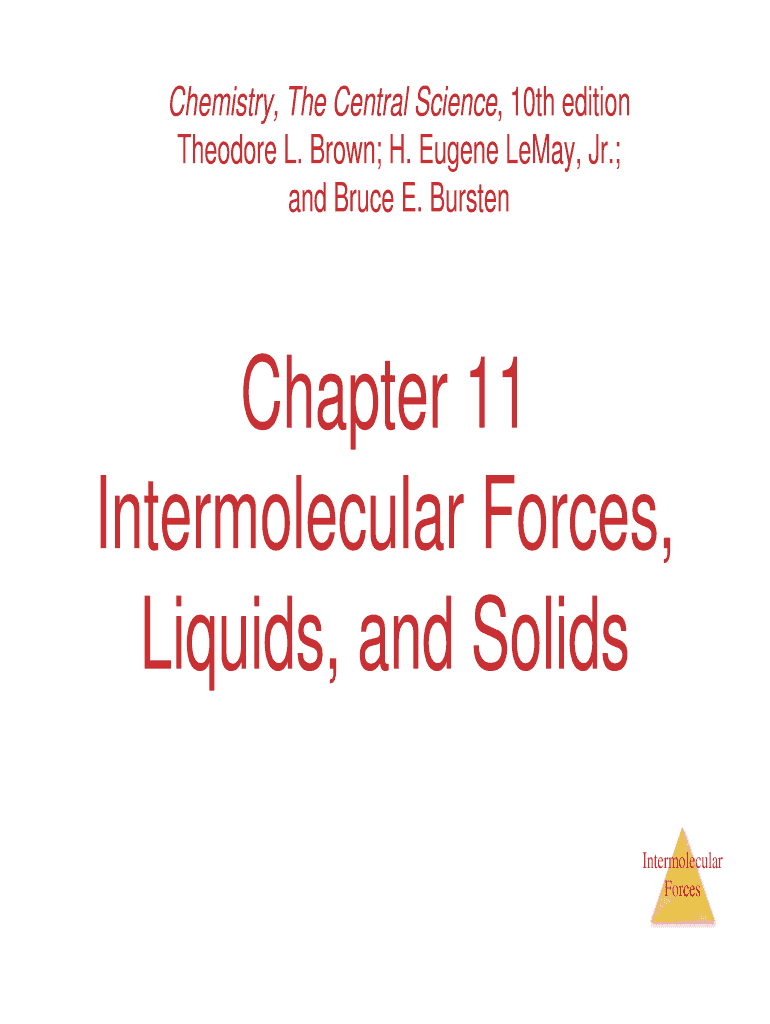
An understanding of the specific terminology used in "Chemistry: The Central Science" is crucial for comprehending the subject matter and its applications. This includes terms like 'intermolecular forces,' which describe the forces that act between molecules.
Key Terms
- Intermolecular Forces: Forces that influence boiling and melting points.
- Phase Diagrams: Graphical representations of the states of matter.
- Vapor Pressure: The pressure exerted by a vapor in equilibrium with its liquid or solid phase.
Key Elements Covered in Chemistry Resources
The critical components covered in "Chemistry: The Central Science" include molecular interactions, state transitions, and thermodynamic principles. These elements provide the building blocks for understanding more complex chemical behavior.
Fundamental Topics
- Molecular Interactions: Describes ionic, covalent, and van der Waals forces.
- State Transitions: Details on how substances move between solid, liquid, and gas phases.
- Thermodynamics: Explores energy changes during chemical reactions.