






Definition and Meaning
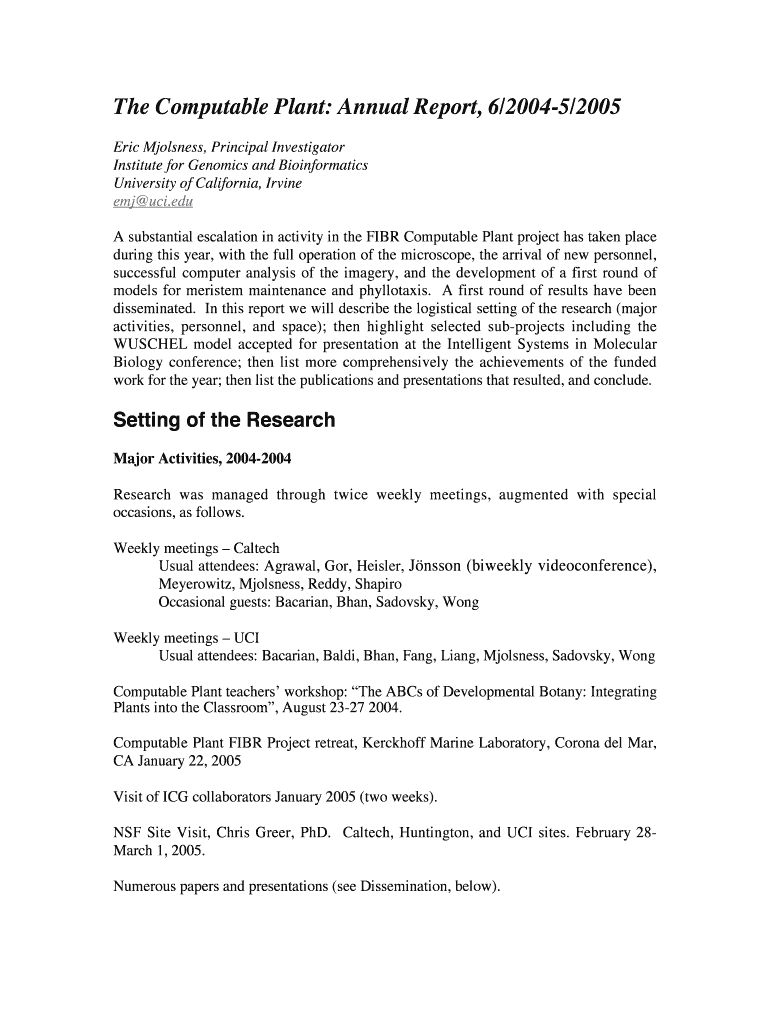
The "Annual Report, 2005 - The Computable Plant - University of - computableplant ics uci" is a comprehensive document detailing the advancements and accomplishments of the Computable Plant project at the University of California, Irvine, for the period of June 2004 to May 2005. This initiative focuses on the integration of computational and biological sciences to better understand plant structures and processes. The report highlights significant milestones such as the full operation of advanced imaging equipment, the enhancement of analytical models for processes like meristem maintenance and phyllotaxis, and the rich collaborative efforts among researchers. It serves as both a record of scientific progress and a repository of insights gained throughout the project’s development.
Key Elements of the Computable Plant Annual Report
The report encompasses several crucial components, each contributing to a holistic understanding of the project's objectives and outcomes.
- Research Advancements: Detailed discussions of breakthroughs in plant modeling and computational techniques used in analyzing plant functions.
- Personnel and Collaboration: Information about new personnel involved in the project and the extent of collaborative research efforts undertaken within the scientific community.
- Technological Achievements: A showcase of newly operational technologies like microscopes and the role they play in the project.
- Data Acquisition: Methods and strategies employed in collecting extensive data and conducting image analysis to further the project’s aims.
- Educational Outreach: Initiatives aimed at integrating plant biology into educational frameworks and promoting wider community engagement.
Steps to Utilize the Computable Plant Annual Report
Leveraging the insights of this report involves a systematic approach:
- Review the Report: Start by thoroughly reading each section to understand the scope of the research and findings.
- Identify Relevant Data: Focus on specific data points and findings that align with your research or academic interests.
- Implement Findings: Apply relevant models or methodologies from the report to your own work in computational biology or related fields.
- Collaborate: Reach out to researchers mentioned in the report for potential collaboration or further discussion.
- Incorporate into Curriculum: Use the report’s educational resources to integrate cutting-edge plant biology topics into teaching materials.
Importance of the Computable Plant Annual Report
This annual report is vital for several reasons:
- Scientific Contribution: It advances understanding in the field of plant biology by providing new models and data analysis techniques.
- Collaboration: The project underscores the synergistic benefits of interdisciplinary collaboration among scientists.
- Resource for Educators: Educators can utilize the report as a teaching tool to illustrate modern applications of biology and computation in real-world scenarios.
- Foundation for Future Research: The documented advancements offer a solid groundwork for subsequent studies and innovations in computational plant sciences.
Who Typically Utilizes This Annual Report
The primary audience for the annual report includes:
- Researchers in Plant Biology: Individuals conducting similar or complementary research benefit from the insights and data provided.
- Academics and Educators: University faculty and educators incorporate report findings into teaching materials for courses in computational biology and plant sciences.
- Policymakers in Science and Technology: Decision-makers use such reports to guide funding and support for innovative scientific initiatives.
- Students: Both undergraduate and graduate students studying computational biology or related fields use the report as a resource for research and learning.
Legal Considerations
While the report primarily serves scientific and educational purposes, it’s essential to abide by intellectual property laws when utilizing its content. Proper attribution should be given when referencing data or methodologies in academic publications or presentations, ensuring compliance with academic integrity standards.
Business Entities Benefiting from Computable Plant Insights
Entities such as agricultural research firms, biotechnology startups, and environmental organizations find significant value in the findings of the report. These businesses leverage articulated computational models and plant biology advancements to drive industry innovation, improve agricultural productivity, and enhance conservation efforts.
Digital vs. Paper Version
While the report is available in both digital and paper formats, the digital version offers greater accessibility and ease of distribution. This format supports interactive features like hyperlinks to supporting documents and multimedia integration, which enrich the reader’s experience and facilitate deeper engagement with the content.
Versions or Alternatives to the Annual Report
Aside from the 2005 report, other annual reports from subsequent or previous years may provide additional context or updates on the project's progress. These alternative versions help in understanding the project's trajectory and the cumulative advancements achieved over time.