






Definition and Scope of Chapter 8 and 9 Homework
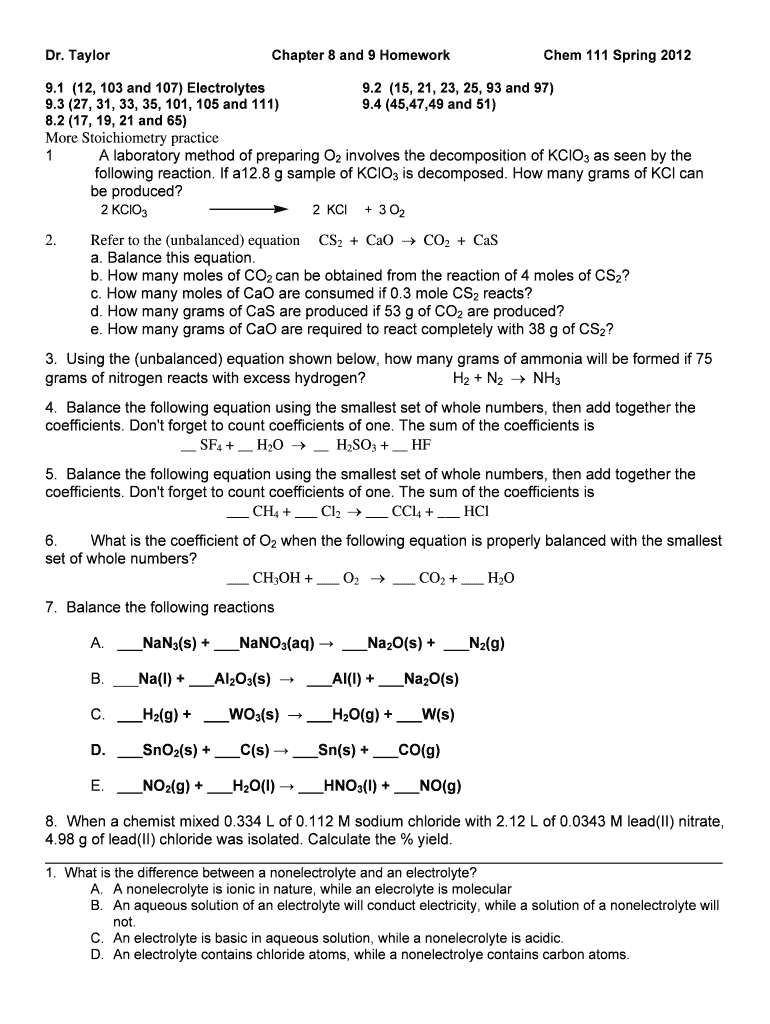
Chapter 8 and 9 Homework typically refers to assignments given in a chemistry course, often labeled as Chem 111. These chapters might cover complex topics, including stoichiometry, balancing chemical equations, understanding electrolytes, and performing calculations related to reactions and concentrations. It is crucial for students to understand these concepts to perform various chemical calculations and understand the behavior of different electrolytes and solutions.
Specific Topics Covered
- Electrolytes: This topic involves understanding how different substances dissolve and conduct electricity in solution.
- Stoichiometry: Learning to relate quantities of reactants and products in chemical reactions.
- Balancing Chemical Equations: Essential for accurately representing reactions in molecular terms.
- Reaction Calculations: Involves determining yields and other quantitative aspects of chemical reactions.
How to Use the Chapter 8 and 9 Homework
Students are encouraged to practice problems individually or in study groups, applying textbook knowledge to solve questions within these chapters. This often requires consulting lecture notes, supplemental materials, or collaborative online platforms like DocHub to streamline and enhance document workflows, enabling better management of assignment files and collaboration with peers.
Practical Steps to Follow
- Review Notes: Before attempting the homework, revisit lecture notes and relevant textbook sections.
- Problem Solving: Tackle each question by applying fundamental principles discussed in the chapters.
- Group Studies: Collaborative problem-solving helps clarify doubts and solidify understanding.
- Use Online Tools: Platforms like DocHub can aid in sharing and annotating problem sets for group study.
How to Obtain Chapter 8 and 9 Homework
Homework assignments typically are distributed by professors either in printed format or through digital learning platforms associated with the course. With the rising reliance on digital platforms, retrieving assignments through course management software or email has become common.
Popular Methods for Acquiring Homework
- In-Class Distribution: Traditional handouts during lectures.
- Online Platforms: Downloading from educational portals or receiving via email.
- Study Groups: Sharing with peers to ensure all receive the necessary tasks.
Steps to Complete the Chapter 8 and 9 Homework
Successfully accomplishing Chapter 8 and 9 Homework involves a systematic approach. Each problem may need specific strategies depending on its complexity and nature.
General Workflow
- Comprehension: Start by thoroughly reading the problem statement.
- Identifying Known Data: Highlight given values and constants.
- Equation Setup: Use chemical laws and formulas to set up equations.
- Calculation: Solve equations using algebraic principles.
- Verification: Cross-check answers with peer review or solution manuals.
Detailed Strategies
- Balancing Equations: Apply the law of conservation of mass strictly.
- Stoichiometric Calculations: Convert between moles, grams, and molecules where necessary.
Why Undertake Chapter 8 and 9 Homework
Engaging with this homework is critical for building foundational chemistry skills. It ensures a deep comprehension of chemical reactions and the principles behind material changes.
Reasons and Benefits
- Skill Development: Enhances problem-solving and analytical thinking.
- Concept Reinforcement: Repeated practice solidifies understanding and retention.
- Preparation: Prepares students for exams and practical applications in laboratories.
Important Terms Related to Chapter 8 and 9 Homework
Understanding specific chemical terms is paramount when engaging with Chapter 8 and 9 Homework. It not only aids in solving problems but also in grasping broader concepts.
Key Terms
- Molar Mass: Represents the mass of one mole of a substance.
- Electrolyte: A substance that produces ions in solution, enabling conductivity.
- Limiting Reagent: The reactant that is entirely consumed in a chemical reaction.
- Theoretical Yield: Maximum amount of product that can be produced from given reactants.
- Actual Yield: The empirically obtained product amount from a reaction.
Examples of Using the Chapter 8 and 9 Homework
Real-world scenarios and practical examples often make these complex topics more tangible and understandable.
Sample Homework Problems
- Decomposition Reaction: Calculate oxygen released when KClO3 decomposes.
- Balancing Reactions: Balance a combustion equation involving hydrocarbons.
- Yield Problems: Determine the actual vs. theoretical yield in synthesis reactions.
Practical Implications
Understanding the stoichiometry of reactions is essential not only for academic purposes but also to apply these principles in chemical engineering, laboratory research, and industrial chemistry.
Software Compatibility for Chapter 8 and 9 Homework
Given the need for organized document processing, software like DocHub can be utilized for managing and annotating these assignments digitally.
Compatible Software Tools
- DocHub: Enhances document management and collaborative editing.
- Google Workspace: Facilitates easy file sharing and storage.
- Microsoft Office Suite: Useful for text processing and calculation.
Benefits
- Seamless Integration: Import and export capabilities with various platforms.
- Collaboration Features: Real-time editing and note-sharing with classmates.
- Security: Protects sensitive academic documents with robust security protocols.
By using such software, completing chemistry homework becomes a more streamlined, efficient, and collaborative process.