






Definition & Meaning
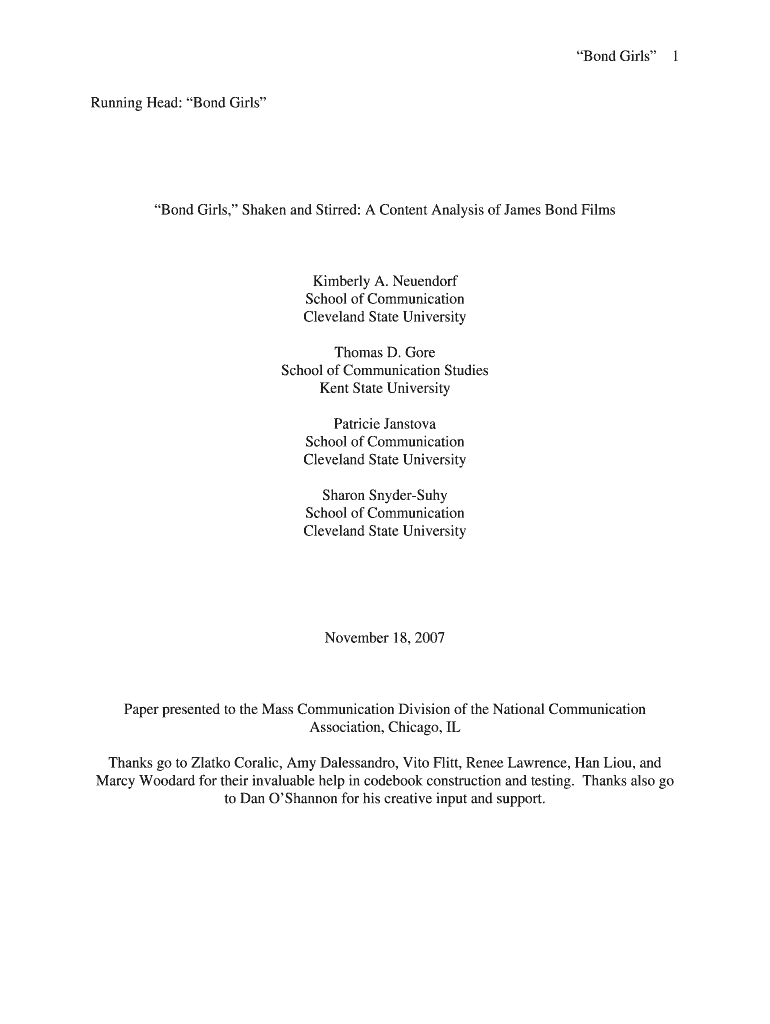
The document titled "Bond Girls, Shaken and Stirred: A Content Analysis of James Bond Films" is an academic study conducted by Cleveland State University. It focuses on the portrayal of female characters, commonly referred to as 'Bond girls,' in the James Bond film series. The analysis explores themes such as physical characteristics, sexual activity, and experiences of violence, providing a comprehensive overview of how these characters have been depicted from 1962 to 2007. This study is essential for understanding the evolution of gender roles and stereotypes in popular culture, particularly within the iconic James Bond franchise.
Key Elements of the Bond Girls, Shaken and Stirred - Cleveland State University - Academic csuohio
The document covers several critical elements regarding the portrayal of Bond girls:
- Physical Characteristics: Analysis of the visual and physical traits as depicted in the films, serving as a baseline to examine changes over time.
- Sexual Activity: Examination of the frequency and nature of sexual encounters involving Bond girls, drawing attention to how sexuality is portrayed.
- Experiences of Violence: Discussion on the duality of these characters as both independent individuals and victims, highlighting patterns of vulnerability.
- Stereotypes and Patterns: Identification of recurring themes and persistent stereotypes, such as sexualization and disposability, within the narratives.
Steps to Complete the Bond Girls, Shaken and Stirred - Cleveland State University - Academic csuohio
Completing the content analysis involves a structured approach:
-
Literature Review: Begin by reviewing relevant literature on gender representation in film to provide context and support for the study.
-
Data Collection: Gather data from all James Bond films released between 1962 and 2007, with particular focus on scenes involving Bond girls.
-
Quantitative Content Analysis: Employ quantitative methods to analyze the collected data, focusing on measurable attributes such as screen time, dialogue, and interactions.
-
Thematic Analysis: Conduct a thematic analysis to identify and categorize recurring themes, such as empowerment and objectification.
-
Report Findings: Summarize the findings in a structured report, detailing the evolution of Bond girls over the decades and their impact on cultural perceptions.
Who Typically Uses the Bond Girls, Shaken and Stirred - Cleveland State University - Academic csuohio
This academic document is primarily used by:
- Researchers and Scholars: Those studying film, gender studies, and cultural representations use it as a resource for understanding complex gender dynamics.
- Students: Particularly those pursuing courses in film studies or sociology, who require comprehensive case studies on gender portrayal in media.
- Film Critics and Historians: Individuals examining the evolution of film narratives and character development across significant franchises.


Important Terms Related to Bond Girls, Shaken and Stirred - Cleveland State University - Academic csuohio
Understanding this document requires familiarity with several key terms:
- Quantitative Content Analysis: A research method that quantifies elements within the films to systematically analyze specific content.
- Stereotypes: Oversimplified and fixed ideas about gender roles that often appear in media portrayals.
- Sexualization: The act or process by which individuals are portrayed in a sexual manner.
- Disposability: Referring to how Bond girls are often depicted as interchangeable within the storyline.
Examples of Using the Bond Girls, Shaken and Stirred - Cleveland State University - Academic csuohio
The practical application of this document can be seen in various academic and professional settings:
- Course Syllabi: In inclusion in university-level film studies or sociology courses as a case study or required reading.
- Research Papers: As a source of quantitative data and thematic insights for studies on media representation.
- Cultural Analysis: Film critics may reference the findings to comment on the portrayal of women in modern adaptations or new films.
Legally Binding Electronic Signatures
Utilizing DocHub for handling such academic documents involves understanding its features like legally binding electronic signatures. This capability allows users to authenticate their work and provide signed attestations. Electronic signatures comply with the ESIGN Act, ensuring legality and validity, which is essential for academic integrity and formal submissions.
Creation Methods
- Drawing: Use a mouse or trackpad to create your signature, offering a personal touch.
- Typing: Type and stylize your signature for a professional-looking result.
- Uploading: Import an image of your handwritten signature for authenticity.
Receiving Signatures
To obtain signatures from collaborators or reviewers:
- Create a Sign Request: Specify recipients, outlining the signing order.
- Send via Email: Efficiently request and track the signature process.
- Track Progress: Use automated reminders and set deadlines for timely completion.
Software Compatibility (TurboTax, QuickBooks, etc.)
While DocHub is predominantly used for document workflow, understanding its interoperability with other software systems is crucial. Users dealing with educational documents may benefit from compatibility insights when integrating with business-grade software:
- Seamless Integration with Google Workspace: Import from and export to Google Drive or Gmail without the hassle of downloads.
- Cloud Storage Sync: Ensure documents are kept in sync across platforms, contributing to streamlined academic collaboration or review processes.
By retaining the alignment with available technical infrastructure, users maximize efficiency and accuracy across diverse systems.