






Definition and Meaning of "Farewell to Growth"
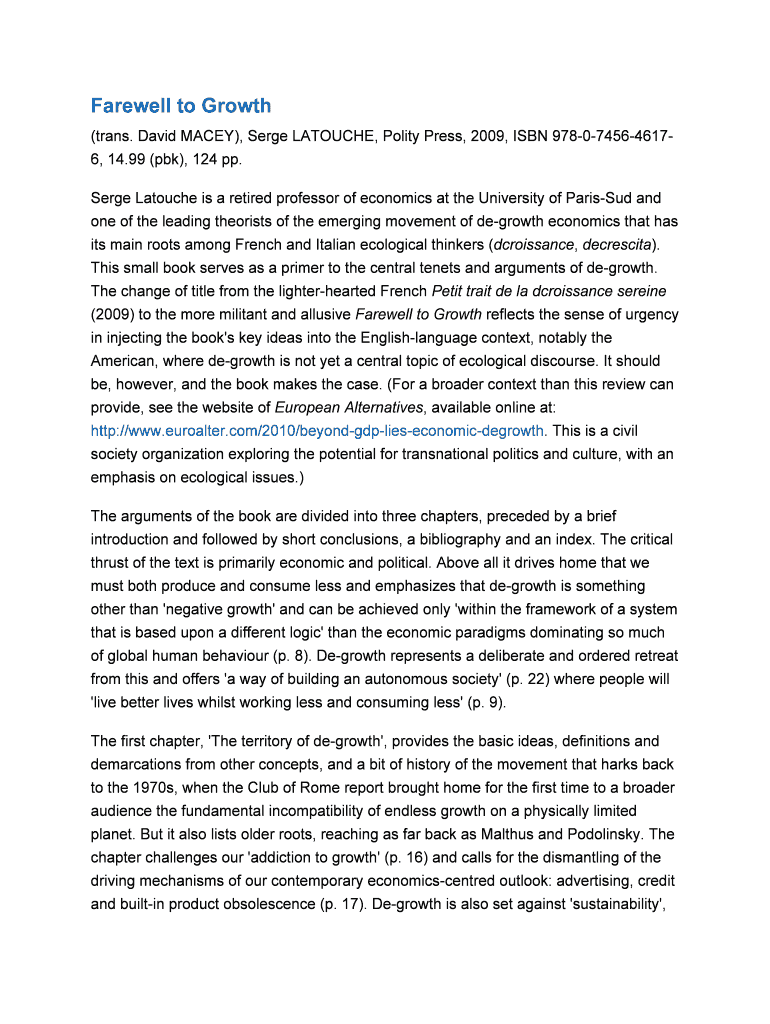
The notion of "Farewell to Growth" derives from the economic theory known as de-growth. Introduced by Serge Latouche, this concept challenges the traditional paradigm of continuous economic expansion. De-growth advocates for a deliberate reduction in production and consumption to address the unsustainability of perpetual growth. It calls for a shift towards localized, ecological practices prioritizing social well-being over profitability. The idea focuses on restructuring societal goals to better align with environmental preservation and social equity.
How to Use the "Farewell to Growth" Approach
Implementing the "Farewell to Growth" approach involves transitioning towards more sustainable lifestyle choices and business practices. This approach requires individuals and organizations to reassess their consumption patterns, reducing reliance on non-renewable resources. It encourages the adoption of practices such as recycling, minimizing waste, and opting for local products to reduce the carbon footprint. Communities are urged to invest in public spaces and services that enhance quality of life rather than focusing solely on economic metrics such as GDP.
Key Elements of the "Farewell to Growth" Concept
The "Farewell to Growth" concept is structured around several key principles, often summarized as the 'eight R's': Re-evaluate, Re-conceptualize, Restructure, Relocate, Redistribute, Reduce, Re-use, and Recycle. These elements serve as guidelines for transitioning towards a sustainable society. For instance, restructuring involves changing production and consumption priorities, while redistributing emphasizes social equity. By following these principles, societies can move toward a more balanced approach that addresses both human and environmental needs.
Examples of Using the "Farewell to Growth" Model
Practical applications of the "Farewell to Growth" model can be seen in initiatives like community-supported agriculture (CSA) and cooperatives. These models prioritize local production and community involvement, reducing reliance on global supply chains. Urban farming projects and renewable energy cooperatives also exemplify how communities can adopt de-growth strategies. By focusing on sustainable practices and community engagement, these projects help reduce environmental impact while fostering social cohesion.
Important Terms Related to "Farewell to Growth"
Understanding "Farewell to Growth" involves grasping several important terms. Decentralization is the process of distributing resources and decision-making power away from central authorities, emphasized in de-growth as a path to empower local communities. Sustainability refers to the ability to maintain ecological and social systems healthily over time. Localization highlights the focus on local resources and economies to reduce dependency on the global market and its associated environmental costs.
Legal Use and Implications of the "Farewell to Growth"
While "Farewell to Growth" itself is not a legal document, the principles it advocates have legal implications. For instance, policies supporting this philosophy might involve legislative changes focused on environmental protection and social equity. Local governments can introduce laws that encourage sustainable practices, such as tax incentives for businesses that reduce their carbon footprint. Legal frameworks play a crucial role in facilitating the de-growth transition by creating supportive environments for sustainable practices.
Digital vs. Paper Version: Disseminating "Farewell to Growth" Ideas
Spreading the "Farewell to Growth" ideology can occur through both digital and traditional means. Digitally, online platforms, webinars, and e-books can facilitate widespread access to de-growth philosophies, enabling easy sharing and discussion. On the other hand, paper publications, such as community newsletters and printed guides, can effectively reach audiences with limited internet access. By balancing both methods, advocates can ensure broader dissemination and engagement.
State-Specific Rules and Applications of the "Farewell to Growth" Approach
The application of "Farewell to Growth" can vary significantly depending on regional policies and regulations in the United States. Certain states, like California, have more progressive policies focused on sustainability and may offer incentives for adopting de-growth practices. Conversely, states with economies heavily reliant on industries such as oil and mining might face more resistance. Local cultural attitudes and economic structures greatly influence how effectively de-growth initiatives can be implemented within different states.
Who Typically Uses the "Farewell to Growth" Philosophy
Individuals and organizations committed to sustainability, environmental activism, and social equity are often aligned with the "Farewell to Growth" philosophy. This includes non-profit organizations advocating for ecological practices, businesses focused on reducing their environmental impact, and community groups promoting local economic initiatives. Additionally, policymakers interested in long-term environmental strategies see the de-growth perspective as a valuable framework for crafting legislation aimed at sustainability.