







Definition and Meaning
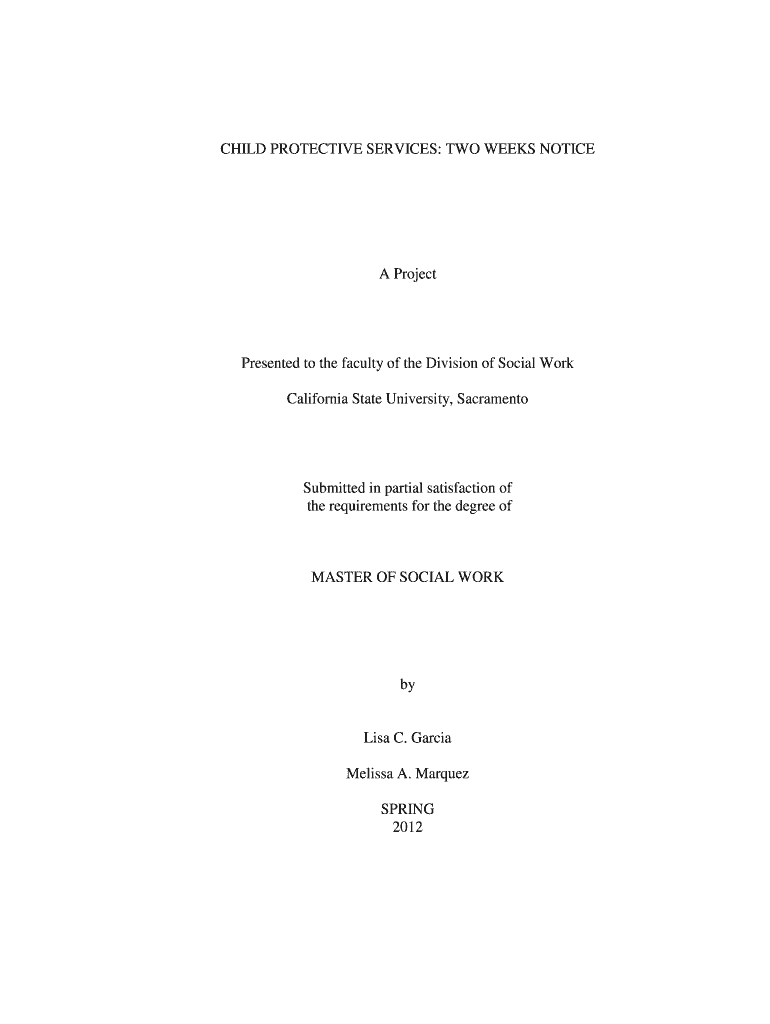
The "Melissa Marquez and Lisa Garcia Final Product" comprises a comprehensive master's project by Lisa C. Garcia and Melissa A. Marquez, submitted to California State University, Sacramento in 2012. This project provides analytical insights into the factors contributing to high turnover rates among child welfare social workers, particularly focusing on El Dorado County, California. The purpose is to aid child welfare agencies in enhancing retention strategies, ultimately improving service delivery to children and families.
Key Elements of the Melissa Marquez and Lisa Garcia Final Product
The final product encompasses several key elements:
- Analysis of Turnover Rates: An in-depth examination of the high turnover rates among social workers within child welfare services.
- Factors of Turnover: Identification of contributing factors such as management support, organizational culture, and workload.
- Improvement Recommendations: Suggestions to enhance retention strategies in child welfare agencies.
- Impact Study: Evaluation of how improved strategies can enhance service delivery to families and children.
Steps to Complete the Melissa Marquez and Lisa Garcia Final Product
- Research Design: Develop a robust framework for analyzing turnover rates.
- Data Collection: Gather qualitative and quantitative data related to social worker retention.
- Assessment: Evaluate the data to identify significant factors contributing to turnover.
- Insights Development: Formulate actionable insights and strategies to reduce turnover.
- Report Compilation: Document findings and recommendations comprehensively.
- Submission: Ensure the final product meets academic standards for submission to California State University.
Why You Should Use the Melissa Marquez and Lisa Garcia Final Product
Utilizing the insights from this project provides:
- Improved Retention: Guidance on enhancing strategies that improve workforce stability.
- Enhanced Service Delivery: Insights lead to better services for children and families.
- Knowledge Exchange: A deeper understanding of challenges in child welfare services.
Who Typically Uses the Melissa Marquez and Lisa Garcia Final Product
- Child Welfare Agencies: Agencies looking to improve worker retention and service quality.
- Academic Researchers: Scholars analyzing workforce dynamics in the social work sector.
- Policymakers: Individuals involved in drafting policies for social work improvements.


Important Terms Related to Melissa Marquez and Lisa Garcia Final Product
- Turnover Rates: The frequency at which employees leave a workforce over a specified period.
- Organizational Culture: Values and behaviors that contribute to the unique social and psychological environment of an organization.
- Retention Strategies: Techniques employed to retain employees in an organization.
Legal Use of the Melissa Marquez and Lisa Garcia Final Product
The legal use of the final product pertains to academic and practical research aimed at policy improvement and workforce management within child welfare agencies. It serves as a documented study that aligns with U.S. academic standards and contributes to societal benefit.
Examples of Using the Melissa Marquez and Lisa Garcia Final Product
- In Policy Formulation: Agencies may apply insights to develop policies that address high turnover rates.
- In Training Programs: Use can extend to training sessions aimed at new social workers to better understand workplace challenges and coping mechanisms.
- In Organizational Development: Implement strategies to improve management support and workload distribution.
Eligibility Criteria
Entities eligible to use the project insights include:
- Educational Institutions: For curriculum development and educational improvement.
- Government Bodies: To refine public services in child welfare systems.
- Non-Profit Organizations: Those focused on advocacy and support for children and families.

Required Documents for Utilizing the Melissa Marquez and Lisa Garcia Final Product
To access and utilize this final product effectively:
- Authorization from Educational Institutions: Verification of eligibility for academic or research purposes.
- Institutional Review Board Approval: If applicable, for any subsequent research derived from the project.
By integrating these elements, stakeholders can leverage this final product to drive change and improvement within child welfare systems, contributing to more stable and effective service delivery.




