







Definition and Purpose of the Sabbatical Leave Report
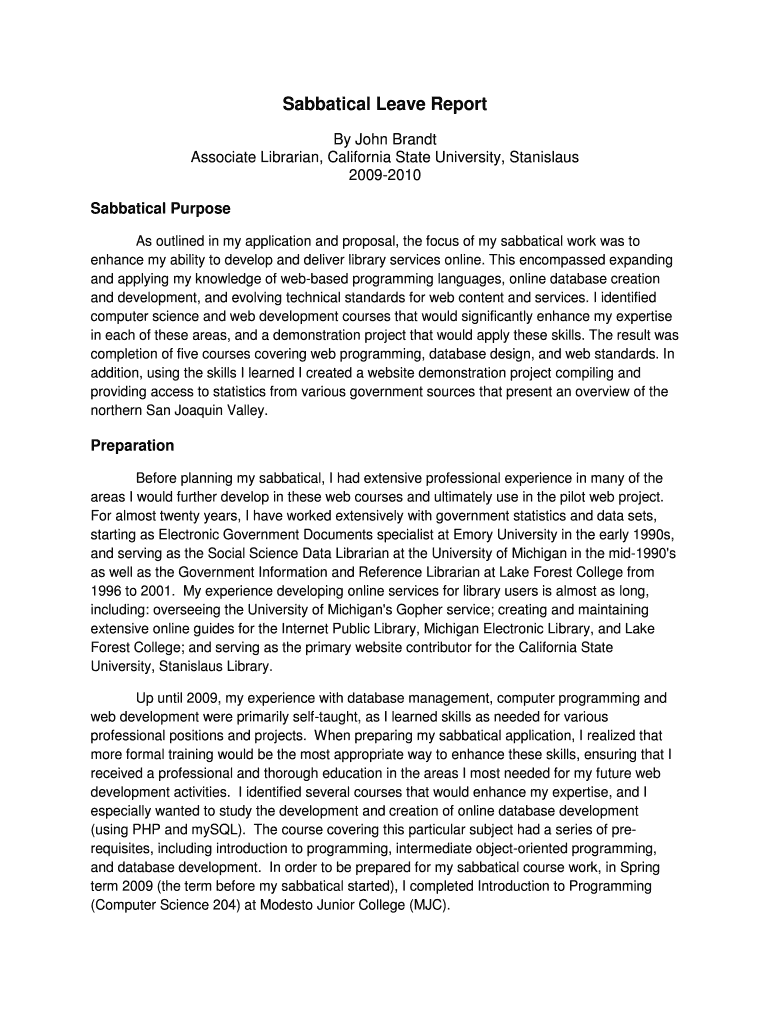
The Sabbatical Leave Report is a comprehensive document employed by professionals who have taken a period away from regular employment to engage in research, professional development, or other scholarly pursuits. This report serves as a formal account of a sabbatical period, detailing the end goals, activities completed, outcomes achieved, and insights gained during the absence from traditional work duties. It is often used in academic settings to ensure that individuals return with enhanced skills and knowledge that contribute to the goals and missions of their institutions.
The Role of a Sabbatical Leave
- Professional Development: The report highlights new skills acquired, such as completing courses or certifications.
- Research and Exploration: It makes a record of innovative projects or research-related work conducted.
- Organizational Contribution: Evidence of how the individual’s experiences will add value to the institution or organization upon their return.
Steps to Complete the Sabbatical Leave Report
Completing a Sabbatical Leave Report can be straightforward with a systematic approach. Follow the typical format to ensure all aspects of the sabbatical period are adequately covered.
Detailed Procedure
- Introduction and Objectives: Clearly articulate the initial objectives set out for the sabbatical. Explain the purpose and what was intended to achieve.
- Summary of Activities: Provide a comprehensive overview of activities undertaken, courses completed, and projects worked on.
- Outcomes and Achievements: Detail the outcomes of those activities, explicitly linking them to the original objectives.
- Impact on Professional Growth: Reflect on the personal and professional growth experienced. Provide specifics on new skills and knowledge gained.
- Future Implications: Assess how the learnings from the sabbatical will be applied in the professional context to benefit the organization or field of work.
Formatting and Submission Tips
- Use subheadings for each section to improve clarity.
- Include any relevant data or statistics to support your activities and outcomes.
- Ensure adherence to any institutional formatting and submission guidelines.
Essential Components of an Effective Sabbatical Leave Report
Successful reports contain specific elements that convey the sabbatical's value and effectiveness. The following details are commonly included:
- Title Page: List name, title, institution, and sabbatical dates.
- Abstract: A concise summary of the report's content.
- Acknowledgments: Recognize any support received before or during the sabbatical.
- Bibliography or References: Include sources or literature cited during the sabbatical.
Critical Sections to Include
- Initial Goals: Emphasize how the goals aligned with both personal and institutional objectives.
- Challenges and Solutions: Discuss any difficulties faced and how those were mitigated.
- Conclusion: Offer a concluding section summarizing key insights and forward-looking statements.
Why and Who Uses the Sabbatical Leave Report
The need for a Sabbatical Leave Report spans multiple professional arenas, and its users often find distinct benefits from its comprehensive format.
Importance of the Report
- Encourages accountability and reflection on one's professional journey.
- Offers organizations documented evidence of growth and enhanced expertise.
Typical Users
- Academics and Researchers: Universities and research institutions regularly require this report to document the accomplishments and benefits during a sabbatical.
- Corporate Settings: Professionals in specialized industries might also use the report to justify the strategic benefits of their sabbatical learning to their firms.
Preparing and Accessing the Sabbatical Leave Report
Navigating the preparation and submission process involves familiarizing oneself with the logistics and resources necessary for an effective report.
Accessing the Template
- Institutional Access: Many companies or educational institutions provide dedicated templates and guidelines for their staff.
- Digital Tools: Platforms like DocHub offer document editing and signing facilities which can be utilized for both preparing and sharing the report securely.
Preparation Guidelines
- Begin gathering materials and reflecting on experiences throughout the sabbatical, rather than rushing at the end.
- Use digital tools to draft, edit, and ensure document security prior to submission.
Legal and Compliance Aspects
Considering regulatory and legal dimensions is crucial for preparing a compliant Sabbatical Leave Report.
Legal Considerations
- Ensure all reported activities are aligned with the initial sabbatical agreement.
- Understand any agreements related to intellectual property or proprietary research that might have been developed during the sabbatical.
Compliance Requirements
- The report should adhere to organizational policies regarding document retention and submission deadlines.
- Verify any specific format or content requirements set forth by governing authorities, particularly within academic settings.
Examples of Use Cases for A Sabbatical Leave Report
Different scenarios illustrate how a Sabbatical Leave Report may be advantageously utilized across varied professions.
Case Study Illustrations
- Academic Example: Dr. Clark, a biology professor, used her sabbatical to publish groundbreaking research on climate change impacts, detailing each phase from lab research to peer-reviewed publication in her report.
- Corporate Example: Ms. Garcia, an IT executive, undertook a sabbatical to explore emerging technologies, documented her enhanced network and strategic direction insights, which led to the adoption of new technologies in her firm.
Outcomes of Effective Reporting
- In both cases, the compiled documentation helped in clearly communicating the professional advancements accomplished, enhancing subsequent career advancements and validating the value of sabbaticals within their respective institutions.




