







Definition & Meaning
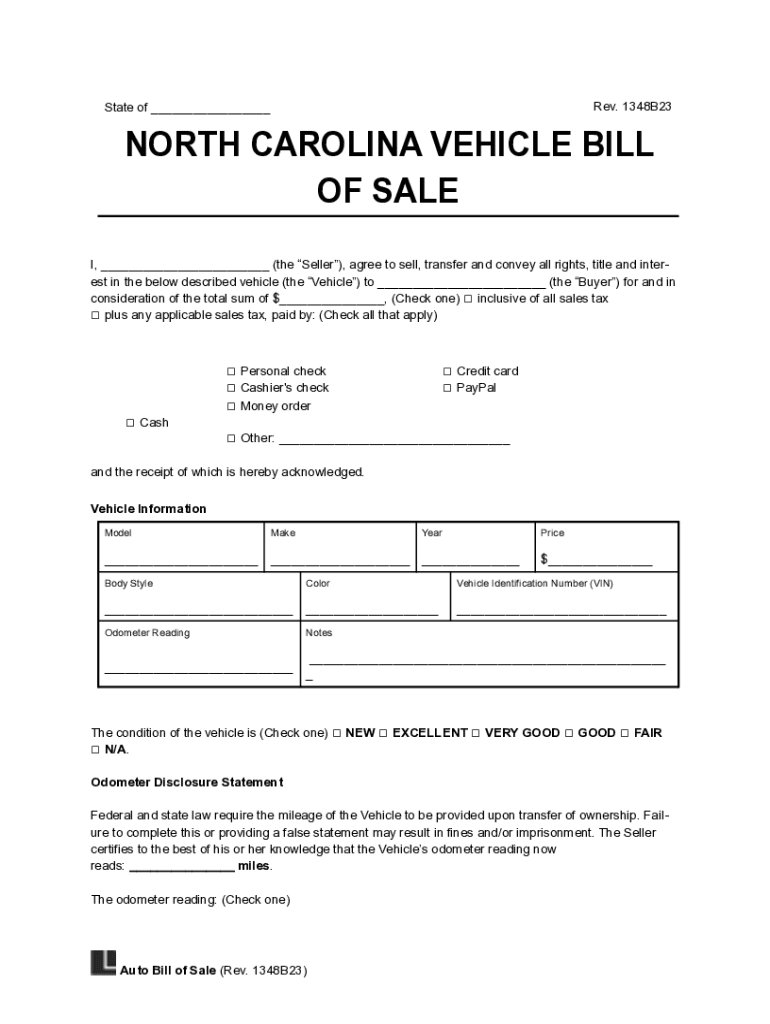
The North Carolina Motor Vehicle Bill of Sale Form, often referred to simply as a bill of sale, is a legal document used to record the sale or transfer of a motor vehicle between a seller and a buyer. This form serves as evidence of the transaction and outlines essential details like the parties involved, vehicle specifications, and payment terms.
Key Components of the Form
- Identification of Parties: The document includes names, addresses, and contact information for both the seller and buyer.
- Vehicle Description: Details such as make, model, year, vehicle identification number (VIN), and mileage.
- Payment Terms: The sale price, payment method, and any conditions related to the sale.
- Signatures: Both parties must sign the form to acknowledge the terms of the sale and affirm their agreement.
How to Obtain the North Carolina Motor Vehicle Bill of Sale Form
To obtain a North Carolina Motor Vehicle Bill of Sale Form, you can either download it from various online legal document platforms or request a hard copy at your local Department of Motor Vehicles (DMV). Many websites, including those that specialize in eForms, offer downloadable and fillable versions of the document for convenience.
Online Resources
- Available on legal form websites where you can fill it out digitally.
- Verify that any online source provides a version compliant with North Carolina state laws.
Local DMV Access
- Visit a nearby North Carolina DMV office.
- Request a physical copy if you prefer handling paperwork directly with state representatives.
Steps to Complete the North Carolina Motor Vehicle Bill of Sale Form
Filling out the North Carolina Motor Vehicle Bill of Sale Form involves several key steps to ensure all required information is accurately recorded.
-
Enter Buyer and Seller Information:
- Include full legal names and contact information for both parties.
-
Provide Vehicle Details:
- Specify make, model, year, VIN, and odometer reading to uniquely identify the vehicle.
-
Outline Payment Agreement:
- Clearly state the purchase price, and payment arrangements (e.g., cash, check, financing).
-
Signatures and Notarization:
- Both parties must sign. Notarization is required to validate the document legally.
Why Use a North Carolina Motor Vehicle Bill of Sale Form
A well-drafted North Carolina Motor Vehicle Bill of Sale Form is crucial for several reasons:
- Legal Record: Provides a formal, legally recognized record of the sale.
- Proof of Ownership Transfer: Documents the change of vehicle ownership, protecting both buyer and seller.
- Protection in Disputes: Useful in resolving potential disputes related to the sale.
- Compliance: Ensures adherence to North Carolina state legal requirements for vehicle sales.
Who Typically Uses the North Carolina Motor Vehicle Bill of Sale Form
This form is primarily used by individuals and businesses involved in the sale or transfer of motor vehicles within North Carolina.


Common Users
- Individual Sellers and Buyers: Engage in private transactions for personal vehicle sales.
- Dealerships: Utilize the form for documenting sales of new or used vehicles.
- Charities and Non-Profits: Use it when donating vehicles as legal proof of the transfer.

State-Specific Rules for the North Carolina Motor Vehicle Bill of Sale Form
There are particular legal stipulations in North Carolina concerning the execution of a bill of sale for motor vehicles.
Important Regulations
- Notarization Requirement: The form must be notarized to be legally valid.
- Buyer Notification: Buyers need to promptly report the transaction to the DMV to update vehicle registration records.
- Tax Obligations: Buyers should be aware of excise tax duties upon purchase.
Legal Use of the North Carolina Motor Vehicle Bill of Sale Form
The proper use of the North Carolina Motor Vehicle Bill of Sale Form involves adherence to the state-mandated legal guidelines presiding over motor vehicle transactions.
Compliance Measures
- Completeness: Ensure all sections are filled out comprehensively before signing.
- Witnessing: Notarization acts as an official witnessing procedure to prevent fraud.
- Retention of Copies: Both parties should keep a copy for personal records and tax purposes.
Key Elements of the North Carolina Motor Vehicle Bill of Sale Form
The bill of sale contains several critical elements essential for capturing the nature of the sale accurately.
Core Elements
- Date of Sale: Establishes the exact date when ownership was transferred.
- Disclosures: Includes odometer readings and any statements regarding the vehicle’s condition.
- Conditions of Sale: Any warranties or as-is purchase terms are documented.
By understanding and utilizing these sections of the North Carolina Motor Vehicle Bill of Sale Form, you can ensure a hassle-free and legally compliant vehicle sale or purchase within the state.




