







Definition and Meaning
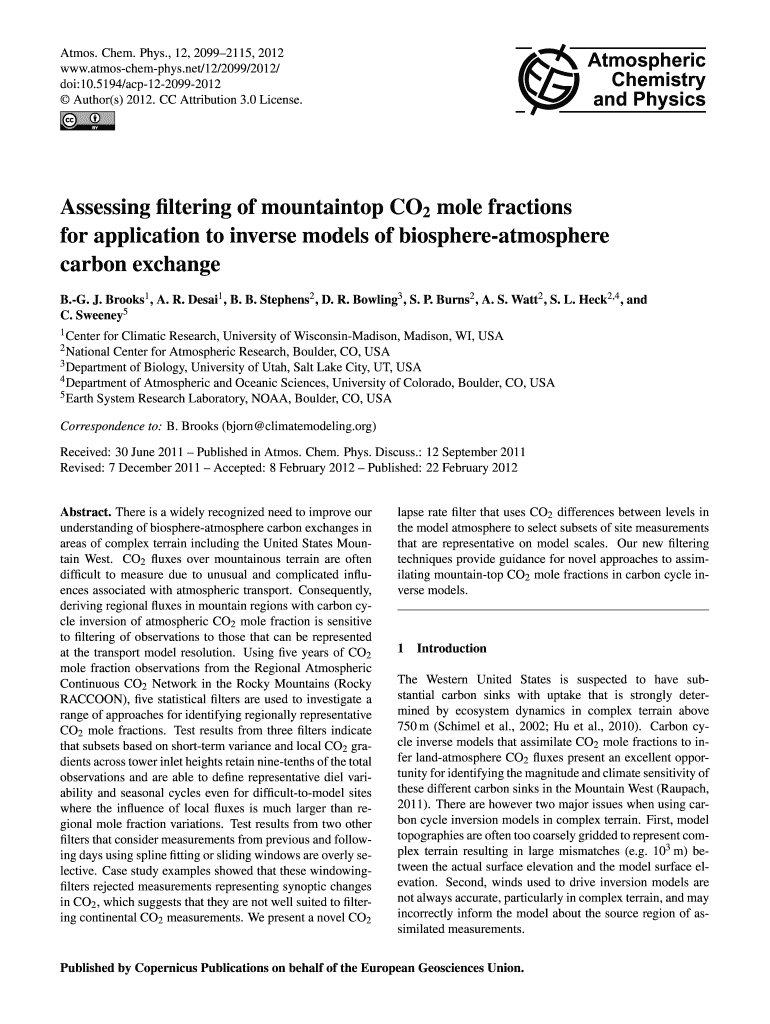
Assessing filtering of mountaintop CO2 mole fractions for application generally refers to the process of evaluating the use and efficacy of various statistical filters designed to identify representative carbon dioxide measurements at mountaintop levels. This is crucial for improving carbon cycle inverse models, which are models used to estimate sources and sinks of CO2 across regions. Accurate filtering is essential in complex terrains where local influences might distort data, thereby affecting the understanding of biosphere-atmosphere carbon exchanges.
Steps to Complete the Application
- Understand the Purpose: Before starting, it is essential to have a clear understanding of why the form is required. This involves familiarizing yourself with the objectives of filtering CO2 measurements, particularly in mountainous regions.
- Gather Necessary Data: Collect all relevant CO2 measurement data from mountaintop locations that need filtering.
- Identify Appropriate Filters: Evaluate and select statistical filters, such as the lapse rate filter, that are most suitable for the geographical and technical requirements of your CO2 data.
- Apply Filters: Implement the chosen filters on the CO2 data to assess their effectiveness in accurately capturing representative mole fractions.
- Verify Results: Cross-check the filtered results with unfiltered data to ensure improvements in the accuracy of CO2 mole fraction representations.
- Documentation: Carefully document the process, filters used, and findings for future reference and validation.
Important Terms Related to the Application
- CO2 Mole Fraction: The ratio of carbon dioxide molecules compared to the total number of molecules in a given air sample.
- Carbon Cycle Inverse Models: These models are used to deduce CO2 sources and sinks based on atmospheric measurement data.
- Statistical Filters: Algorithms or techniques applied to raw data to reduce noise and extract significant values.
- Lapse Rate Filter: A novel approach in filtering that considers atmospheric layer differences to enhance the selection of CO2 data.
Why Use This Assessment
This assessment is essential for improving carbon cycle inverse models, which directly contribute to better understanding and mitigating climate change impacts. By evaluating and applying appropriate filters, researchers can ensure that CO2 data from complex terrains like mountain tops are accurate and reliable, which is crucial for environmental planning and policy-making.
Key Elements of the Form
- Selection of Filters: Key focus on choosing statistical methods capable of distinguishing between local CO2 variations and broader atmospheric trends.
- Data Accuracy: Emphasis on the precision of data post-filtering, ensuring it supports valid scientific analyses.
- Documentation of Process: Detailed recording of methods, filters applied, and the rationale behind chosen methodologies.
- Verification Techniques: Systems in place to check the validity and reliability of the filtered data.
Examples of Use
- Academic Research: Used by environmental scientists to publish studies on CO2 variations in mountainous areas.
- Governmental Research: Employed by agencies monitoring compliance with CO2 emissions standards and environmental regulations.
- Climate Modeling: Utilized by researchers involved in climate projections and the study of environmental consequences of atmospheric changes.
State-Specific Rules
While the assessment of mountaintop CO2 filtering is broadly applicable across different regions, certain states might have specific guidelines, especially those with significant mountainous terrain like Colorado and Utah. Regulations may vary based on local environmental policies and emissions reporting standards.
Digital vs. Paper Version
While traditionally data assessments might be conducted via paper reports, this application is ideally suited to digital methods that allow for sophisticated data analysis and real-time adjustments. Software integration and digital records support more efficient processing and sharing of CO2 filtering applications.
Business Types That Benefit
While primarily academic and governmental research-focused, businesses in environmental consultancy and renewable energy sectors can also greatly benefit from accurate CO2 data filtering. These businesses require precise environmental data to offer effective solutions and meet regulatory compliance.
By exploring these elements, the application offers a comprehensive and systematic approach to handling CO2 data in complex terrains, contributing to greater environmental insights and actions.




