







Definition & Meaning
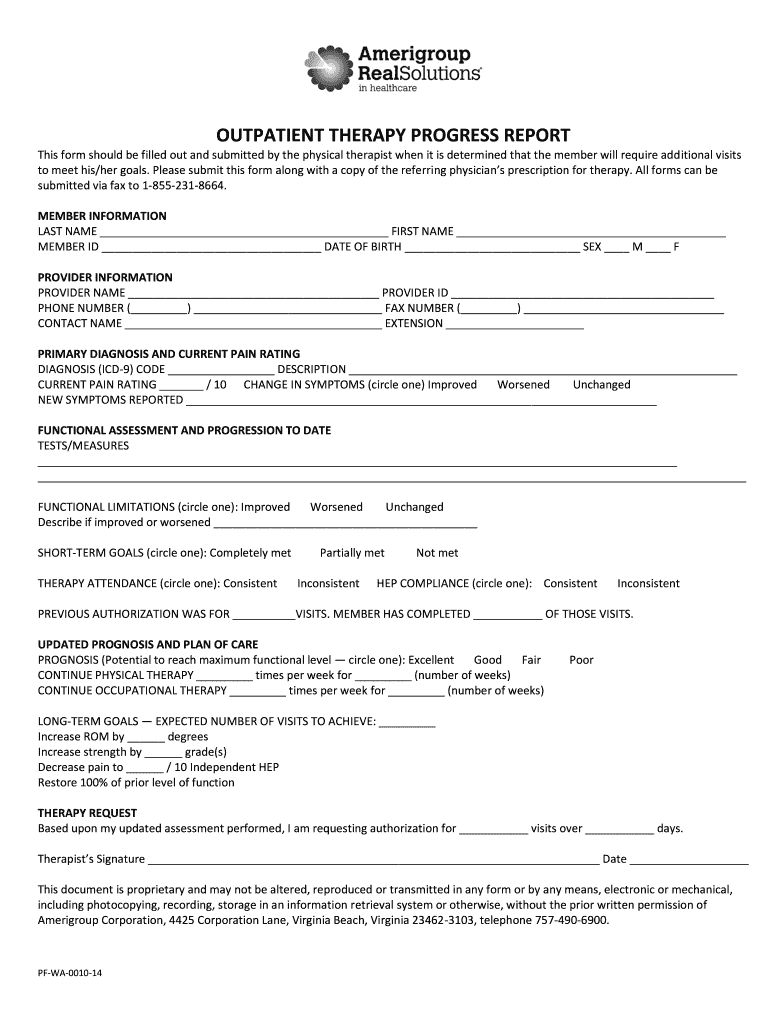
The "Outpatient Therapy Progress Report - Providers Amerigroup" refers to a structured document completed by healthcare professionals, particularly physical therapists, to request additional sessions for a patient receiving outpatient therapy. Its main purpose is to provide a comprehensive account of the patient’s progress, including improvements, ongoing challenges, and justification for continued therapy. This document is essential for securing approval from Amerigroup for extended therapy coverage.
Core Elements
- Patient Information: Identifies the patient through personal details and insurance coverage specifics.
- Therapist and Provider Details: Includes names, contact information, and credentials of the healthcare provider.
- Diagnostic Details: Captures the patient’s current diagnosis and any related medical evaluations guiding the therapy plan.
Purpose and Importance
The report serves as a communication tool between therapists and Amerigroup, ensuring that therapy services provided align with the patient's medical needs and insurance coverage. Accuracy in reporting fosters transparency and efficiency in obtaining necessary authorizations for extended care.
How to Use the Outpatient Therapy Progress Report - Providers Amerigroup
Steps for Usage
- Gather Relevant Information: Start by collecting all necessary patient and therapy details, including previous diagnosis and treatment outcomes.
- Complete Sections in Sequential Order: Follow the form’s structure beginning with patient information, followed by therapy details, and conclude with provider insights.
- Incorporate Objective Data: Use objective measures such as pain ratings and functional assessments to support the need for continued therapy.
Critical Considerations
- Ensure all data entries are accurate and reflective of the patient's current status.
- Leverage the report consistently across therapy sessions to track progress over time.
- Validate the form's compatibility with Amerigroup’s submission requirements to avoid processing delays.
Steps to Complete the Outpatient Therapy Progress Report - Providers Amerigroup
Detailed Procedure
-
Patient and Insurance Information
- Enter detailed patient demographics and Amerigroup insurance information for precise identification.
-
Current Diagnosis and Therapy Summary
- Summarize the existing diagnosis and briefly describe the therapy provided, including specific techniques and interventions used.
-
Functional Assessment
- Document the patient's functional abilities and limitations using standardized assessment tools.
-
Justification for Continued Therapy
- Provide a clear rationale supported by evidence and observations justifying the need for additional therapy sessions.
-
Therapist’s Signature and Date
- Finalize the form with the therapist’s signature and the date of completion to validate the document’s authenticity.
Tips for Accuracy
- Cross-reference information with previous reports to ensure consistency.
- Utilize digital tools available through platforms like DocHub to enhance precision and streamline documentation.
Who Typically Uses the Outpatient Therapy Progress Report - Providers Amerigroup


Targeted Users
- Physical and Occupational Therapists: These professionals primarily utilize the report to document therapy progress and request authorization for further sessions.
- Healthcare Administrators: Involved in managing patient files and liaising with Amerigroup to ensure continuous therapy coverage.
- Patient Advocates: May assist in the process to guarantee that patient rights to extended therapy are upheld.
Institutional Use
The report is integral to clinics and hospitals that provide outpatient therapy services and need to navigate insurance requirements to optimize patient care management efficiently.
Key Elements of the Outpatient Therapy Progress Report - Providers Amerigroup
Essential Components
- Member and Provider Information: Correctly filled personal and professional details to ensure proper communication channels.
- Diagnosis and Prognosis: Medical evaluation showing current health status and expected outcomes.
- Therapy Attendance Records: Reliable logs reflecting regular patient participation and cooperation in therapy sessions.
Importance of Each Element
- Each section must convey precise information to support therapy continuation and secure necessary funding from Amerigroup.
- Aligns therapy goals with the patient’s health improvement, supporting evidence-based treatment planning.
Legal Use of the Outpatient Therapy Progress Report - Providers Amerigroup
Compliance Guidelines
- Adheres to privacy regulations, maintaining patient confidentiality throughout the documentation process.
- Meets Amerigroup’s legal and procedural guidelines for insurance claims related to extended therapy sessions.
Protecting Patient Rights
- Ensures patients receive necessary care as stipulated by medical needs, supported through proper documentation.
- Empowers patients by providing a documented account of therapy progress beneficial for future healthcare considerations.
Digital vs. Paper Version
Advantages of Digital Formats
- Digital forms, such as those edited on DocHub, allow for easier updates, sharing, and storage.
- Improved legibility and reduced risk of incomplete submissions due to digital field validations.
Paper Format Considerations
- Necessary in environments where digital access is limited or during specific compliance checks requiring a hardcopy.
Best Practices
- Utilize digital platforms for efficiency and speed, ensuring that a secure repository is maintained for all electronic records.
- Consider hybrid approaches for clinics that still require tangible proof of documentation while transitioning to digital solutions.
Software Compatibility
Integration with Cloud Services
- Supports Google Workspace facilitating secure document management and streamlined sharing with Amerigroup.
- Compatible with various file formats ensuring broad accessibility for uploads and edits.
Benefits of Compatibility
- Empowers therapists with flexibility, allowing form completion on various devices and platforms without the need for extensive software installations.
- Enhances collaboration, enabling easy access for multiple contributors to review and update patient progress reports.
Recommended Software
- Use platforms like DocHub to efficiently manage therapy reports, promoting seamless integration with existing digital workflows and ensuring robust data protection measures.




