
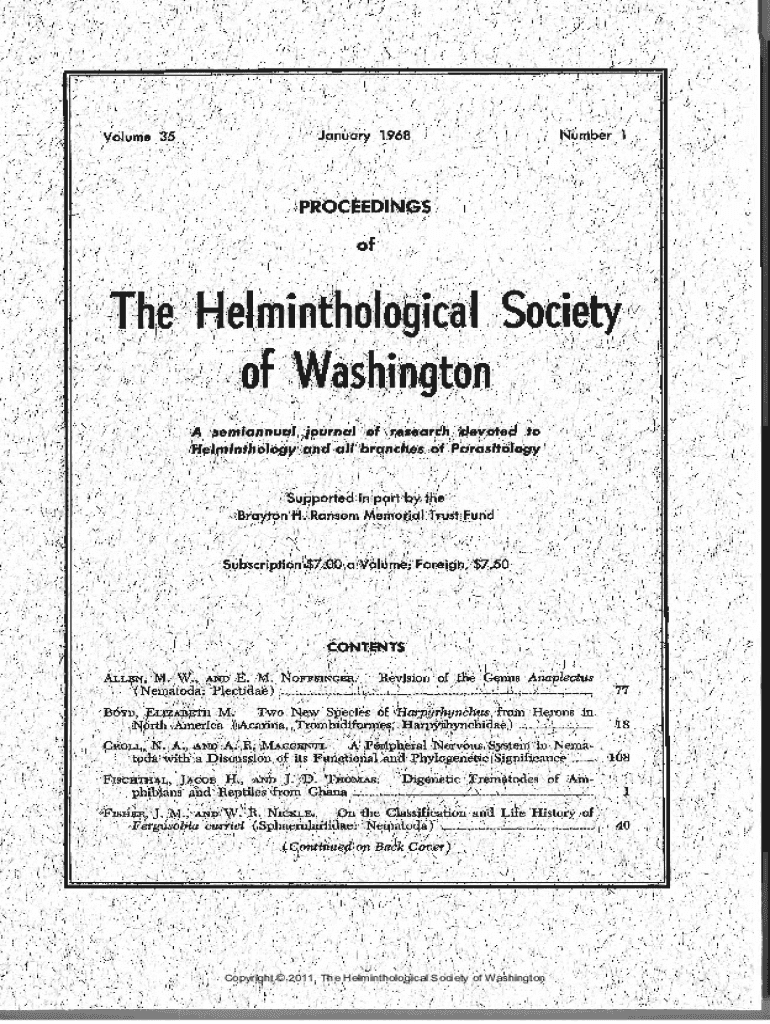







Definition & Meaning
The term "Helmintholodical of Washington - Peru State College" references a specialized area of academic research and publication associated with Helminthology, the study of parasitic worms. Rooted in historical academic journals, this title ties to the traditions of scholarly communication. Helminthology represents a critical area in biological studies, focusing on the identification, biology, and life cycles of parasitic worms that impact various host species, including humans and animals.
Importance of the Form
The "Helmintholodical of Washington - Peru State College" serves as an essential tool for researchers, educators, and students at Peru State College. It enables the structured presentation of research findings, playing a pivotal role in advancing scientific knowledge in the field. For students, it provides a medium for learning and improving research and documentation skills in line with professional scientific standards.
Steps to Complete the Form
-
Gather Necessary Information: Compile all research data, findings, and references related to your study. Ensure clarity and accuracy in all provided information.
-
Follow Institutional Guidelines: Review any specific formatting or structural guidelines provided by Peru State College or the related journal publication.
-
Complete Required Sections: Address all sections of the form comprehensively, including an introduction, methodology, results, and discussion.
-
Review & Proofread: Check for any errors or inconsistencies. Reviewing by colleagues or mentors may provide additional insights.
-
Submit According to Protocol: Utilize the prescribed submission method, ensuring that the form reaches the intended repository or journal editor.
How to Obtain the Form
To acquire the "Helmintholodical of Washington - Peru State College," check the Peru State College's official website or the relevant department's administrative office. It is often available through digital portals dedicated to academic resources or directly from the journal associated with these proceedings.
Key Elements of the Form
- Abstract: A concise summary that encapsulates the study's essence and primary outcomes.
- Introduction: Provides context to the study, outlining the research question and its significance.
- Methodology: Detailed explanation of the research process, tools, and analysis techniques.
- Results & Discussion: Presentation of data with accompanying analysis and interpretation.
- Conclusion: Summarizes the findings and their implications in the broader field of helminthology.
Important Terms Related to Helmintholodical Studies
- Helminths: Parasitic worms, including tapeworms, roundworms, and flukes.
- Parasitology: The study of parasites and their interactions with host organisms.
- Life Cycle: The developmental stages that a helminth undergoes from egg to adulthood.
- Host Organism: The living entity in which a parasite resides and draws nutrients.
State-Specific Rules for the Form
While federal laws govern primary research ethics and conduct, state-specific guidelines may influence how academic forms are managed and submitted. At Peru State College, adherence to Nebraska's educational standards and academic integrity codes is crucial. Compliance with these standards ensures the reliability and ethical soundness of research endeavors.
Digital vs. Paper Version
With technological advancements, the digital version of the "Helmintholodical of Washington - Peru State College" form offers several advantages. These include ease of access, quick dissemination, and enhanced collaborative possibilities through digital platforms. Conversely, the paper version may be preferred for archiving and traditional review processes. Users must weigh the pros and cons of each format based on the intended use and audience.
Examples of Using the Form
Case studies depicting the use of the form include the submission of detailed research on host-parasite interactions sourced from field studies. For example, a study conducted by biology students observing parasites in local wildlife would utilize the form to document methodology, data, and interpretations systematically.
Form Submission Methods
- Online Submission: Typically through academic portals or college websites, allowing for quick uploads.
- Mail Submission: Physical copies sent to the relevant department for traditional processing.
- In-Person Submission: Direct delivery to the administrative office, offering personal oversight.
Penalties for Non-Compliance
Non-adherence to submission guidelines, ethical standards, or academic integrity could result in rejection of the form, academic penalties, or disqualification from future submissions. Ensuring compliance with all regulations is essential for maintaining credibility and contributing effectively to scientific discourse.




